Gulhati Pat, Raghav Kanwal, Shroff Rachna T, Varadhachary Gauri R, Kopetz Scott, Javle Milind, Qiao Wei, Wang Huamin, Morris Jeffrey, Wolff Robert A, Overman Michael J
Hematology/Oncology Fellowship Program, Division of Cancer Medicine, The University of Texas MD Anderson Cancer Center, Houston, Texas.
Division of Cancer Medicine, Department of Gastrointestinal Medical Oncology, The University of Texas MD Anderson Cancer Center, Houston, Texas.
Cancer. 2017 May 15;123(6):1011-1017. doi: 10.1002/cncr.30445. Epub 2016 Nov 14.
Capecitabine with oxaliplatin (CAPOX) has previously demonstrated clinical activity in patients with small bowel adenocarcinoma (SBA) and ampullary adenocarcinoma (AAC). Herein, the authors conducted a phase 2 trial to evaluate the benefit of adding bevacizumab to CAPOX.
In this phase 2, single-arm, single-center, open-label study, patients aged ≥18 years with untreated, advanced SBA or AAC were recruited. Patients received capecitabine at a dose of 750 mg/m orally twice daily on days 1 to 14, oxaliplatin at a dose of 130 mg/m intravenously on day 1, and bevacizumab at a dose of 7.5 mg/kg intravenously on day 1 of a 21-day cycle. The primary endpoint was progression-free survival (PFS) at 6 months. Secondary objectives included response rate, overall PFS, overall survival, and toxicity.
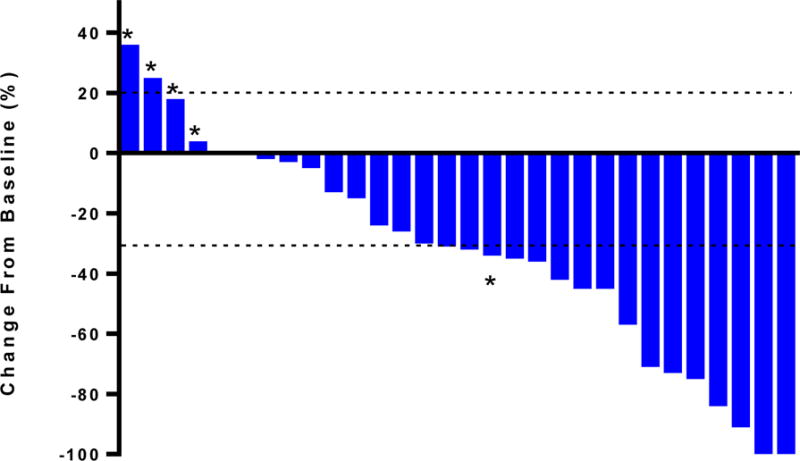
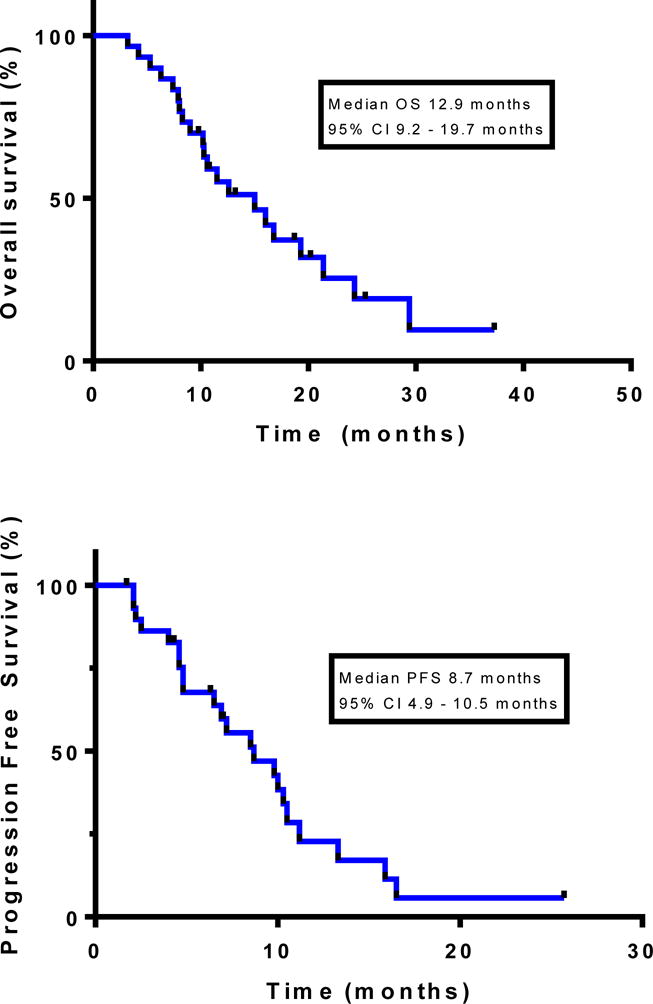
Between August 2011 and November 2014, a total of 30 patients were enrolled into the study (male/female ratio of 13/17; median age of 63 years [range, 33-78 years]; and 7 patients with an Eastern Cooperative Oncology Group performance status [ECOG PS] of 0, 20 patients with an ECOG PS of 1, and 3 patients with an ECOG PS of 2). Of the 30 patients, 23 (77%) had SBA (18 of duodenal origin and 5 of jejunal/ileal origin) and 7 patients (23%) had AAC (5 of pancreaticobiliary subtype, 1 of mixed subtype, and 1 of intestinal subtype). The most common grade 3 toxicities observed were fatigue and hypertension (7 patients each [23%]), neutropenia (6 patients [20%]), and diarrhea (3 patients [10%]) (toxicity was graded according to the National Cancer Institute Common Terminology Criteria for Adverse Events [version 4.0]). The probability of PFS at 6 months was 68% (95% confidence interval [95% CI], 52% to 88%). The response rate was 48.3%, with 1 complete response and 13 partial responses; 10 patients achieved stable disease. At a median follow-up of 25.9 months, the median PFS was 8.7 months (95% CI, 4.9-10.5 months) and the median overall survival was 12.9 months (95% CI, 9.2-19.7 months).
The results of the current study indicate that CAPOX with bevacizumab is an active and well-tolerated regimen for patients with SBA and AAC. These findings support the need for further investigation into the clinical benefit of targeting angiogenesis in patients with SBA and AAC. Cancer 2017;123:1011-17. © 2016 American Cancer Society.
卡培他滨联合奥沙利铂(CAPOX)先前已在小肠腺癌(SBA)和壶腹腺癌(AAC)患者中显示出临床活性。在此,作者进行了一项2期试验,以评估在CAPOX方案中加入贝伐单抗的益处。
在这项2期、单臂、单中心、开放标签研究中,招募了年龄≥18岁、未经治疗的晚期SBA或AAC患者。患者在21天周期的第1至14天口服卡培他滨,剂量为750mg/m²,每日两次;在第1天静脉注射奥沙利铂,剂量为130mg/m²;在第1天静脉注射贝伐单抗,剂量为7.5mg/kg。主要终点是6个月时的无进展生存期(PFS)。次要目标包括缓解率、总PFS、总生存期和毒性。
2011年8月至2014年11月期间,共有30例患者入组本研究(男/女比例为13/17;中位年龄63岁[范围33 - 78岁];东部肿瘤协作组体能状态[ECOG PS]为0的患者7例,ECOG PS为1的患者20例,ECOG PS为2的患者3例)。30例患者中,23例(77%)为SBA(十二指肠起源18例,空肠/回肠起源5例),7例(23%)为AAC(胰胆管亚型5例,混合亚型1例,肠亚型1例)。观察到的最常见3级毒性为疲劳和高血压(各7例[23%])、中性粒细胞减少(6例[20%])和腹泻(3例[10%])(毒性根据美国国立癌症研究所不良事件通用术语标准[第4.0版]分级)。6个月时PFS的概率为68%(95%置信区间[95%CI],52%至88%)。缓解率为48.3%,1例完全缓解,13例部分缓解;10例患者病情稳定。中位随访25.9个月时,中位PFS为8.7个月(95%CI,4.9 - 10.5个月),中位总生存期为12.9个月(95%CI,9.2 - 19.