Qiu Shiqiao, Liu Jing, Xing Feiyue
Department of Immunobiology, Institute of Tissue Transplantation and Immunology, Jinan University, Guangzhou, China.
Key Laboratory of Functional Protein Research of Guangdong, Higher Education Institutes, Jinan University, Guangzhou, China.
Cancer Sci. 2017 Feb;108(2):163-169. doi: 10.1111/cas.13122.
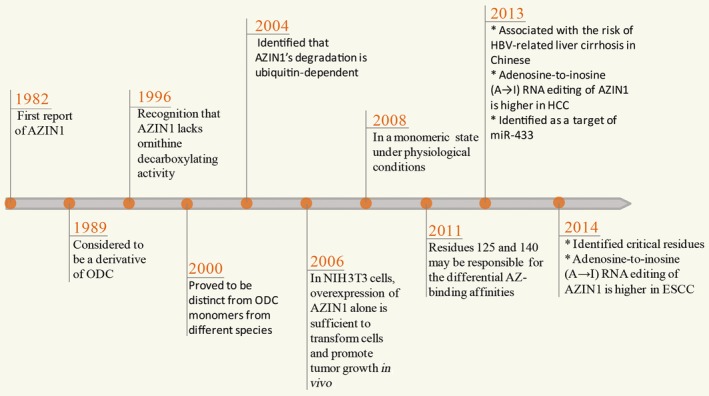
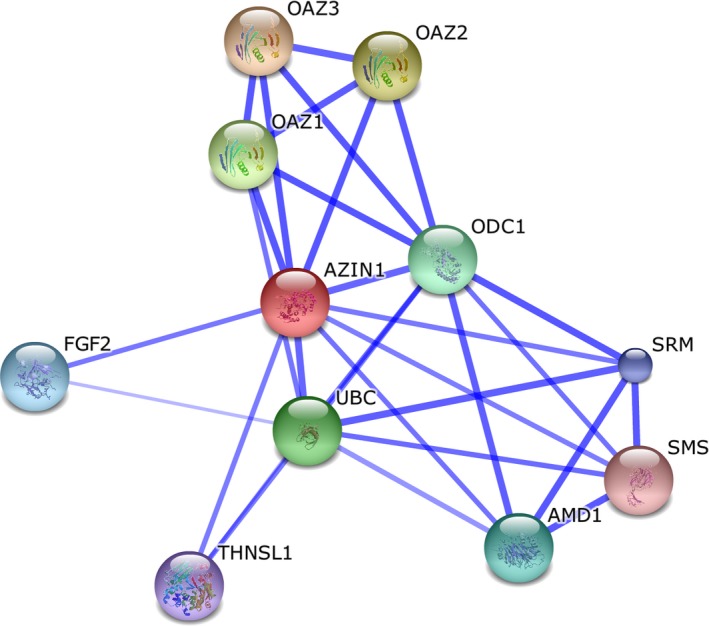
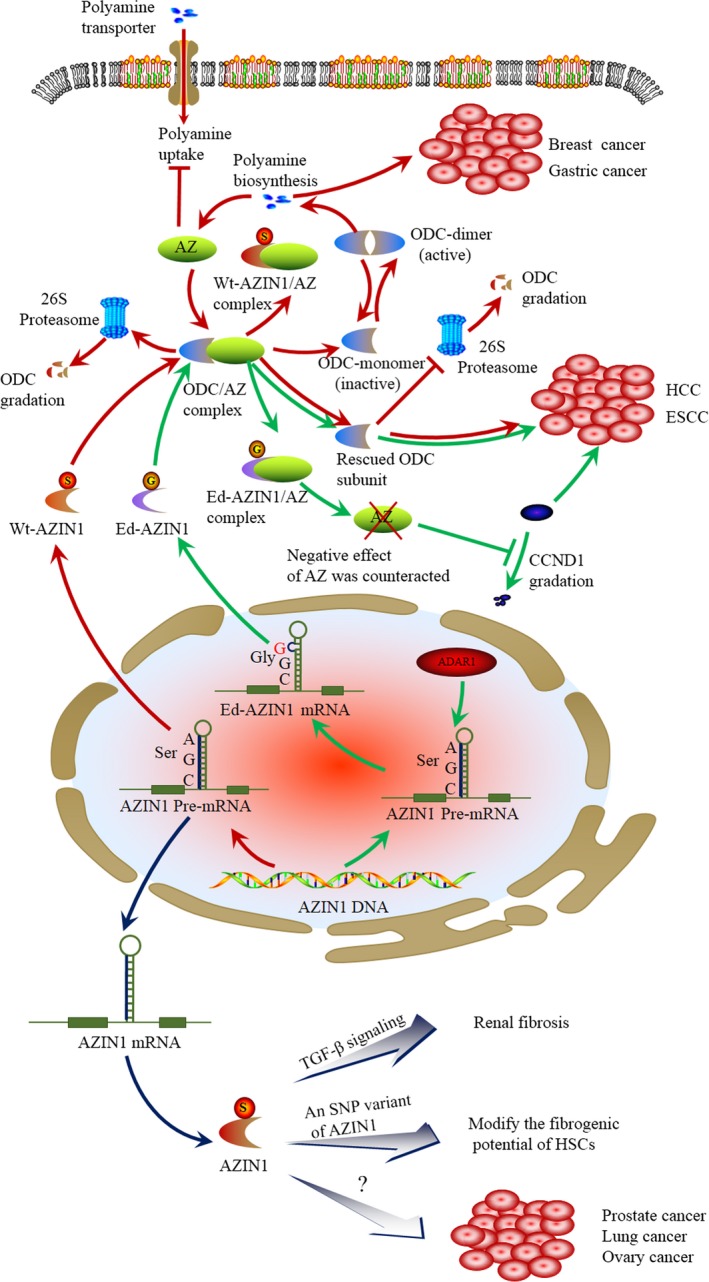
Polyamines are multivalent and organic cations essential for cellular growth, proliferation, differentiation, and apoptosis. Increased levels of polyamines are closely associated with numerous forms of cancer. An autoregulatory circuit composed of ornithine decarboxylase (ODC), antizyme (AZ) and antizyme inhibitor (AZI) govern the intracellular level of polyamines. Antizyme binds with ODC to inhibit ODC activity and to promote the ubiquitin-independent degradation of ODC. Antizyme inhibitor binds to AZ with a higher affinity than ODC. Consequently, ODC is released from the ODC-AZ complex to rescue its activity. Antizyme inhibitor increases the ODC activity to accelerate the formation of intracellular polyamines, triggering gastric and breast carcinogenesis as well as hepatocellular carcinoma and esophageal squamous cell carcinoma development. Antizyme inhibitor 1 (AZIN1), a primary member of the AZI family, has aroused more attention because of its contribution to cancer. Even though its conformation is changed by adenosine-to-inosine (A→I) RNA editing, it plays an important role in tumorigenesis through regulating intracellular polyamines. Encouragingly, AZIN1 has been revealed to have an additional function outside the polyamine pathway so as to bypass the deficiency of targeting the polyamine biosynthetic pathway, promising to become a critical target for cancer therapy. Here, we review the latest research advances into AZIN1 and its potential contribution to carcinogenesis.
多胺是细胞生长、增殖、分化和凋亡所必需的多价有机阳离子。多胺水平升高与多种癌症密切相关。由鸟氨酸脱羧酶(ODC)、抗酶(AZ)和抗酶抑制剂(AZI)组成的自调节回路控制着细胞内多胺的水平。抗酶与ODC结合以抑制ODC活性并促进ODC的非泛素依赖性降解。抗酶抑制剂与AZ的结合亲和力高于与ODC的结合亲和力。因此,ODC从ODC-AZ复合物中释放出来以恢复其活性。抗酶抑制剂增加ODC活性以加速细胞内多胺的形成,引发胃癌和乳腺癌的发生以及肝细胞癌和食管鳞状细胞癌的发展。抗酶抑制剂1(AZIN1)是AZI家族的主要成员,因其对癌症的作用而受到更多关注。尽管其构象因腺苷到肌苷(A→I)RNA编辑而改变,但它通过调节细胞内多胺在肿瘤发生中起重要作用。令人鼓舞的是,已发现AZIN1在多胺途径之外具有额外功能,从而绕过了靶向多胺生物合成途径的不足,有望成为癌症治疗的关键靶点。在此,我们综述了关于AZIN1的最新研究进展及其对致癌作用的潜在贡献。