Capo-Chichi Callinice D, Yeasky Toni M, Smith Elizabeth R, Xu Xiang-Xi
Sylvester Comprehensive Cancer Center/University of Miami, Miami, Florida, 33136, USA.
Department of Cell Biology, University of Miami Miller School of Medicine, Miami, FL, 33136, USA.
BMC Cell Biol. 2016 Nov 22;17(1):37. doi: 10.1186/s12860-016-0114-8.
The Cancer Atlas project has shown that p53 is the only commonly (96 %) mutated gene found in high-grade serous epithelial ovarian cancer, the major histological subtype. Another general genetic change is extensive aneuploidy caused by chromosomal numerical instability, which is thought to promote malignant transformation. Conventionally, aneuploidy is thought to be the result of mitotic errors and chromosomal nondisjunction during mitosis. Previously, we found that ovarian cancer cells often lost or reduced nuclear lamina proteins lamin A/C, and suppression of lamin A/C in cultured ovarian epithelial cells leads to aneuploidy. Following up, we investigated the mechanisms of lamin A/C-suppression in promoting aneuploidy and synergy with p53 inactivation.
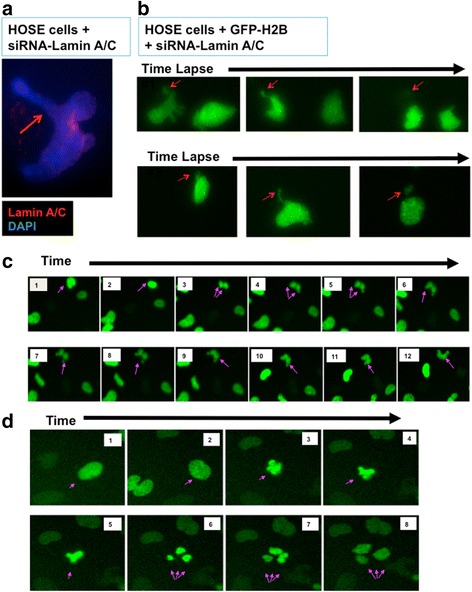
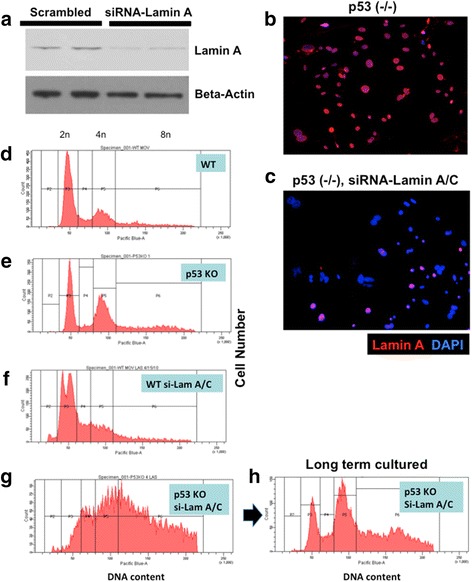
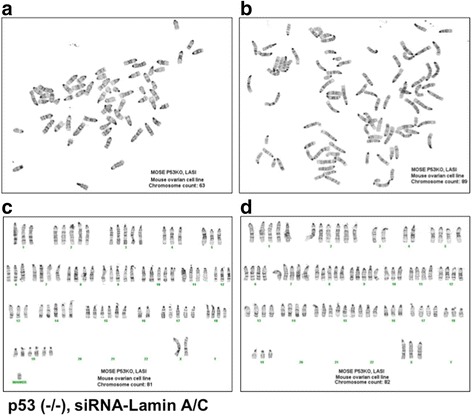
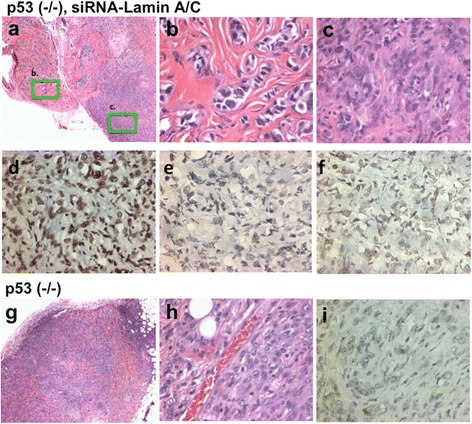
We found that suppression of lamin A/C by siRNA in human ovarian surface epithelial cells led to frequent nuclear protrusions and formation of micronuclei. Lamin A/C-suppressed cells also often underwent mitotic failure and furrow regression to form tetraploid cells, which frequently underwent aberrant multiple polar mitosis to form aneuploid cells. In ovarian surface epithelial cells isolated from p53 null mice, transient suppression of lamin A/C produced massive aneuploidy with complex karyotypes, and the cells formed malignant tumors when implanted in mice.
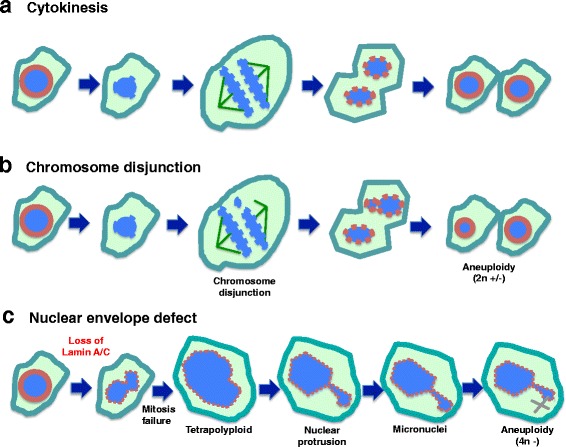
Based on the results, we conclude that a nuclear envelope structural defect, such as the loss or reduction of lamin A/C proteins, leads to aneuploidy by both the formation of tetraploid intermediates following mitotic failure, and the reduction of chromosome (s) following nuclear budding and subsequent loss of micronuclei. We suggest that the nuclear envelope defect, rather than chromosomal unequal distribution during cytokinesis, is the main cause of aneuploidy in ovarian cancer development.
癌症图谱项目表明,p53是在高级别浆液性上皮性卵巢癌(主要的组织学亚型)中发现的唯一常见(96%)突变基因。另一个普遍的基因变化是由染色体数目不稳定性引起的广泛非整倍体,这被认为会促进恶性转化。传统上,非整倍体被认为是有丝分裂错误和有丝分裂期间染色体不分离的结果。此前,我们发现卵巢癌细胞经常丢失或减少核纤层蛋白A/C,并且在培养的卵巢上皮细胞中抑制核纤层蛋白A/C会导致非整倍体。后续,我们研究了核纤层蛋白A/C抑制促进非整倍体形成的机制以及与p53失活的协同作用。
我们发现,在人卵巢表面上皮细胞中通过小干扰RNA抑制核纤层蛋白A/C会导致频繁的核突出和微核形成。核纤层蛋白A/C抑制的细胞也经常经历有丝分裂失败和沟回退形成四倍体细胞,这些四倍体细胞经常经历异常的多极有丝分裂形成非整倍体细胞。在从p53基因敲除小鼠分离的卵巢表面上皮细胞中,短暂抑制核纤层蛋白A/C会产生具有复杂核型的大量非整倍体,并且这些细胞植入小鼠后会形成恶性肿瘤。
基于这些结果,我们得出结论,核膜结构缺陷,如核纤层蛋白A/C蛋白的丢失或减少,通过有丝分裂失败后四倍体中间体的形成以及核出芽和随后微核丢失导致的染色体减少,导致非整倍体形成。我们认为核膜缺陷而非胞质分裂期间染色体的不均等分布是卵巢癌发展中非整倍体的主要原因。