Wong Eric T, Timmons Joshua, Callahan Amy, O'Loughlin Lauren, Giarusso Bridget, Alsop David C
Brain Tumor Center & Neuro-Oncology Unit, Department of Neurology, Beth Israel Deaconess Medical Center, Harvard Medical School, 330 Brookline Avenue, Boston, Massachusetts, 02215, USA.
MRI Research, Department of Radiology, Beth Israel Deaconess Medical Center, Harvard Medical School, 330 Brookline Avenue, Boston, Massachusetts, 02215, USA.
BMC Cancer. 2016 Nov 22;16(1):914. doi: 10.1186/s12885-016-2945-2.
The treatment goal for recurrent malignant gliomas centers on disease stabilization while minimizing therapy-related side effects. Metronomic dosing of cytotoxic chemotherapy has emerged as a promising option to achieve this objective.
This phase I study was performed using metronomic temozolomide (mTMZ) at 25 or 50 mg/m/day continuously in 42-day cycles. Correlative studies were incorporated using arterial spin labeling MRI to assess tumor blood flow, analysis of matrix metalloproteinase-2 (MMP-2) and MMP-9 activities in the cerebrospinal fluid (CSF) as surrogates for tumor angiogenesis and invasion, as well as determination of CSF soluble interleukin-2 receptor alpha (sIL-2Rα) levels as a marker of immune modulation.
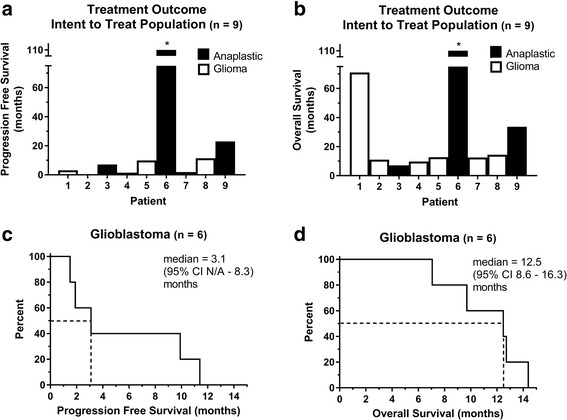
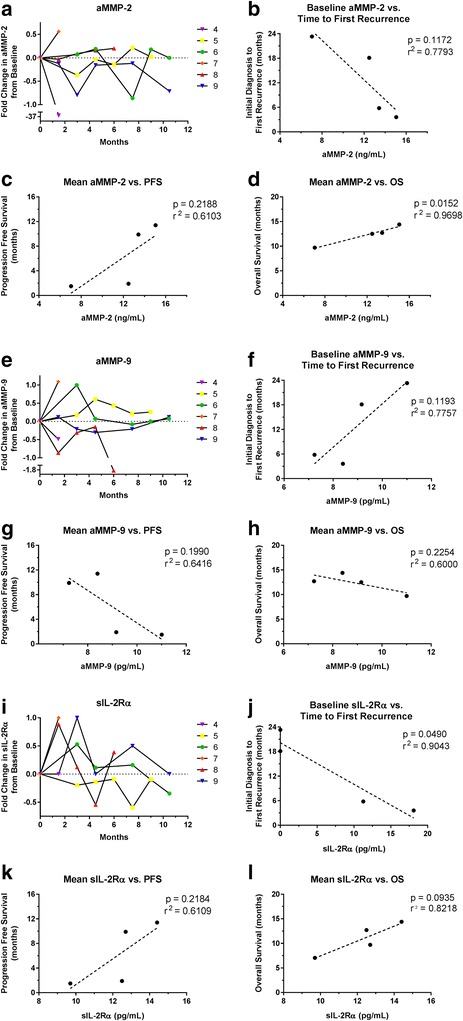
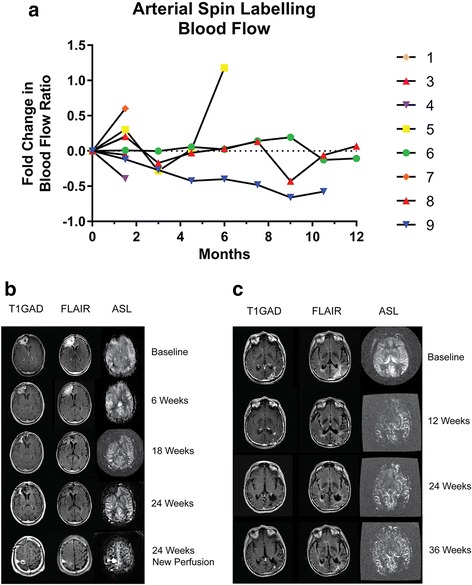
Nine subjects were enrolled and toxicity consisted of primarily grade 1 or 2 hematological and gastrointestinal side effects; only one patient had a grade 3 elevated liver enzyme level that was reversible. Tumor blood flow was variable across subjects and time, with two experiencing a transient increase before a decrease to below baseline level while one exhibited a gradual drop in blood flow over time. MMP-2 activity correlated with overall survival but not with progression free survival, while MMP-9 activity did not correlate with either outcome parameters. Baseline CSF sIL-2Rα level was inversely correlated with time from initial diagnosis to first progression, suggesting that subjects with higher sIL-2Rα may have more aggressive disease. But they lived longer when treated with mTMZ, probably due to drug-related changes in T-cell constituency.
mTMZ possesses efficacy against recurrent malignant gliomas by altering blood flow, slowing invasion and modulating antitumor immune function.
复发性恶性胶质瘤的治疗目标是以疾病稳定为核心,同时尽量减少治疗相关的副作用。节拍式给予细胞毒性化疗已成为实现这一目标的一种有前景的选择。
本I期研究采用节拍式替莫唑胺(mTMZ),剂量为25或50mg/m²/天,持续42天为一个周期。采用动脉自旋标记MRI进行相关研究,以评估肿瘤血流,分析脑脊液(CSF)中基质金属蛋白酶-2(MMP-2)和MMP-9活性作为肿瘤血管生成和侵袭的替代指标,以及测定CSF可溶性白细胞介素-2受体α(sIL-2Rα)水平作为免疫调节的标志物。
纳入9名受试者,毒性主要包括1级或2级血液学和胃肠道副作用;只有1例患者出现3级肝酶水平升高,且可逆转。肿瘤血流在受试者和时间上存在差异,2例在血流减少至基线水平以下之前出现短暂增加,而1例随着时间推移血流逐渐下降。MMP-2活性与总生存期相关,但与无进展生存期无关,而MMP-9活性与这两个结局参数均无关。基线CSF sIL-2Rα水平与从初始诊断到首次进展的时间呈负相关,表明sIL-2Rα水平较高的受试者可能患有侵袭性更强的疾病。但他们接受mTMZ治疗后存活时间更长,可能是由于药物引起的T细胞组成变化。
mTMZ通过改变血流、减缓侵袭和调节抗肿瘤免疫功能,对复发性恶性胶质瘤具有疗效。