Leone Augusto, Colamaria Antonio, Fochi Nicola Pio, Sacco Matteo, Landriscina Matteo, Parbonetti Giovanni, de Notaris Matteo, Coppola Giulia, De Santis Elena, Giordano Guido, Carbone Francesco
Department of Neurosurgery, Städtisches Klinikum Karlsruhe, 76133 Karlsruhe, Germany.
Department of Neurosurgery, Charité Universitätsmedizin Berlin, 10117 Berlin, Germany.
Biomedicines. 2022 Aug 9;10(8):1927. doi: 10.3390/biomedicines10081927.
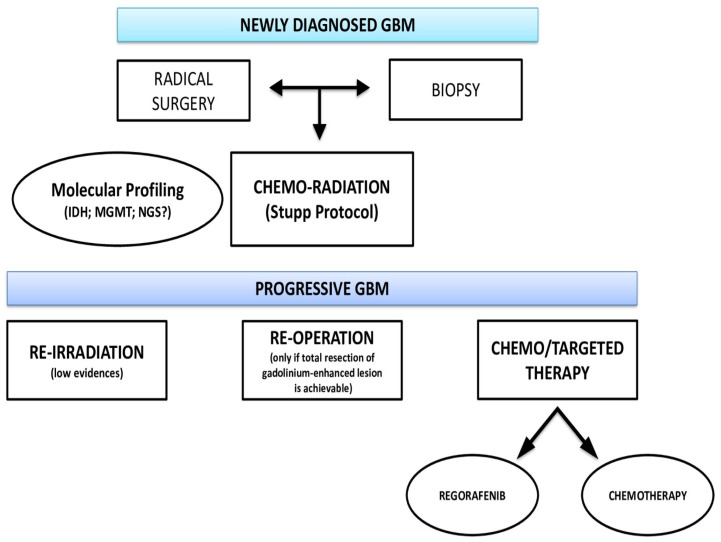
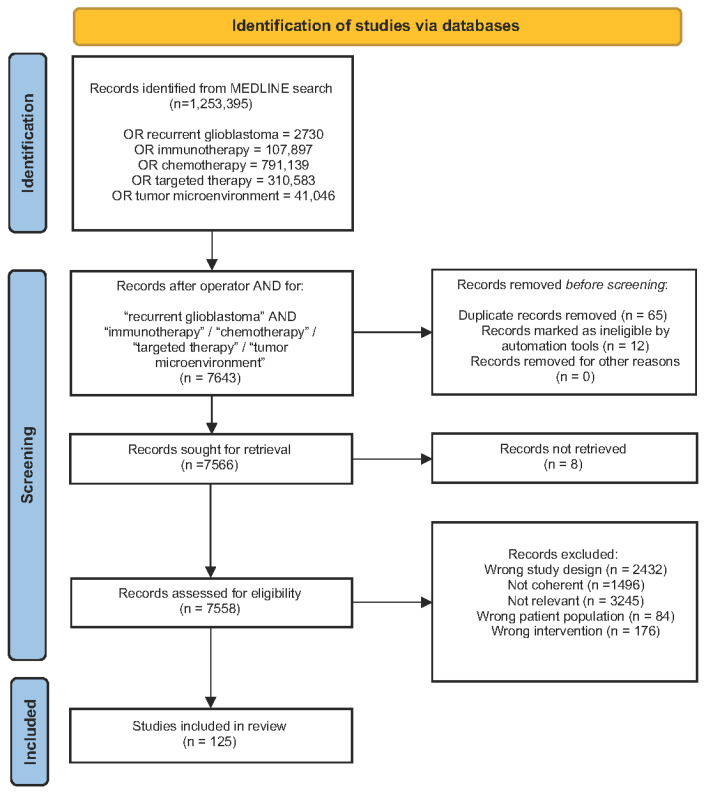
Current treatment guidelines for the management of recurrent glioblastoma (rGBM) are far from definitive, and the prognosis remains dismal. Despite recent advancements in the pharmacological and surgical fields, numerous doubts persist concerning the optimal strategy that clinicians should adopt for patients who fail the first lines of treatment and present signs of progressive disease. With most recurrences being located within the margins of the previously resected lesion, a comprehensive molecular and genetic profiling of rGBM revealed substantial differences compared with newly diagnosed disease. In the present comprehensive review, we sought to examine the current treatment guidelines and the new perspectives that polarize the field of neuro-oncology, strictly focusing on progressive disease. For this purpose, updated PRISMA guidelines were followed to search for pivotal studies and clinical trials published in the last five years. A total of 125 articles discussing locoregional management, radiotherapy, chemotherapy, and immunotherapy strategies were included in our analysis, and salient findings were critically summarized. In addition, an in-depth description of the molecular profile of rGBM and its distinctive characteristics is provided. Finally, we integrate the above-mentioned evidence with the current guidelines published by international societies, including AANS/CNS, EANO, AIOM, and NCCN.
目前复发性胶质母细胞瘤(rGBM)的治疗指南远未明确,预后仍然很差。尽管在药理学和外科领域取得了最新进展,但对于一线治疗失败且出现疾病进展迹象的患者,临床医生应采取何种最佳策略仍存在诸多疑问。由于大多数复发位于先前切除病变的边缘,rGBM的全面分子和基因分析显示与新诊断疾病相比存在显著差异。在本综述中,我们试图研究目前的治疗指南以及使神经肿瘤学领域产生两极分化的新观点,严格聚焦于疾病进展。为此,我们遵循更新后的PRISMA指南,搜索过去五年发表的关键研究和临床试验。我们的分析共纳入了125篇讨论局部区域管理、放疗、化疗和免疫治疗策略的文章,并对突出发现进行了批判性总结。此外,还对rGBM的分子特征及其独特特性进行了深入描述。最后,我们将上述证据与国际协会(包括AANS/CNS、EANO、AIOM和NCCN)发布的现行指南进行整合。