Eba Marvlyn, Njunda Anna Longdoh, Mouliom Rene Njikam, Kwenti Emmanuel Tebit, Fuh Anold Nsoh, Nchanji Gordon Takop, Atashili Julius
Department of Medical Laboratory Sciences, Faculty of Health Sciences, University of Buea, P.O. Box 63, Buea, Cameroon.
Regional Hospital Limbe, Limbe, South West Region, Cameroon.
BMC Res Notes. 2016 Nov 22;9(1):494. doi: 10.1186/s13104-016-2302-1.
Onychomycosis is an infection of the nail unit by a fungus. This is a very common infection amongst diabetics. Its occurrence among diabetics in Fako division is unknown. In this study we provide information on the characteristics of onychomycosis in diabetics in Fako division, Cameroon.
A cross-sectional descriptive and analytical hospital-based study was conducted in two diabetic clinics in the Buea and Limbe regional hospitals. We recruited 152 consenting diabetics into the study. Demographic, behavioural, and clinical data of patients were obtained through the use of structured questionnaires. Toenail, finger nail, skin scrapings and nail clippings were collected from participants, KOH mounts were prepared and observed under the microscope and cultured on Sabouraud Dextrose Agar supplemented with chloramphenicol to isolate causative fungi. Identification of isolates was done to species level using the cello tape flag method and slide culture. The presence of a dermatophyte by either microscopy or culture or both methods was considered positive for onychomycosis. Antifungal susceptibility testing was carried out using selected antifungals by the Kirby-Bauer disk diffusion method on Sabouraud Dextrose Agar.
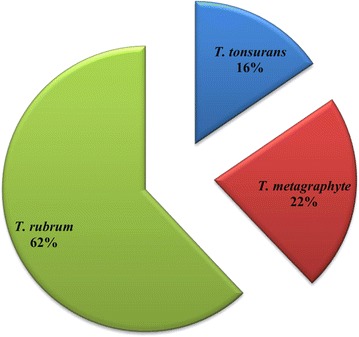
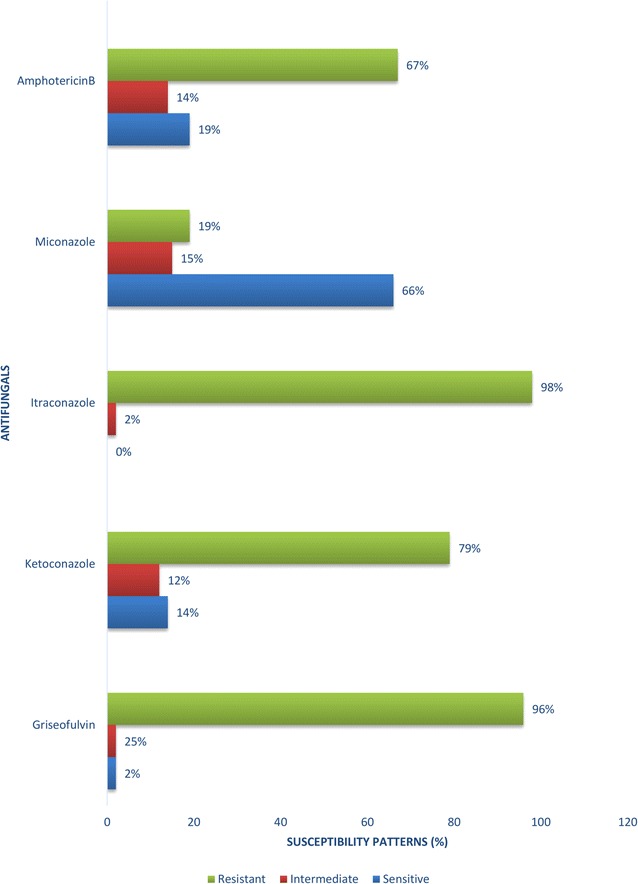
Clinical onychomycosis was found in 77 of the 152 diabetics tested giving a prevalence of 50.7% (95% CI 42.4-58.9) in diabetics in Fako. No socio-demographic or clinical factor studied was significantly associated with onychomycosis. Trichophyton rubrum was the most common isolate (62%). Other isolates included Trichophyton metagraphyte (22%) and Trichophyton tonsurans (16%). Dermatophytes were sensitive to miconazole (66%), amphotericin B (19%) and ketoconazole (14%).
Onychomycosis is common in diabetics in Fako signifying the need for regular screening by either microscopy or culture. Infected nails could be treated with miconazole.
甲癣是由真菌引起的指甲单位感染。这在糖尿病患者中是一种非常常见的感染。其在喀麦隆法科分区糖尿病患者中的发生率尚不清楚。在本研究中,我们提供了喀麦隆法科分区糖尿病患者甲癣特征的相关信息。
在布埃亚和林贝地区医院的两家糖尿病诊所进行了一项基于医院的横断面描述性和分析性研究。我们招募了152名同意参与研究的糖尿病患者。通过使用结构化问卷获取患者的人口统计学、行为学和临床数据。从参与者处收集趾甲、指甲、皮肤刮屑和指甲剪,制备氢氧化钾涂片并在显微镜下观察,然后在添加氯霉素的沙氏葡萄糖琼脂上培养以分离致病真菌。使用透明胶带标记法和玻片培养法将分离株鉴定到种水平。通过显微镜检查或培养或两种方法检测到皮肤癣菌被认为甲癣检测呈阳性。在沙氏葡萄糖琼脂上使用 Kirby-Bauer 纸片扩散法对选定的抗真菌药物进行抗真菌药敏试验。
在152名接受检测的糖尿病患者中,有77例临床诊断为甲癣,法科糖尿病患者中的患病率为50.7%(95%可信区间42.4 - 58.9)。所研究的社会人口统计学或临床因素均与甲癣无显著关联。红色毛癣菌是最常见的分离株(62%)。其他分离株包括断发毛癣菌(22%)和须癣毛癣菌(16%)。皮肤癣菌对咪康唑敏感(66%)、对两性霉素B敏感(19%)和对酮康唑敏感(14%)。
甲癣在法科糖尿病患者中很常见,这表明需要通过显微镜检查或培养进行定期筛查。感染的指甲可用咪康唑治疗。