Qian Sixuan, Li Jianyong, Hong Ming, Zhu Yu, Zhao Huihui, Xie Yue, Huang Jiayu, Lian Yun, Li Yanru, Wang Shuai, Mao Jianping, Chen Yaoyu
Department of Hematology, The First Affiliated Hospital of Nanjing Medical University, Jiangsu Province Hospital, 300 Guangzhou Road, Nanjing, 210029, China.
J Hematol Oncol. 2016 Nov 25;9(1):128. doi: 10.1186/s13045-016-0360-4.
Cancer cells show increased glycolysis and take advantage of this metabolic pathway to generate ATP. The TP53-induced glycolysis and apoptosis regulator (TIGAR) inhibits aerobic glycolysis and protects tumor cells from intracellular reactive oxygen species (ROS)-associated apoptosis. However, the function of TIGAR in glycolysis and survival of acute myeloid leukemia cells remains unclear.
We analyzed TIGAR expression in cytogenetically normal (CN-) AML patients and the correlations with clinical and biological parameters. In vivo and in vitro, we tested whether glycolysis may induce TIGAR expression and evaluated the combination effect of glycolysis inhibitor and TIGAR knockdown on human leukemia cell proliferation.
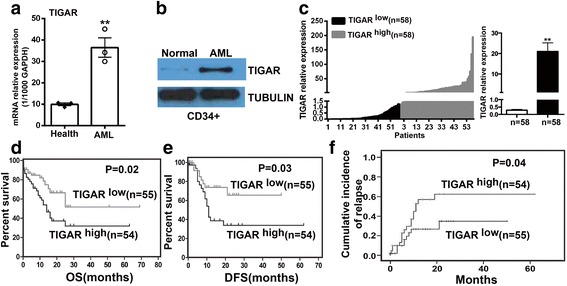
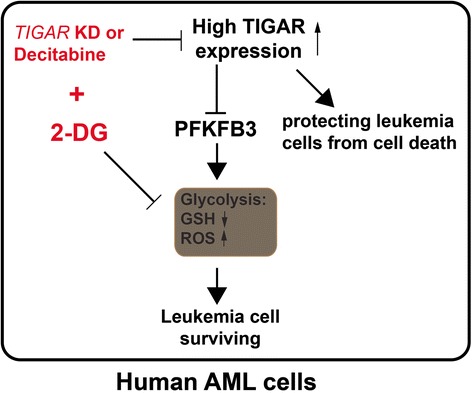
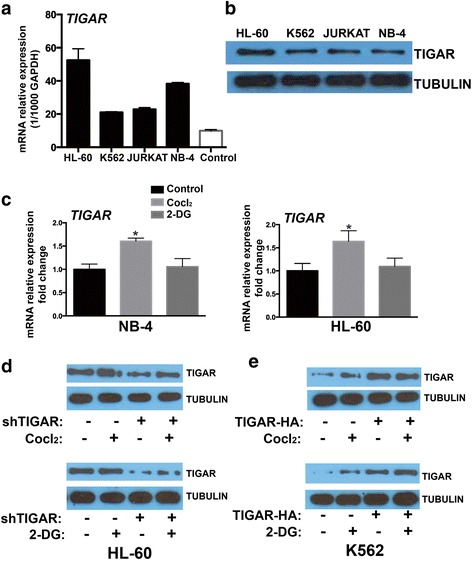
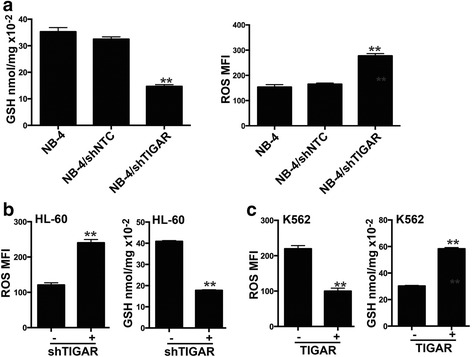
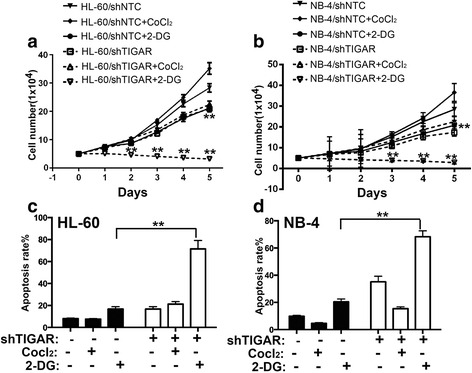
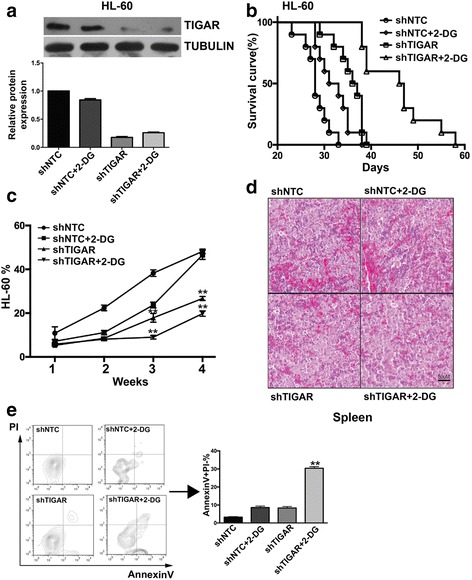
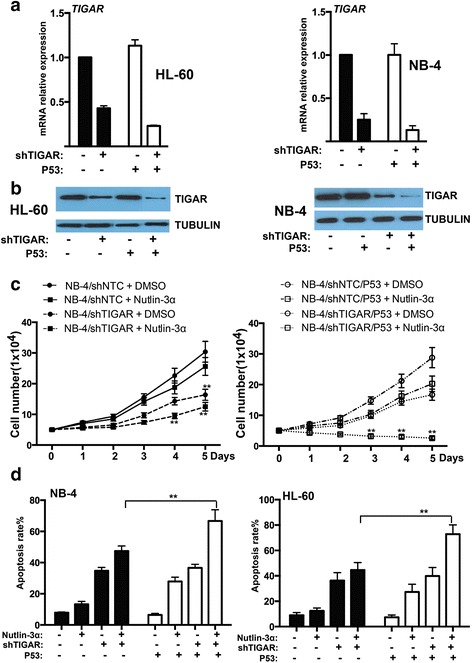
High TIGAR expression was an independent predictor of poor survival and high incidence of relapse in adult patients with CN-AML. TIGAR also showed high expression in multiple human leukemia cell lines and knockdown of TIGAR activated glycolysis through PFKFB3 upregulation in human leukemia cells. Knockdown of TIGAR inhibited the proliferation of human leukemia cells and sensitized leukemia cells to glycolysis inhibitor both in vitro and in vivo. Furthermore, TIGAR knockdown in combination with glycolysis inhibitor 2-DG led leukemia cells to apoptosis. In addition, the p53 activator Nutlin-3α showed a significant combinational effect with TIGAR knockdown in leukemia cells. However, TIGAR expression and its anti-apoptotic effects were uncoupled from overexpression of exogenous p53 in leukemia cells.
TIGAR might be a predictor of poor survival and high incidence of relapse in AML patients, and the combination of TIGAR inhibitors with anti-glycolytic agents may be novel therapies for the future clinical use in AML patients.
癌细胞表现出糖酵解增加,并利用这种代谢途径生成三磷酸腺苷(ATP)。TP53诱导的糖酵解和凋亡调节因子(TIGAR)抑制有氧糖酵解,并保护肿瘤细胞免受细胞内活性氧(ROS)相关的凋亡。然而,TIGAR在急性髓系白血病细胞糖酵解和存活中的作用仍不清楚。
我们分析了细胞遗传学正常(CN-)急性髓系白血病患者中TIGAR的表达及其与临床和生物学参数的相关性。在体内和体外,我们测试了糖酵解是否可诱导TIGAR表达,并评估了糖酵解抑制剂与TIGAR基因敲低对人白血病细胞增殖的联合作用。
TIGAR高表达是成人CN-急性髓系白血病患者生存不良和复发率高的独立预测因子。TIGAR在多种人白血病细胞系中也呈高表达,敲低TIGAR可通过上调人白血病细胞中的6-磷酸果糖-2-激酶/果糖-2,6-二磷酸酶3(PFKFB3)激活糖酵解。敲低TIGAR在体外和体内均抑制人白血病细胞的增殖,并使白血病细胞对糖酵解抑制剂敏感。此外,TIGAR基因敲低与糖酵解抑制剂2-脱氧葡萄糖(2-DG)联合可导致白血病细胞凋亡。此外,p53激活剂Nutlin-3α在白血病细胞中与TIGAR基因敲低显示出显著的联合效应。然而,白血病细胞中TIGAR的表达及其抗凋亡作用与外源性p53的过表达无关。
TIGAR可能是急性髓系白血病患者生存不良和复发率高的预测因子,TIGAR抑制剂与抗糖酵解药物联合可能是未来用于急性髓系白血病患者临床治疗的新方法。