Giesel Frederik L, Hadaschik B, Cardinale J, Radtke J, Vinsensia M, Lehnert W, Kesch C, Tolstov Y, Singer S, Grabe N, Duensing S, Schäfer M, Neels O C, Mier W, Haberkorn U, Kopka K, Kratochwil C
Department of Nuclear Medicine, University Hospital Heidelberg, INF 400, 69120, Heidelberg, Germany.
Department of Urology, University Hospital Heidelberg, Heidelberg, Germany.
Eur J Nucl Med Mol Imaging. 2017 Apr;44(4):678-688. doi: 10.1007/s00259-016-3573-4. Epub 2016 Nov 26.
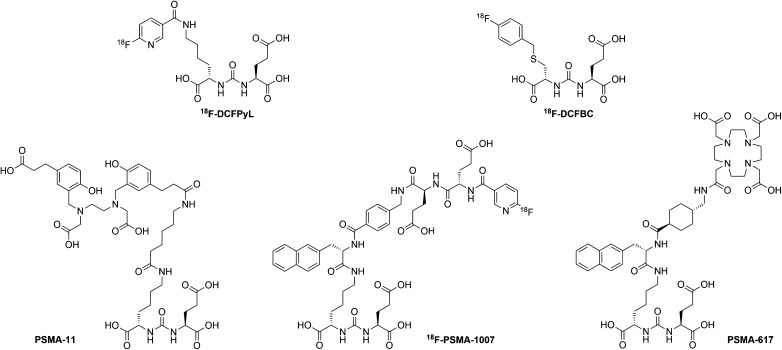
The prostate-specific membrane antigen (PSMA) targeted positron-emitting-tomography (PET) tracer Ga-PSMA-11 shows great promise in the detection of prostate cancer. However, Ga has several shortcomings as a radiolabel including short half-life and non-ideal energies, and this has motivated consideration of F-labelled analogs. F-PSMA-1007 was selected among several F-PSMA-ligand candidate compounds because it demonstrated high labelling yields, outstanding tumor uptake and fast, non-urinary background clearance. Here, we describe the properties of F-PSMA-1007 in human volunteers and patients.
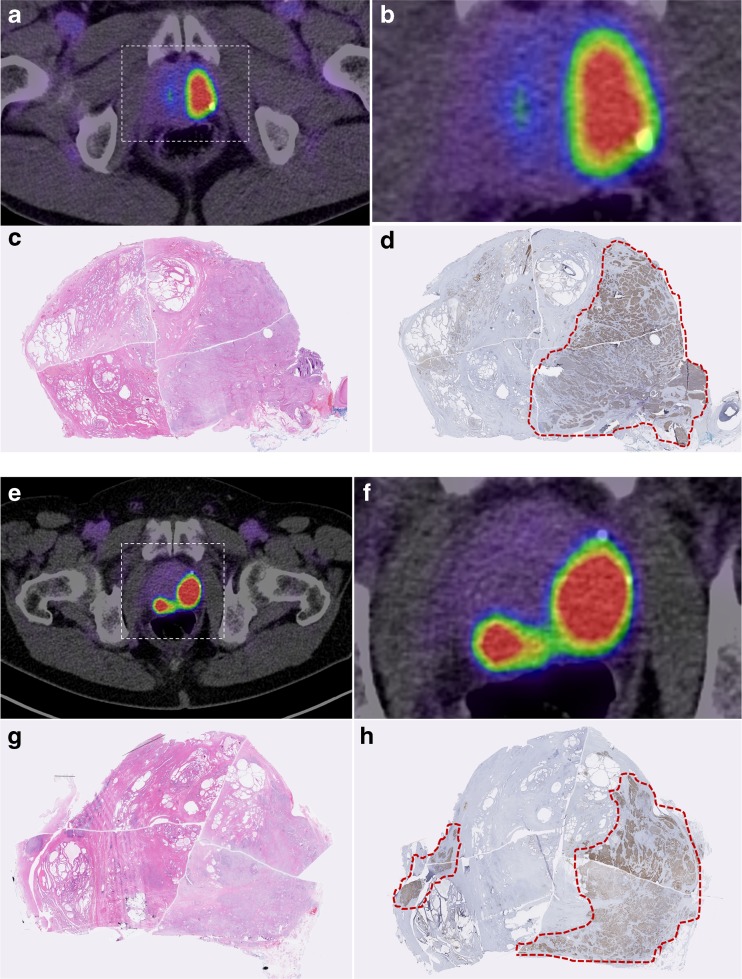
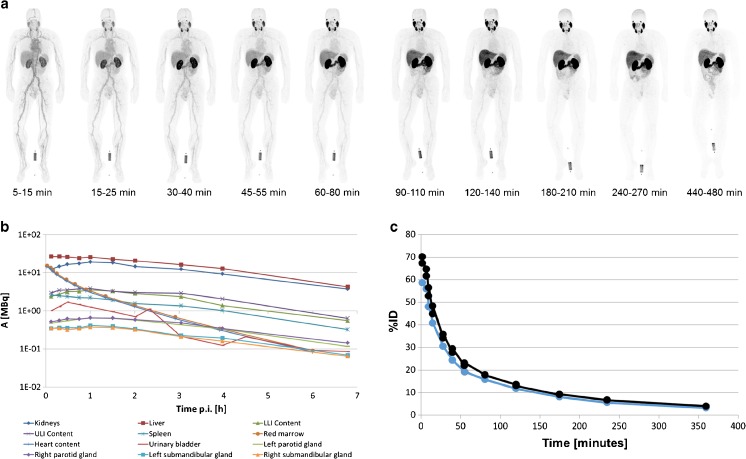
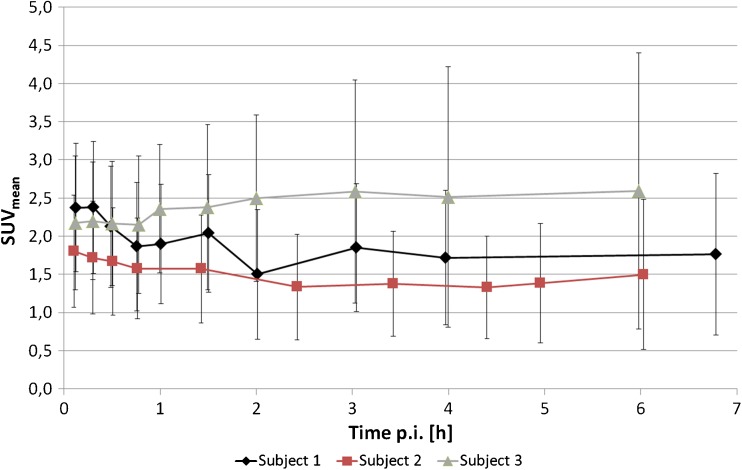
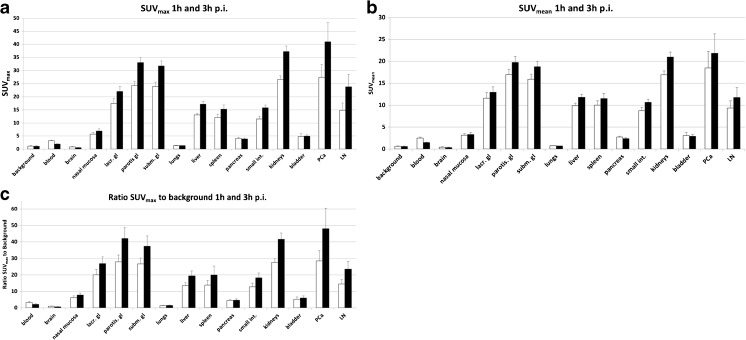
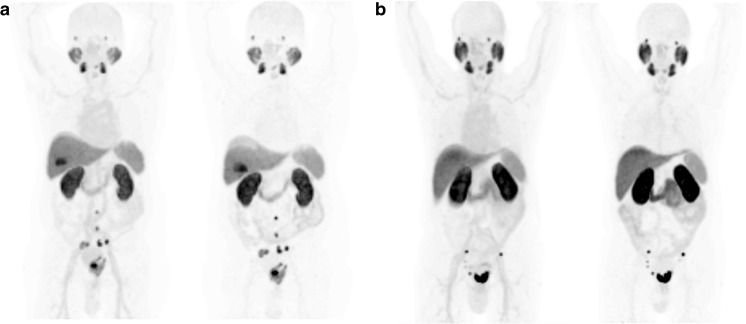
Radiation dosimetry of F-PSMA-1007 was determined in three healthy volunteers who underwent whole-body PET-scans and concomitant blood and urine sampling. Following this, ten patients with high-risk prostate cancer underwent F-PSMA-1007 PET/CT (1 h and 3 h p.i.) and normal organ biodistribution and tumor uptakes were examined. Eight patients underwent prostatectomy with extended pelvic lymphadenectomy. Uptake in intra-prostatic lesions and lymph node metastases were correlated with final histopathology, including PSMA immunostaining.
With an effective dose of approximately 4.4-5.5 mSv per 200-250 MBq examination, F-PSMA-1007 behaves similar to other PSMA-PET agents as well as to other F-labelled PET-tracers. In comparison to other PSMA-targeting PET-tracers, F-PSMA-1007 has reduced urinary clearance enabling excellent assessment of the prostate. Similar to F-DCFPyL and with slightly slower clearance kinetics than PSMA-11, favorable tumor-to-background ratios are observed 2-3 h after injection. In eight patients, diagnostic findings were successfully validated by histopathology. F-PSMA-1007 PET/CT detected 18 of 19 lymph node metastases in the pelvis, including nodes as small as 1 mm in diameter.
F-PSMA-1007 performs at least comparably to Ga-PSMA-11, but its longer half-life combined with its superior energy characteristics and non-urinary excretion overcomes some practical limitations of Ga-labelled PSMA-targeted tracers.
前列腺特异性膜抗原(PSMA)靶向正电子发射断层扫描(PET)示踪剂Ga-PSMA-11在前列腺癌检测中显示出巨大潜力。然而,Ga作为放射性标记物存在一些缺点,包括半衰期短和能量不理想,这促使人们考虑使用F标记的类似物。F-PSMA-1007是从几种F-PSMA配体候选化合物中筛选出来的,因为它显示出高标记率、出色的肿瘤摄取以及快速的非尿液背景清除率。在此,我们描述了F-PSMA-1007在人类志愿者和患者中的特性。
在三名接受全身PET扫描并同时采集血液和尿液样本的健康志愿者中测定F-PSMA-1007的辐射剂量学。在此之后,十名高危前列腺癌患者接受了F-PSMA-1007 PET/CT检查(注射后1小时和3小时),并检查了正常器官的生物分布和肿瘤摄取情况。八名患者接受了前列腺切除术并扩大盆腔淋巴结清扫术。前列腺内病变和淋巴结转移灶的摄取情况与最终组织病理学结果相关,包括PSMA免疫染色。
每200 - 250 MBq检查的有效剂量约为4.4 - 5.5 mSv,F-PSMA-1007的表现与其他PSMA-PET剂以及其他F标记的PET示踪剂相似。与其他靶向PSMA的PET示踪剂相比,F-PSMA-1007的尿液清除率降低,从而能够对前列腺进行出色的评估。与F-DCFPyL相似,清除动力学略慢于PSMA-11,注射后2 - 3小时观察到良好的肿瘤与背景比值。在八名患者中,诊断结果通过组织病理学成功验证。F-PSMA-1007 PET/CT检测到盆腔19个淋巴结转移灶中的18个,包括直径小至1毫米的淋巴结。
F-PSMA-1007的表现至少与Ga-PSMA-11相当,但其较长的半衰期、优越的能量特性以及非尿液排泄克服了Ga标记的PSMA靶向示踪剂的一些实际限制。