Thangavelu Pulari U, Krenács Tibor, Dray Eloise, Duijf Pascal H G
University of Queensland Diamantina Institute, The University of Queensland, Translational Research Institute, 37 Kent Street, Brisbane, QLD 4102 Australia.
1st Department of Pathology and Experimental Cancer Research, Semmelweis University and MTA-SE Cancer Progression Research Group, Budapest, Hungary.
Clin Epigenetics. 2016 Nov 18;8:120. doi: 10.1186/s13148-016-0290-6. eCollection 2016.
Metastasis is a leading cause of death among cancer patients. In the tumor microenvironment, altered levels of extracellular matrix proteins, such as collagens, can facilitate the first steps of cancer cell metastasis, including invasion into surrounding tissue and intravasation into the blood stream. However, the degree of misexpression of collagen genes in tumors remains understudied, even though this knowledge could greatly facilitate the development of cancer treatment options aimed at preventing metastasis.
We systematically evaluate the expression of all 44 collagen genes in breast cancer and assess whether their misexpression provides clinical prognostic significance. We use immunohistochemistry on 150 ductal breast cancers and 361 cervical cancers and study DNA methylation in various epithelial cancers.
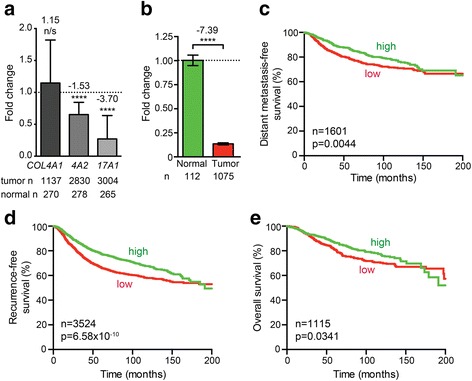
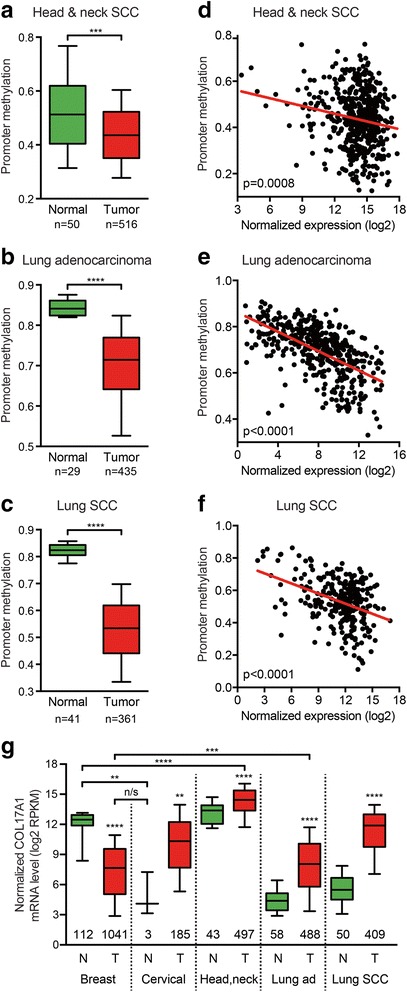
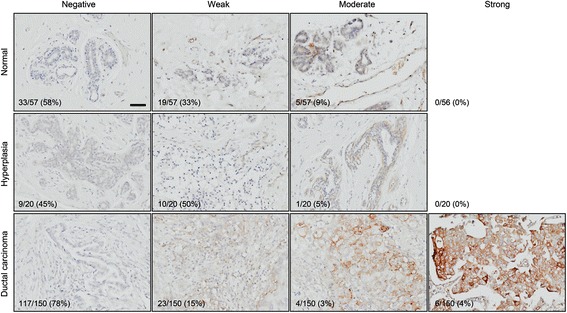
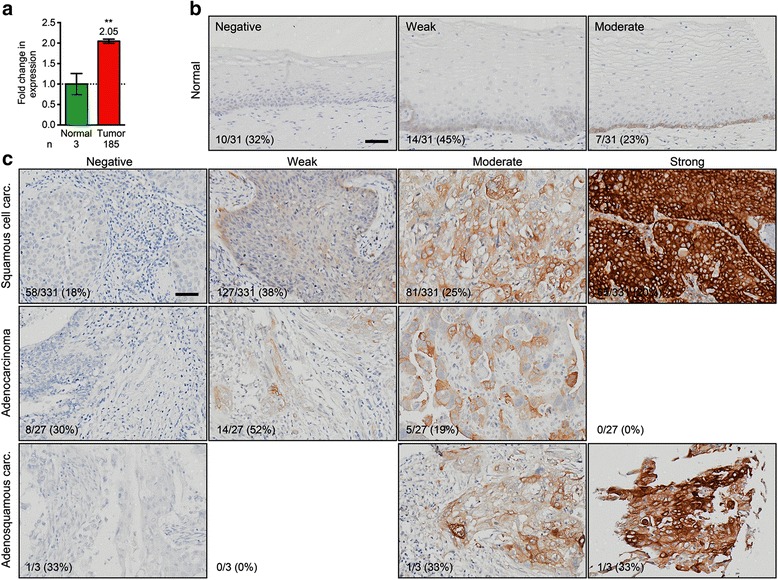
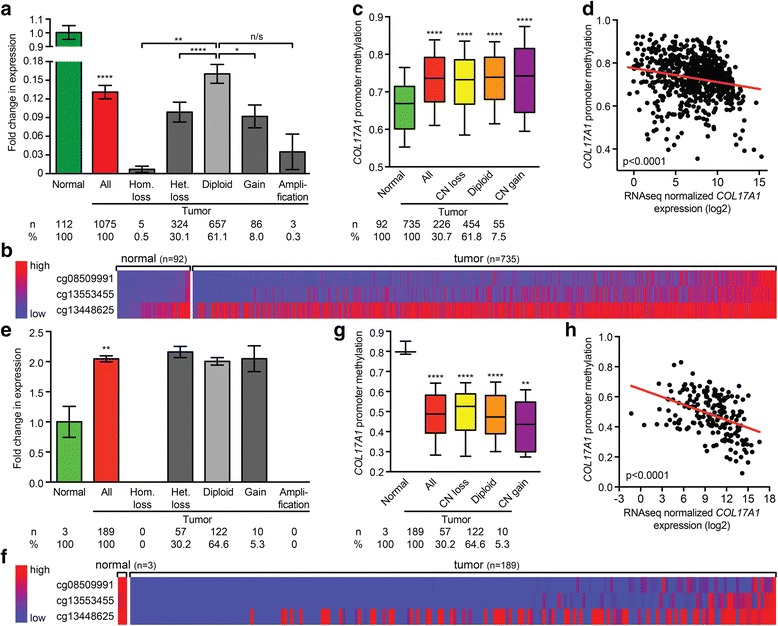
In breast cancer, various tests show that and overexpression and (, ) underexpression provide independent prognostic strength (HR = 1.25, 95% CI = 1.17-1.34, = 3.03 × 10; HR = 1.18, 95% CI = 1.11-1.25, = 8.11 × 10; HR = 0.86, 95% CI = 0.81-0.92, = 4.57 × 10; respectively). Immunohistochemistry on ductal breast cancers confirmed that the protein product, collagen XVII, is underexpressed. This strongly correlates with advanced stage, increased invasion, and postmenopausal status. In contrast, immunohistochemistry on cervical tumors showed that collagen XVII is overexpressed in cervical cancer and this is associated with increased local dissemination. Interestingly, consistent with the opposed direction of misexpression in these cancers, the promoter is hypermethylated in breast cancer and hypomethylated in cervical cancer. We also find that the promoter is hypomethylated in head and neck squamous cell carcinoma, lung squamous cell carcinoma, and lung adenocarcinoma, in all of which collagen XVII overexpression has previously been shown.
Paradoxically, collagen XVII is underexpressed in breast cancer and overexpressed in cervical and other epithelial cancers. However, the promoter methylation status accurately predicts both the direction of misexpression and the increased invasive nature for five out of five epithelial cancers. This implies that aberrant epigenetic control is a key driver of gene misexpression and tumor cell invasion. These findings have significant clinical implications, suggesting that the promoter methylation status can be used to predict patient outcome. Moreover, epigenetic targeting of could represent a novel strategy to prevent metastasis in patients.
转移是癌症患者死亡的主要原因。在肿瘤微环境中,细胞外基质蛋白(如胶原蛋白)水平的改变可促进癌细胞转移的第一步,包括侵入周围组织和进入血流。然而,尽管了解肿瘤中胶原蛋白基因的错误表达程度可能极大地促进旨在预防转移的癌症治疗方案的开发,但这方面的研究仍然不足。
我们系统地评估了44种胶原蛋白基因在乳腺癌中的表达,并评估它们的错误表达是否具有临床预后意义。我们对150例乳腺导管癌和361例宫颈癌进行了免疫组织化学检测,并研究了各种上皮癌中的DNA甲基化情况。
在乳腺癌中,各种检测表明,[具体基因1]和[具体基因2]的过表达以及[具体基因3]([具体基因3],[具体基因4])的低表达具有独立的预后强度(风险比[HR]=1.25,95%置信区间[CI]=1.17-1.34,P=3.03×10;HR=1.18,95%CI=1.11-1.25,P=8.11×10;HR=0.86,95%CI=0.81-0.92,P=4.57×10;分别)。乳腺导管癌的免疫组织化学证实,[具体基因3]的蛋白产物胶原蛋白XVII表达不足。这与晚期、侵袭增加和绝经后状态密切相关。相比之下,宫颈肿瘤的免疫组织化学显示,胶原蛋白XVII在宫颈癌中过表达,这与局部扩散增加有关。有趣的是,与这些癌症中错误表达的相反方向一致,[具体基因3]启动子在乳腺癌中高度甲基化,而在宫颈癌中低甲基化。我们还发现,[具体基因3]启动子在头颈部鳞状细胞癌、肺鳞状细胞癌和肺腺癌中低甲基化,此前已证明在所有这些癌症中胶原蛋白XVII均过表达。
矛盾地是,胶原蛋白XVII在乳腺癌中表达不足,而在宫颈癌和其他上皮癌中过表达。然而,[具体基因3]启动子甲基化状态准确地预测了五种上皮癌中错误表达的方向和侵袭性增加的性质。这意味着异常的表观遗传控制是[具体基因3]基因错误表达和肿瘤细胞侵袭的关键驱动因素。这些发现具有重要的临床意义,表明[具体基因3]启动子甲基化状态可用于预测患者的预后。此外,针对[具体基因3]的表观遗传靶向可能代表一种预防患者转移的新策略。