Lee M J, Son J S, Lee J H, Kim S J, Lyoo C H, Lee M S
Department of Neurology, Pusan National University Hospital, Pusan National University School of Medicine and Biomedical Research Institute, Busan, Republic of Korea.
Department of Physical Medicine & Rehabilitation, Northwestern University, Chicago, Illinois, United States of America.
PLoS One. 2016 Nov 28;11(11):e0167034. doi: 10.1371/journal.pone.0167034. eCollection 2016.
Sensory information is essential for the precise control of movement. Patients with Parkinson's disease (PD) have higher-order sensory dysfunctions including prolonged temporal discrimination threshold (TDT). However, the impact of prolonged TDT on parkinsonian motor deficits is uncertain.
This study includes 33 PD patients and 24 healthy controls. TDT values were measured in the index finger. Using coin rotation task (CRT), dexterous finger movement was assessed. Using an inertial sensor, the speed, amplitude, and frequency of finger tapping were measured. The impact of prolonged index finger TDT on two different finger movements was analyzed using the general estimating equation.
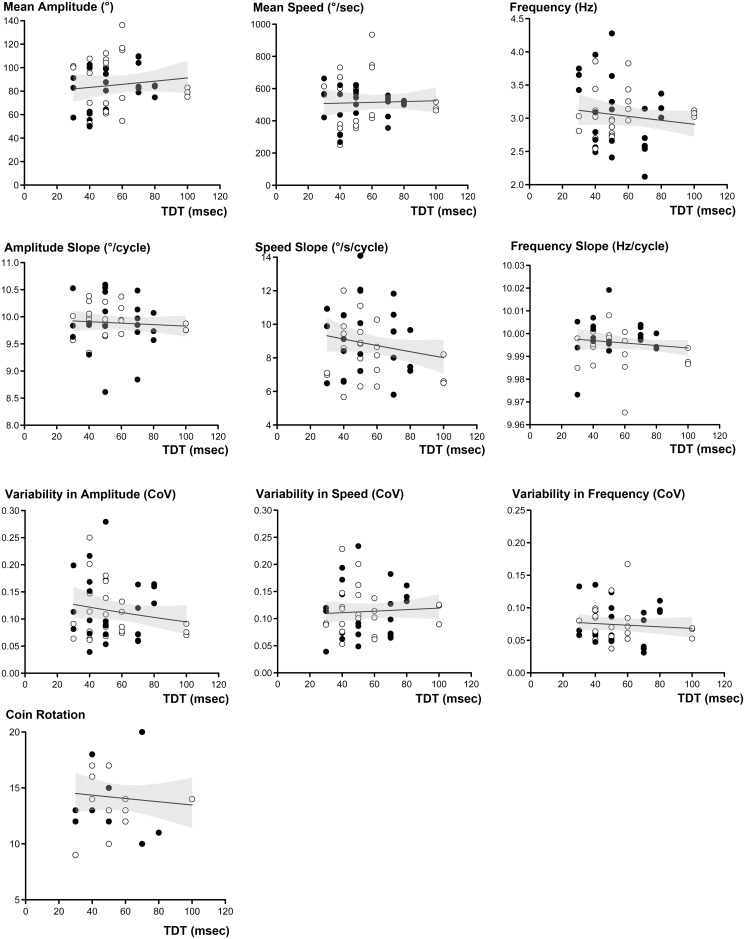
Compared to healthy controls, TDT was prolonged in the PD patients. There was no impact of TDT on mean values or decrement for amplitude and speed, as well as mean values, decrement and variability of tapping frequency. However, prolonged TDT had a significant impact on the variability in amplitude (B = 436.905 × 10⁻⁴, Wald χ2 = 9.140, p = 0.014) and speed (B = 425.655 × 10⁻⁴, Wald χ2 = 9.876, p = 0.014) of finger tapping. There was a marginal correlation between TDT and CRT. In addition, CRT correlated with variability in amplitude and speed of finger tapping.
In PD, cutaneous temporal discriminative sensory dysfunction appears to be related to increased variabilities in the speed and amplitude of fast repetitive finger movements and disturbed finger dexterity.
感觉信息对于精确控制运动至关重要。帕金森病(PD)患者存在包括延长的时间辨别阈值(TDT)在内的高级感觉功能障碍。然而,延长的TDT对帕金森病运动障碍的影响尚不确定。
本研究纳入33例PD患者和24名健康对照。测量食指的TDT值。使用硬币旋转任务(CRT)评估手指的灵巧运动。使用惯性传感器测量手指敲击的速度、幅度和频率。使用广义估计方程分析延长的食指TDT对两种不同手指运动的影响。
与健康对照相比,PD患者的TDT延长。TDT对幅度和速度的平均值或递减以及敲击频率的平均值、递减和变异性没有影响。然而,延长的TDT对手指敲击幅度(B = 436.905×10⁻⁴,Wald χ2 = 9.140,p = 0.014)和速度(B = 425.655×10⁻⁴,Wald χ2 = 9.876,p = 0.014)的变异性有显著影响。TDT与CRT之间存在边缘相关性。此外,CRT与手指敲击幅度和速度的变异性相关。
在PD中,皮肤时间辨别感觉功能障碍似乎与快速重复手指运动的速度和幅度变异性增加以及手指灵活性受损有关。