Rossetti Stefano, Ren MingQiang, Visconti Nicolo, Corlazzoli Francesca, Gagliostro Vincenzo, Somenzi Giulia, Yao Jin, Sun Yijun, Sacchi Nicoletta
Department of Cancer Genetics, Roswell Park Cancer Institute, Buffalo, NY 14263, USA.
The State University of New York at Buffalo, Center of Excellence in Bioinformatics and Life Sciences, Buffalo, NY 14203, USA.
Oncotarget. 2016 Dec 27;7(52):87064-87080. doi: 10.18632/oncotarget.13500.
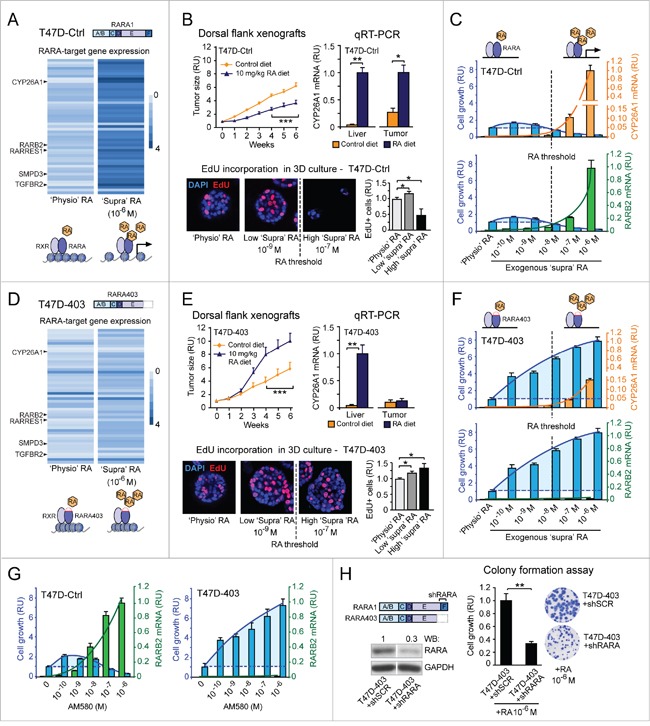
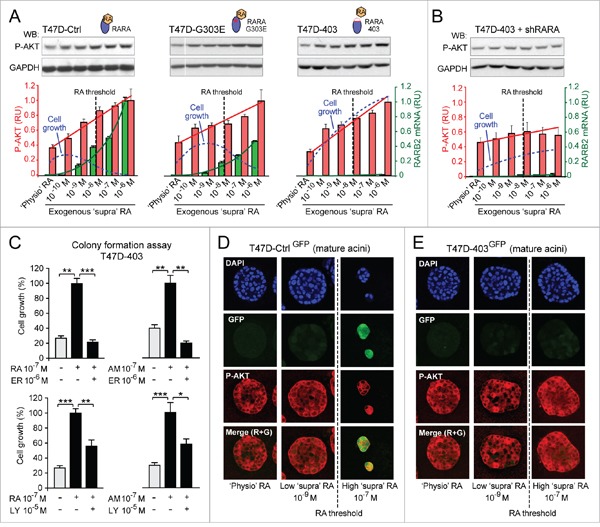
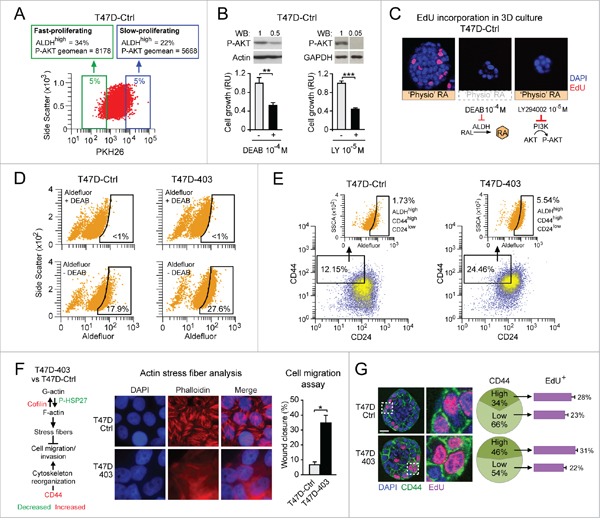
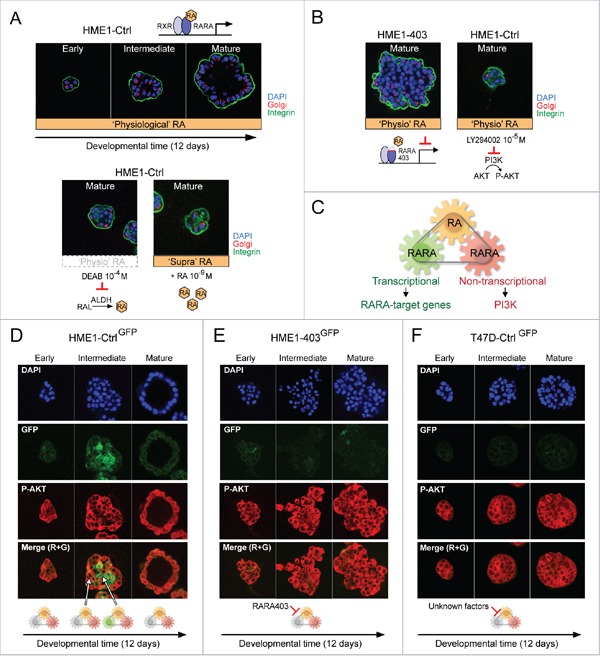
A hallmark of cancer cells is the ability to evade the growth inhibitory/pro-apoptotic action of physiological all-trans retinoic acid (RA) signal, the bioactive derivative of Vitamin A. However, as we and others reported, RA can also promote cancer cell growth and invasion. Here we show that anticancer and cancer-promoting RA actions in breast cancer have roots in a mechanism of mammary epithelial cell morphogenesis that involves both transcriptional (epigenetic) and non-transcriptional RARα (RARA) functions. We found that the mammary epithelial cell-context specific degree of functionality of the RARA transcriptional (epigenetic) component of this mechanism, by tuning the effects of the non-transcriptional RARA component, determines different cell fate decisions during mammary morphogenesis. Indeed, factors that hamper the RARA epigenetic function make physiological RA drive aberrant morphogenesis via non-transcriptional RARA, thus leading to cell transformation. Remarkably, also the cell context-specific degree of functionality of the RARA epigenetic component retained by breast cancer cells is critical to determine cell fate decisions in response to physiological as well as supraphysiological RA variation. Overall this study supports the proof of principle that the epigenetic functional plasticity of the mammary epithelial cell RARA mechanism, which is essential for normal morphogenetic processes, is necessary to deter breast cancer onset/progression consequent to the insidious action of physiological RA.
癌细胞的一个标志是能够逃避生理全反式视黄酸(RA)信号(维生素A的生物活性衍生物)的生长抑制/促凋亡作用。然而,正如我们和其他人所报道的,RA也可以促进癌细胞的生长和侵袭。在这里,我们表明,乳腺癌中RA的抗癌和促癌作用源于乳腺上皮细胞形态发生机制,该机制涉及转录(表观遗传)和非转录RARα(RARA)功能。我们发现,通过调节非转录RARA成分的作用,该机制中RARA转录(表观遗传)成分在乳腺上皮细胞环境中的特定功能程度决定了乳腺形态发生过程中不同的细胞命运决定。事实上,阻碍RARA表观遗传功能的因素会使生理RA通过非转录RARA驱动异常形态发生,从而导致细胞转化。值得注意的是,乳腺癌细胞保留的RARA表观遗传成分在细胞环境中的特定功能程度对于决定细胞对生理以及超生理RA变化的命运决定也至关重要。总体而言,这项研究支持了这样一个原理证明,即乳腺上皮细胞RARA机制的表观遗传功能可塑性对于正常形态发生过程至关重要,对于防止因生理RA的潜在作用而导致的乳腺癌发生/进展是必要的。