Nakamura Tatsuro, Yamaguchi Naho, Miyauchi Yuu, Takeda Tomoki, Yamazoe Yasushi, Nagata Kiyoshi, Mackenzie Peter I, Yamada Hideyuki, Ishii Yuji
Laboratory of Molecular Life Sciences, Graduate School of Pharmaceutical Sciences, Kyushu University Fukuoka, Japan.
The Cabinet Office, Government of Japan Tokyo, Japan.
Front Pharmacol. 2016 Nov 14;7:427. doi: 10.3389/fphar.2016.00427. eCollection 2016.
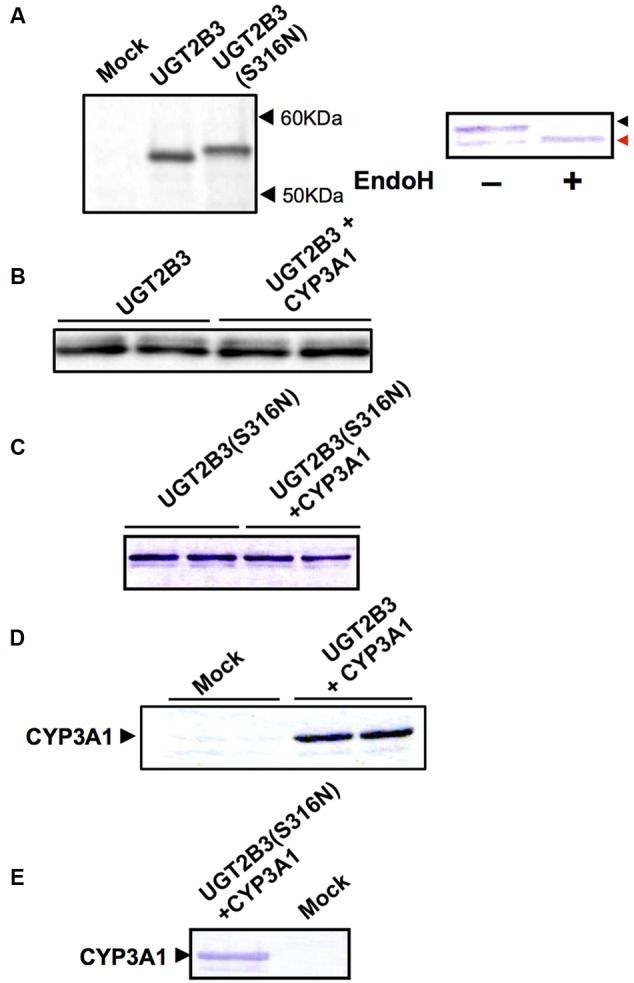
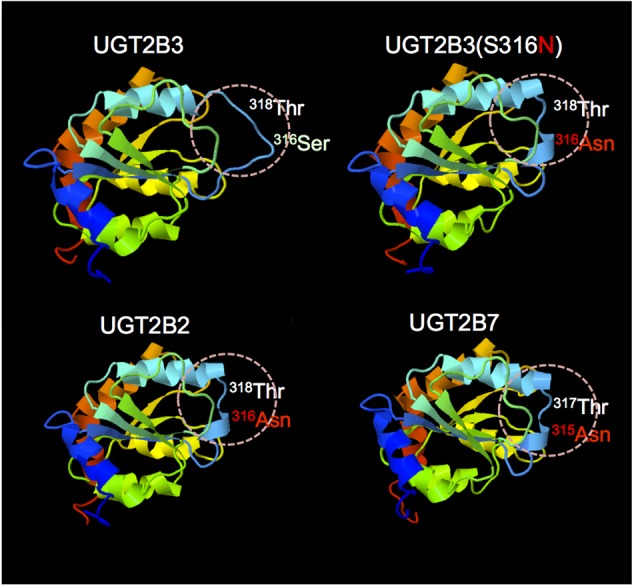
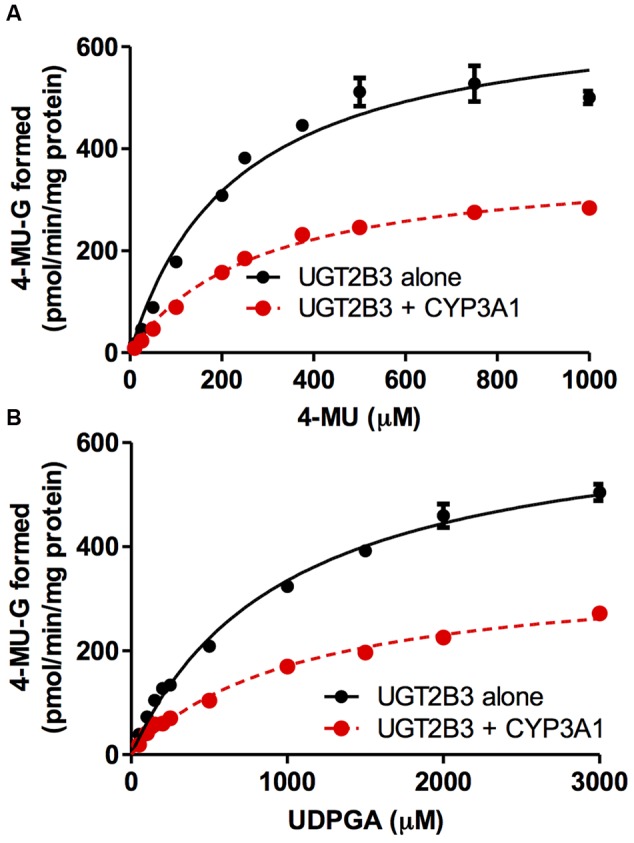
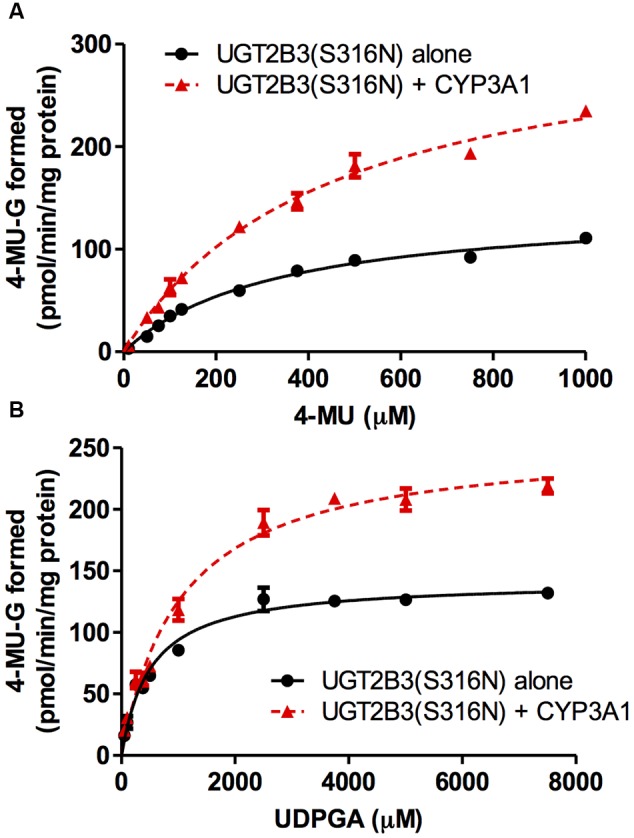
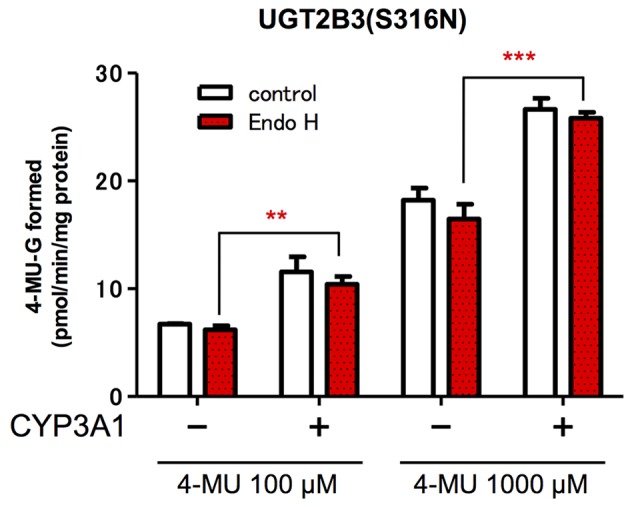
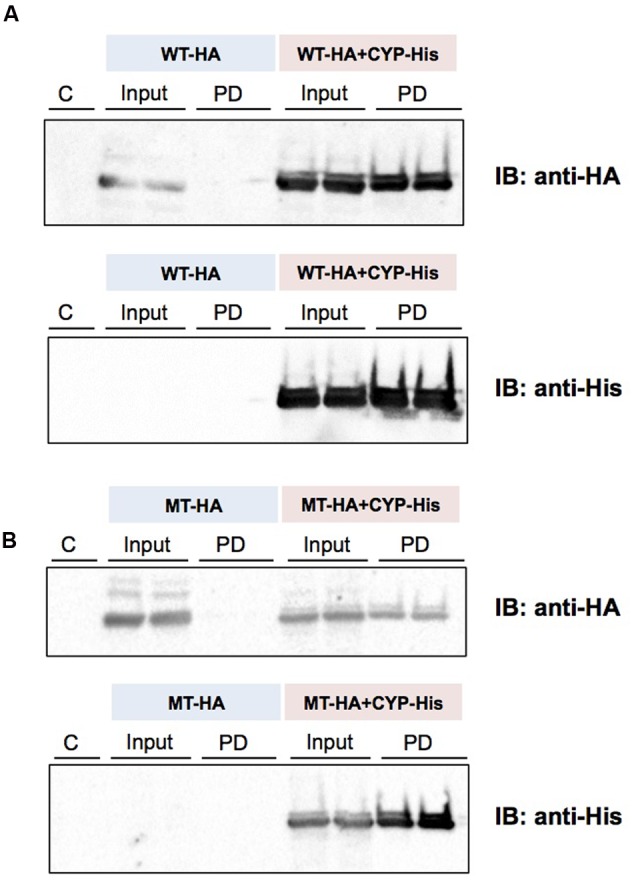
Our previous studies have demonstrated functional protein-protein interactions between cytochrome P450 (CYP) 3A and UDP-glucuronosyltransferase (UGT). However, the role of carbohydrate chains of UGTs in the interaction with CYP is not well understood. To address this issue, we examined whether CYP3A1 modulates the function of UGT2B3 which lacks potential glycosylation sites. We also examined whether the introduction of glycosylation to UGT2B3 affects CYP3A-dependent modulation of UGT function. To introduce a potential glycosylation site into UGT2B3, Ser 316 of UGT2B3 was substituted with Asn by site-directed mutagenesis. A baculovirus-Sf-9 cell system for expressing CYP3A1 and UGT2B3/UGT2B3(S316N) was established using a Bac-to-Bac system. Glycosylation of UGT2B3(S316N) was demonstrated in this expression system. The microsomal activity of recombinant UGT was determined using 4-methylumbelliferone as a substrate. The effect of CYP3A1 co-expression on UGT function was examined by comparing the kinetic profiles between single (UGT alone) and double expression (UGT plus CYP) systems. The kinetics of the two expression systems fitted a Michaelis-Menten equation. When the 4-MU concentration was varied, co-expression of CYP3A1 lowered the of UGT2B3-mediated conjugation. Conversely, for UGT2B3(S316N), the in the dual expression system was higher than that in the single expression system. The data obtained demonstrate that the introduction of glycosylation to UGT2B3 alters its sensitivity to CYP3A1-dependent modulation while CYP3A1 enhanced UGT2B3(S316N) activity, and wild-type UGT2B3 was suppressed by CYP3A1. These data suggest that glycosylation of UGT is one of the determinants regulating the interaction between CYP3A and UGT.
我们之前的研究已证明细胞色素P450(CYP)3A与尿苷二磷酸葡萄糖醛酸转移酶(UGT)之间存在功能性蛋白质-蛋白质相互作用。然而,UGT糖链在与CYP相互作用中的作用尚未完全明确。为解决这一问题,我们研究了CYP3A1是否会调节缺乏潜在糖基化位点的UGT2B3的功能。我们还研究了向UGT2B3引入糖基化是否会影响CYP3A对UGT功能的调节作用。为了在UGT2B3中引入潜在的糖基化位点,通过定点诱变将UGT2B3的丝氨酸316替换为天冬酰胺。利用杆状病毒-杆状病毒表达系统(Bac-to-Bac系统)建立了用于表达CYP3A1和UGT2B3/UGT2B3(S316N)的杆状病毒-Sf-9细胞系统。在此表达系统中证实了UGT2B3(S316N)的糖基化。以4-甲基伞形酮为底物测定重组UGT的微粒体活性。通过比较单表达(单独的UGT)和双表达(UGT加CYP)系统之间的动力学曲线,研究了CYP3A1共表达对UGT功能的影响。两种表达系统的动力学均符合米氏方程。当改变4-MU浓度时,CYP3A1的共表达降低了UGT2B3介导的结合反应的米氏常数。相反,对于UGT2B3(S316N),双表达系统中的米氏常数高于单表达系统。所获得的数据表明,向UGT2B3引入糖基化会改变其对CYP3A1依赖性调节的敏感性,而CYP3A1增强了UGT2B3(S316N)的活性,野生型UGT2B3则受到CYP3A1的抑制。这些数据表明,UGT的糖基化是调节CYP3A与UGT之间相互作用的决定因素之一。