Tatsuzawa Masaomi, Ogawa Ryuichi, Ohkubo Atsushi, Shimojima Kazuyo, Maeda Kunimi, Echizen Hirotoshi, Miyazaki Akihisa
Department of Pharmacy, Juntendo University Nerima Hospital, 3-1-10 Takanodai, Nerima-ku, Tokyo, 177-8521 Japan.
Department of Pharmacotherapy, Meiji Pharmaceutical University, 2-522-1 Noshio, Kiyose-shi, Tokyo, 204-8588 Japan.
J Pharm Health Care Sci. 2016 Nov 22;2:34. doi: 10.1186/s40780-016-0068-1. eCollection 2016.
Hyperphosphatemia is one of the common complications in patients undergoing hemodialysis. Although calcium carbonate (CaC) is often used to control serum inorganic phosphorus level in dialysis patients, co-administration of gastric acid reducers (ARs) may interfere with the phosphate binding effect of CaC. We performed a retrospective medical chart review to study whether ARs attenuate the hypophosphatemic effect of CaC in patients undergoing hemodialysis.
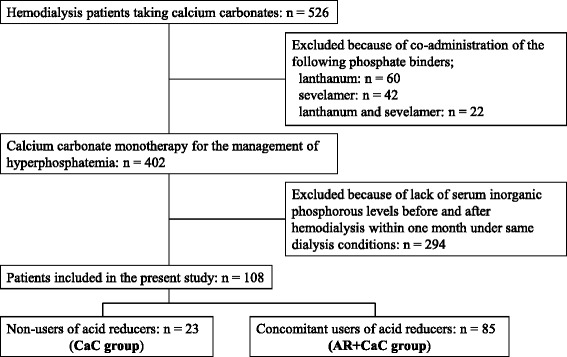
One hundred and eight chronic hemodialysis patients receiving either CaC alone or CaC concomitant with one of the ARs (proton pump inhibitors and histamine H-receptor antagonists) were retrieved from the medical charts in Juntendo University Nerima Hospital. The patients were subdivided according to the interval between hemodialysis sessions (interdialysis interval of 48 or 72 h). A multivariate analysis was performed to identify clinical covariates associated with the variability of serum inorganic phosphorus levels. The study protocol was approved by the Institutional Review Board before the study was begun.
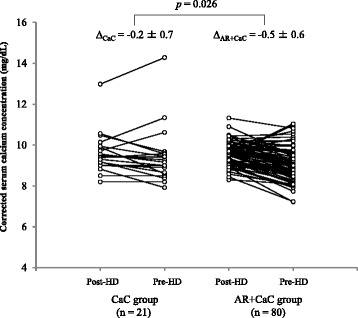
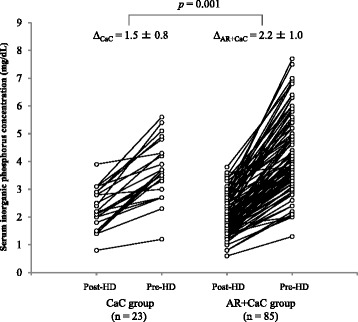
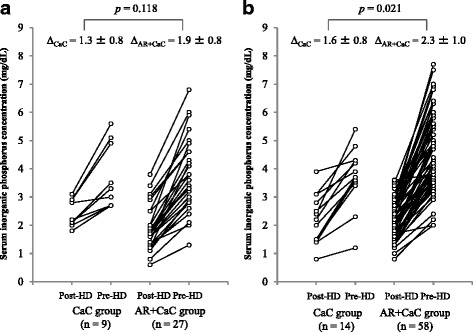
Among patients on hemodialysis with a 72-h interdialysis interval, the magnitude of increase in serum inorganic phosphorus concentration in patients receiving CaC and AR was significantly greater than in those receiving CaC alone. While a similar trend was observed among patients with a 48-h interdialysis interval, the difference did not reach a significant level. A multivariate regression analysis revealed that concomitant administration of ARs with CaC and a longer interdialysis interval (72 h) were significantly and independently associated with the magnitude of increase in serum phosphorus concentration between dialysis sessions. No significant differences in albumin-corrected serum calcium concentrations and incidence of pathological fractures were observed between patients receiving CaC alone and those receiving CaC with ARs.
Concomitant use of ARs with CaC may attenuate the hypophosphatemic effect of CaC in patients undergoing chronic hemodialysis. When hemodialysis patients require prescription of ARs for the prevention of upper gastrointestinal mucosal diseases (such as peptic ulcer), it may be prudent to choose a phosphate binder other than CaC.
高磷血症是血液透析患者常见的并发症之一。虽然碳酸钙(CaC)常用于控制透析患者的血清无机磷水平,但同时使用胃酸抑制剂(ARs)可能会干扰CaC的磷结合效果。我们进行了一项回顾性病历审查,以研究ARs是否会减弱CaC对血液透析患者的降磷作用。
从顺天堂大学练马医院的病历中检索出108例接受单独CaC或CaC与一种ARs(质子泵抑制剂和组胺H受体拮抗剂)联合治疗的慢性血液透析患者。根据血液透析疗程之间的间隔时间(透析间隔为48或72小时)将患者进行细分。进行多变量分析以确定与血清无机磷水平变异性相关的临床协变量。研究方案在研究开始前获得了机构审查委员会的批准。
在透析间隔为72小时的血液透析患者中,接受CaC和ARs的患者血清无机磷浓度的升高幅度明显大于仅接受CaC的患者。虽然在透析间隔为48小时的患者中也观察到了类似趋势,但差异未达到显著水平。多变量回归分析显示,ARs与CaC联合使用以及较长的透析间隔时间(72小时)与透析期间血清磷浓度升高幅度显著且独立相关。在单独接受CaC的患者和接受CaC与ARs联合治疗的患者之间,白蛋白校正后的血清钙浓度和病理性骨折发生率没有显著差异。
CaC与ARs联合使用可能会减弱CaC对慢性血液透析患者的降磷作用。当血液透析患者需要开具ARs以预防上消化道黏膜疾病(如消化性溃疡)时,谨慎选择除CaC以外的磷结合剂可能是明智的。