Klassen Oliver, Schmidt Martina E, Ulrich Cornelia M, Schneeweiss Andreas, Potthoff Karin, Steindorf Karen, Wiskemann Joachim
Division of Sports Therapy, Hospital Münsterland, Bad Rothenfelde, Germany.
Division of Physical Activity, Prevention and Cancer, National Center for Tumor Diseases (NCT) and German Cancer Research Center (DKFZ), Heidelberg, Germany.
J Cachexia Sarcopenia Muscle. 2017 Apr;8(2):305-316. doi: 10.1002/jcsm.12165. Epub 2016 Nov 28.
Muscle dysfunction and sarcopenia have been associated with poor performance status, an increased mortality risk, and greater side effects in oncologic patients. However, little is known about how performance is affected by cancer therapy. We investigated muscle strength in breast cancer patients in different adjuvant treatment settings and also compared it with data from healthy individuals.
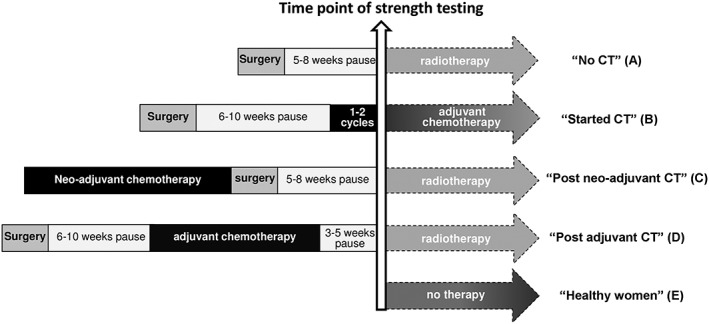
Breast cancer patients (N = 255) from two randomized controlled exercise trials, staged 0-III and aged 54.4 ± 9.4 years, were categorized into four groups according to their treatment status. In a cross-sectional design, muscle function was assessed bilaterally by isokinetic dynamometry (0°, 60°, 180°/s) as maximal voluntary isometric contraction (MVIC) and maximal isokinetic peak torque (MIPT) in shoulder rotators and knee flexors and extensors. Additionally, muscular fatigue index (FI%) and shoulder flexibility were evaluated. Healthy women (N = 26), aged 53.3 ± 9.8 years, were tested using the same method. Analysis of covariance was used to estimate the impact of different cancer treatments on skeletal muscle function with adjustment for various clinical and socio-demographic factors.
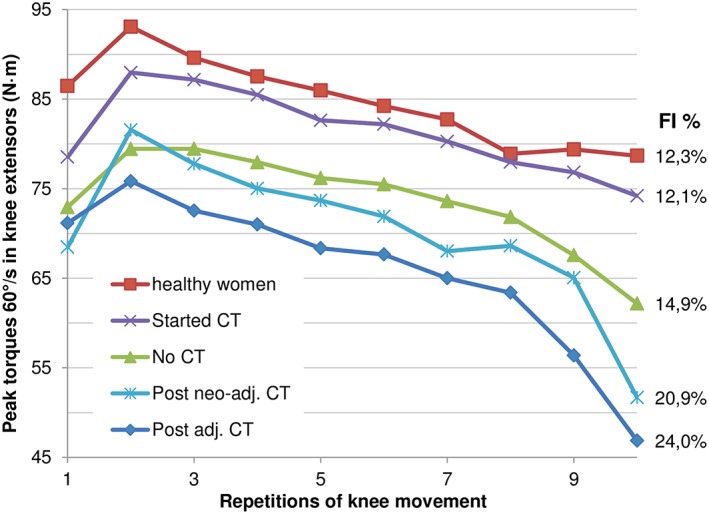
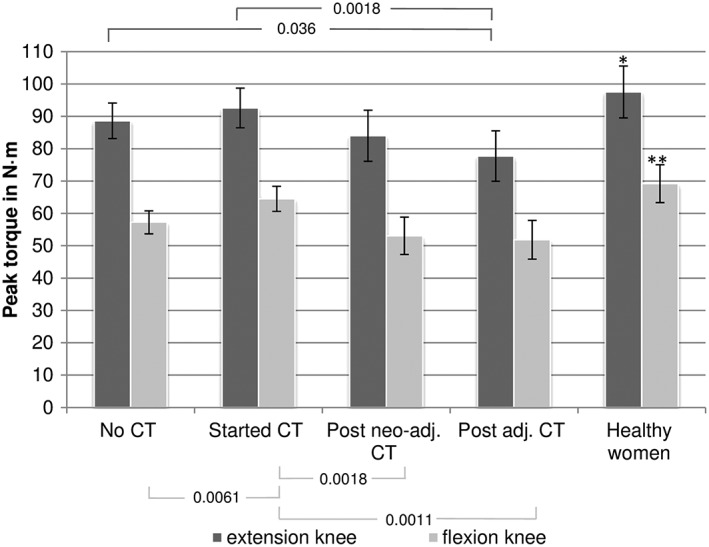
Consistently, lower muscle strength was measured in shoulder and knee strength in patients after chemotherapy. On average, patients had up to 25% lower strength in lower extremities and 12-16% in upper extremities in MVIC and MIPT during cancer treatment compared with healthy women. No substantial difference between patient groups in shoulder strength, but significantly lower shoulder flexibility in patients with radical mastectomy was measured. Chemotherapy-treated patients had consistently higher FI%. No serious adverse events were reported.
Breast cancer patients showed markedly impaired muscle strength and joint dysfunctions before and after anticancer treatment. The significant differences between patients and healthy individuals underline the need of exercise therapy as early as possible in order to prevent or counteract the loss of muscle function after curative surgery as well as the consequences of neo-/adjuvant chemotherapy.
肌肉功能障碍和肌肉减少症与肿瘤患者的身体状况不佳、死亡风险增加以及更多副作用相关。然而,关于癌症治疗如何影响身体状况知之甚少。我们调查了处于不同辅助治疗阶段的乳腺癌患者的肌肉力量,并将其与健康个体的数据进行了比较。
来自两项随机对照运动试验的255例乳腺癌患者,分期为0-III期,年龄54.4±9.4岁,根据其治疗状态分为四组。在横断面设计中,通过等速测力法(0°、60°、180°/秒)双侧评估肌肉功能,测量肩部旋转肌以及膝关节屈伸肌的最大自主等长收缩(MVIC)和最大等速峰值扭矩(MIPT)。此外,评估肌肉疲劳指数(FI%)和肩部柔韧性。对26名年龄53.3±9.8岁的健康女性使用相同方法进行测试。采用协方差分析来估计不同癌症治疗对骨骼肌功能的影响,并对各种临床和社会人口学因素进行调整。
化疗后患者肩部和膝关节力量的测量结果一直较低。平均而言,与健康女性相比,癌症治疗期间患者下肢的MVIC和MIPT力量平均低25%,上肢低12-16%。患者组之间肩部力量无显著差异,但接受根治性乳房切除术的患者肩部柔韧性明显较低。接受化疗的患者FI%一直较高。未报告严重不良事件。
乳腺癌患者在抗癌治疗前后肌肉力量明显受损,关节功能障碍。患者与健康个体之间的显著差异突显了尽早进行运动治疗的必要性,以预防或对抗根治性手术后肌肉功能的丧失以及新辅助/辅助化疗的后果。