Marquet Laurie-Anne, Hausswirth Christophe, Molle Odeline, Hawley John A, Burke Louise M, Tiollier Eve, Brisswalter Jeanick
Laboratory of Sport, Expertise and Performance, French National Institute of Sport, Expertise and Performance (INSEP), 75012 Paris, France.
Université Côte d'Azur, LAMHESS, 06205 Nice, France.
Nutrients. 2016 Nov 25;8(12):755. doi: 10.3390/nu8120755.
"Sleep-low" consists of a sequential periodization of carbohydrate (CHO) availability-low glycogen recovery after "train high" glycogen-depleting interval training, followed by an overnight-fast and light intensity training ("train low") the following day. This strategy leads to an upregulation of several exercise-responsive signaling proteins, but the chronic effect on performance has received less attention. We investigated the effects of short-term exposure to this strategy on endurance performance.
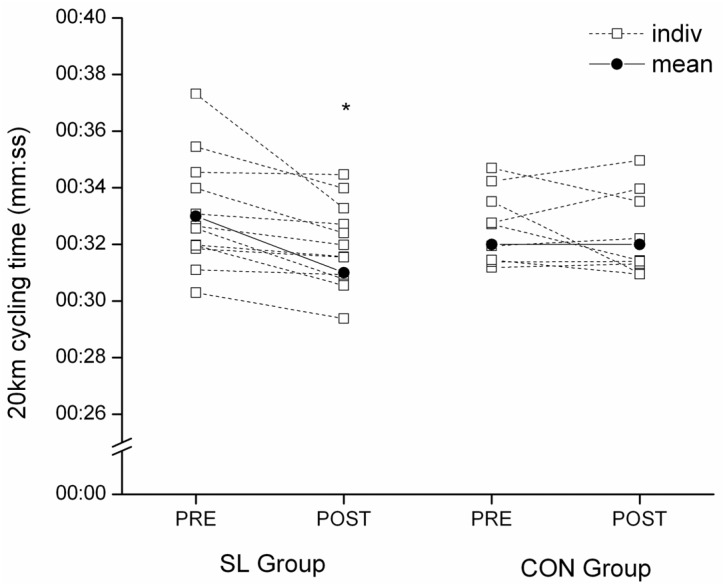
Following training familiarization, 11 trained cyclists were divided into two groups for a one-week intervention-one group implemented three cycles of periodized CHO intake to achieve the sleep-low strategy over six training sessions (SL, CHO intake: 6 g·kg·day), whereas the control group consumed an even distribution of CHO over the day (CON). Tests were a 2 h submaximal ride and a 20 km time trial.
SL improved their performance (mean: +3.2%; < 0.05) compared to CON. The improvement was associated with a change in pacing strategy with higher power output during the second part of the test. No change in substrate utilization was observed after the training period for either group.
Implementing the "sleep-low" strategy for one week improved performance by the same magnitude previously seen in a three-week intervention, without any significant changes in selected markers of metabolism.
“低睡眠期”包括碳水化合物(CHO)可利用性的顺序周期性变化——在“高训练量”糖原消耗性间歇训练后糖原恢复较低,随后是一夜禁食,以及第二天的低强度训练(“低训练量”)。这种策略会导致几种运动反应信号蛋白上调,但对运动表现的长期影响受到的关注较少。我们研究了短期采用这种策略对耐力表现的影响。
在训练适应后,11名训练有素的自行车运动员被分为两组进行为期一周的干预——一组在六个训练时段实施三个周期的周期性CHO摄入,以实现“低睡眠期”策略(SL组,CHO摄入量:6 g·kg·天),而对照组在一天中均匀摄入CHO(CON组)。测试包括2小时次最大强度骑行和20公里计时赛。
与CON组相比,SL组的表现有所提高(平均提高3.2%;<0.05)。这种提高与测试第二部分中更高功率输出的配速策略变化有关。训练期后两组的底物利用均未观察到变化。
实施一周的“低睡眠期”策略可使运动表现提高到与之前为期三周的干预相同的幅度,且所选代谢指标无任何显著变化。