Kroeger Paul T, Drapkin Ronny
Department of Obstetrics and Gynecology, Ovarian Cancer Research Center, Perelman School of Medicine, University of Pennsylvania, Philadelphia, Pennsylvania, USA.
Curr Opin Obstet Gynecol. 2017 Feb;29(1):26-34. doi: 10.1097/GCO.0000000000000340.
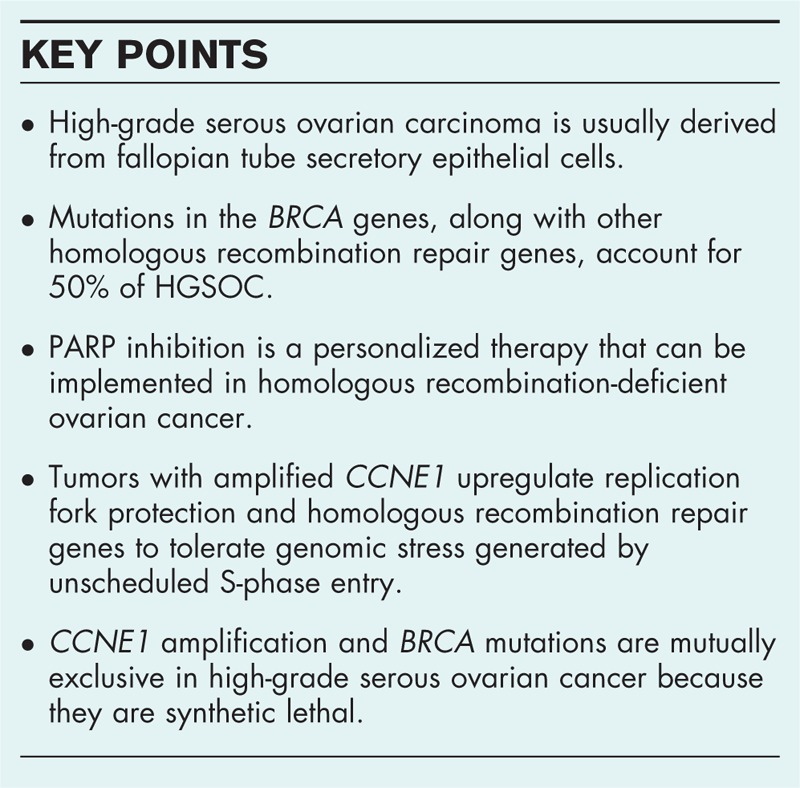
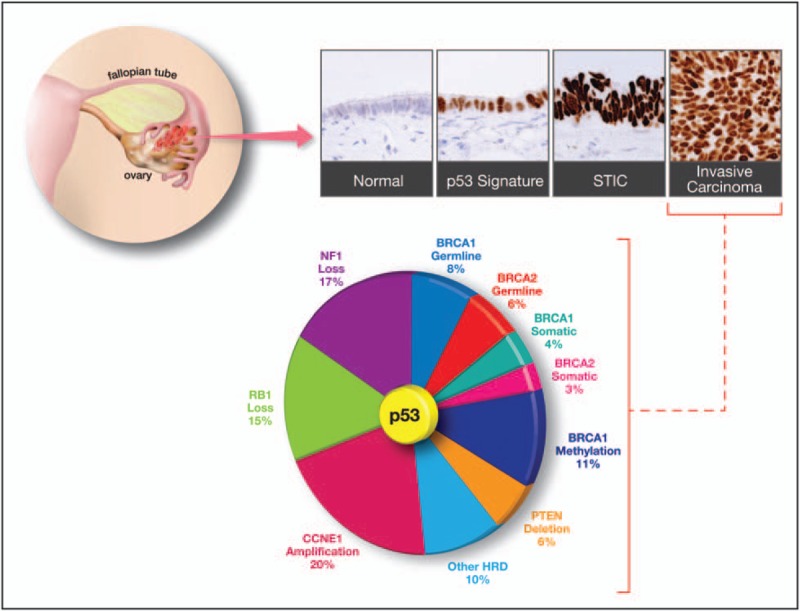
The most common type of ovarian cancer, high-grade serous ovarian carcinoma (HGSOC), was originally thought to develop from the ovarian surface epithelium. However, recent data suggest that the cells that undergo neoplastic transformation and give rise to the majority of HGSOC are from the fallopian tube. This development has impacted both translational research and clinical practice, revealing new opportunities for early detection, prevention, and treatment of ovarian cancer.
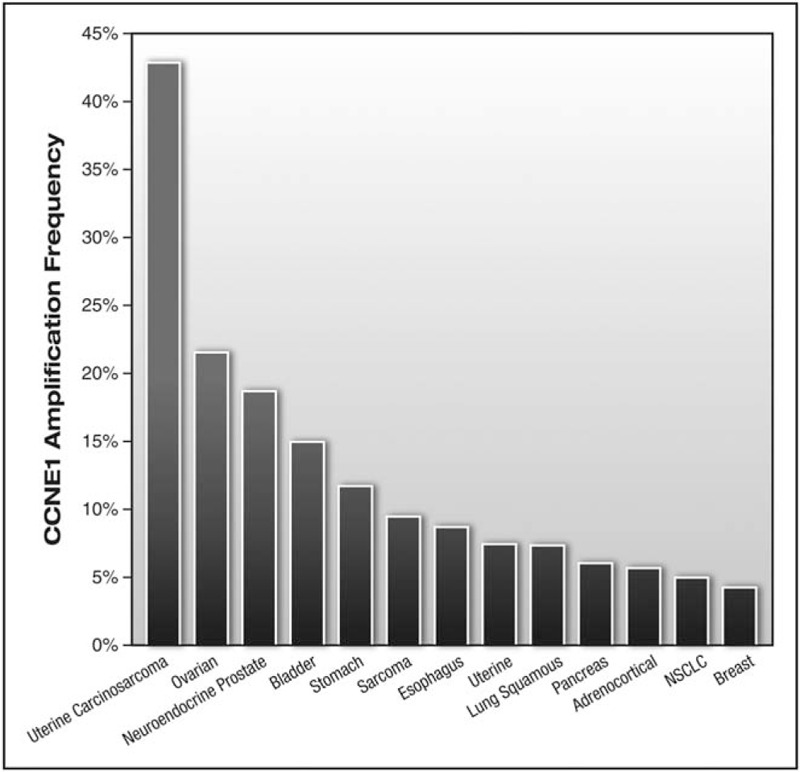
Genomic studies indicate that approximately 50% of HGSOC are characterized by mutations in genes involved in the homologous recombination pathway of DNA repair, especially BRCA1 and BRCA2. Clinical trials have demonstrated successful treatment of homologous recombination-defective cancers with poly-ribose polymerase inhibitors through synthetic lethality. Recently, amplification of CCNE1 was found to be another major factor in HGSOC tumorigenesis, accounting for approximately 20% of all cases. Interestingly, amplification of CCNE1 and mutation of homologous recombination repair genes are mutually exclusive in HGSOC.
The fallopian tube secretory cell is the cell of origin for the majority of ovarian cancers. Although it remains unclear what triggers neoplastic transformation of these cells, certain tumors exhibit loss of BRCA function or amplification of CCNE1. These alterations represent unique therapeutic opportunities in ovarian cancer.
卵巢癌最常见的类型,即高级别浆液性卵巢癌(HGSOC),最初被认为起源于卵巢表面上皮。然而,最近的数据表明,发生肿瘤转化并导致大多数HGSOC的细胞来自输卵管。这一进展对转化研究和临床实践都产生了影响,为卵巢癌的早期检测、预防和治疗揭示了新的机会。
基因组研究表明,约50%的HGSOC具有参与DNA修复同源重组途径的基因突变特征,尤其是BRCA1和BRCA2。临床试验已证明,聚核糖聚合酶抑制剂通过合成致死性成功治疗了同源重组缺陷型癌症。最近发现,CCNE1扩增是HGSOC肿瘤发生的另一个主要因素,约占所有病例的20%。有趣的是,在HGSOC中,CCNE1扩增与同源重组修复基因的突变相互排斥。
输卵管分泌细胞是大多数卵巢癌的起源细胞。虽然尚不清楚是什么触发了这些细胞的肿瘤转化,但某些肿瘤表现出BRCA功能丧失或CCNE1扩增。这些改变代表了卵巢癌独特的治疗机会。