
卵巢癌及输卵管浆液性上皮内癌中MicroRNA-200通路的特征分析
Characterization of MicroRNA-200 pathway in ovarian cancer and serous intraepithelial carcinoma of fallopian tube.
作者信息
Yang Junzheng, Zhou Yilan, Ng Shu-Kay, Huang Kuan-Chun, Ni Xiaoyan, Choi Pui-Wah, Hasselblatt Kathleen, Muto Michael G, Welch William R, Berkowitz Ross S, Ng Shu-Wing
机构信息
Department of Obstetrics/Gynecology and Reproductive Biology, Brigham and Women's Hospital, Boston, MA, 02115, USA.
School of Medicine and Menzies Health Institute Queensland, Griffith University, QLD, Nathan, 4111, Australia.
出版信息
BMC Cancer. 2017 Jun 17;17(1):422. doi: 10.1186/s12885-017-3417-z.
BACKGROUND
Ovarian cancer is the leading cause of death among gynecologic diseases in Western countries. We have previously identified a miR-200-E-cadherin axis that plays an important role in ovarian inclusion cyst formation and tumor invasion. The purpose of this study was to determine if the miR-200 pathway is involved in the early stages of ovarian cancer pathogenesis by studying the expression levels of the pathway components in a panel of clinical ovarian tissues, and fallopian tube tissues harboring serous tubal intraepithelial carcinomas (STICs), a suggested precursor lesion for high-grade serous tumors.
METHODS
RNA prepared from ovarian and fallopian tube epithelial and stromal fibroblasts was subjected to quantitative real-time reverse-transcription polymerase chain reaction (qRT-PCR) to determine the expression of miR-200 families, target and effector genes and analyzed for clinical association. The effects of exogenous miR-200 on marker expression in normal cells were determined by qRT-PCR and fluorescence imaging after transfection of miR-200 precursors.
RESULTS
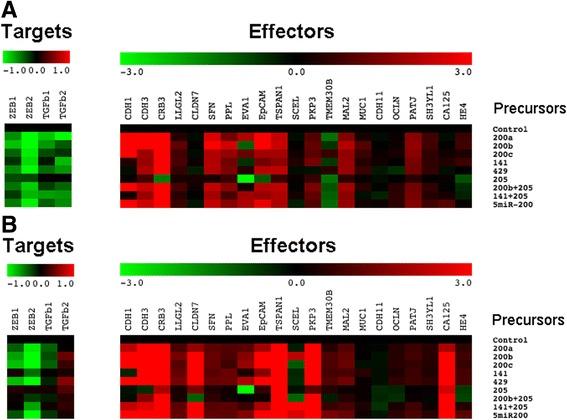
Ovarian epithelial tumor cells showed concurrent up-regulation of miR-200, down-regulation of the four target genes (ZEB1, ZEB2, TGFβ1 and TGFβ2), and up-regulation of effector genes that were negatively regulated by the target genes. STIC tumor cells showed a similar trend of expression patterns, although the effects did not reach significance because of small sample sizes. Transfection of synthetic miR-200 precursors into normal ovarian surface epithelial (OSE) and fallopian tube epithelial (FTE) cells confirmed reduced expression of the target genes and elevated levels of the effector genes CDH1, CRB3 and EpCAM in both normal OSE and FTE cells. However, only FTE cells had a specific induction of CA125 after miR-200 precursor transfection.
CONCLUSIONS
The activation of the miR-200 pathway may be an early event that renders the OSE and FTE cells more susceptible to oncogenic mutations and histologic differentiation. As high-grade serous ovarian carcinomas (HGSOC) usually express high levels of CA125, the induction of CA125 expression in FTE cells by miR-200 precursor transfection is consistent with the notion that HGSOC has an origin in the distal fallopian tube.
背景
在西方国家,卵巢癌是妇科疾病中导致死亡的主要原因。我们之前已确定一条miR - 200 - E - 钙黏蛋白轴,其在卵巢包涵囊肿形成和肿瘤侵袭中起重要作用。本研究的目的是通过研究一组临床卵巢组织以及含有浆液性输卵管上皮内癌(STICs)的输卵管组织(高级别浆液性肿瘤的一种推测前体病变)中该通路成分的表达水平,来确定miR - 200通路是否参与卵巢癌发病机制的早期阶段。
方法
从卵巢和输卵管上皮及基质成纤维细胞制备的RNA进行定量实时逆转录聚合酶链反应(qRT - PCR),以确定miR - 200家族、靶基因和效应基因的表达,并分析其临床相关性。在转染miR - 200前体后,通过qRT - PCR和荧光成像确定外源性miR - 200对正常细胞中标志物表达的影响。
结果
卵巢上皮肿瘤细胞显示miR - 200同时上调,四个靶基因(ZEB1、ZEB2、TGFβ1和TGFβ2)下调,以及被靶基因负调控的效应基因上调。STIC肿瘤细胞显示出类似的表达模式趋势,尽管由于样本量小,这些效应未达到显著水平。将合成的miR - 200前体转染到正常卵巢表面上皮(OSE)细胞和输卵管上皮(FTE)细胞中,证实靶基因表达降低,且正常OSE细胞和FTE细胞中效应基因CDH1、CRB3和EpCAM水平升高。然而,仅FTE细胞在转染miR - 200前体后有CA125的特异性诱导。
结论
miR - 200通路的激活可能是使OSE细胞和FTE细胞更易发生致癌突变和组织学分化的早期事件。由于高级别浆液性卵巢癌(HGSOC)通常表达高水平的CA125,miR - 200前体转染在FTE细胞中诱导CA125表达与HGSOC起源于输卵管远端的观点一致。


 Zotero 插件