Lotta Luca A, Scott Robert A, Sharp Stephen J, Burgess Stephen, Luan Jian'an, Tillin Therese, Schmidt Amand F, Imamura Fumiaki, Stewart Isobel D, Perry John R B, Marney Luke, Koulman Albert, Karoly Edward D, Forouhi Nita G, Sjögren Rasmus J O, Näslund Erik, Zierath Juleen R, Krook Anna, Savage David B, Griffin Julian L, Chaturvedi Nishi, Hingorani Aroon D, Khaw Kay-Tee, Barroso Inês, McCarthy Mark I, O'Rahilly Stephen, Wareham Nicholas J, Langenberg Claudia
MRC Epidemiology Unit, University of Cambridge, Cambridge, United Kingdom.
Department of Public Health and Primary Care, University of Cambridge, Cambridge, United Kingdom.
PLoS Med. 2016 Nov 29;13(11):e1002179. doi: 10.1371/journal.pmed.1002179. eCollection 2016 Nov.
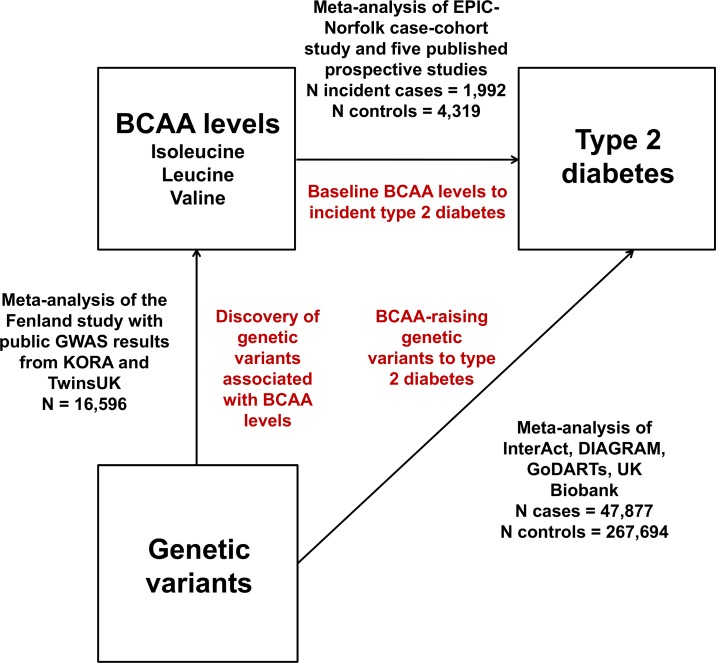
Higher circulating levels of the branched-chain amino acids (BCAAs; i.e., isoleucine, leucine, and valine) are strongly associated with higher type 2 diabetes risk, but it is not known whether this association is causal. We undertook large-scale human genetic analyses to address this question.
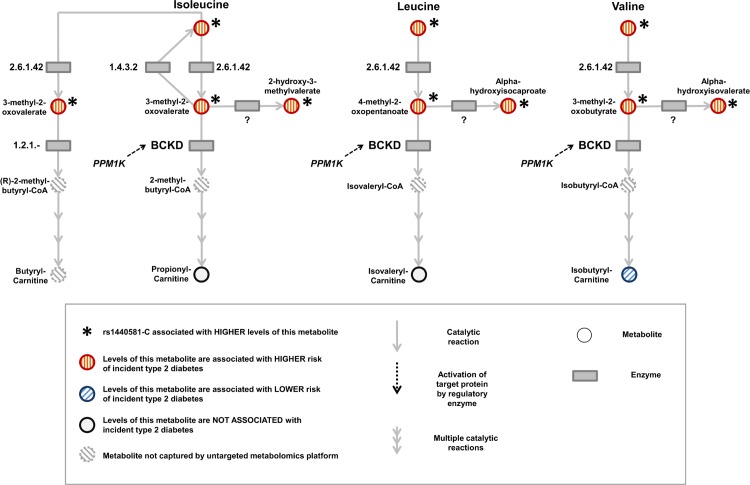
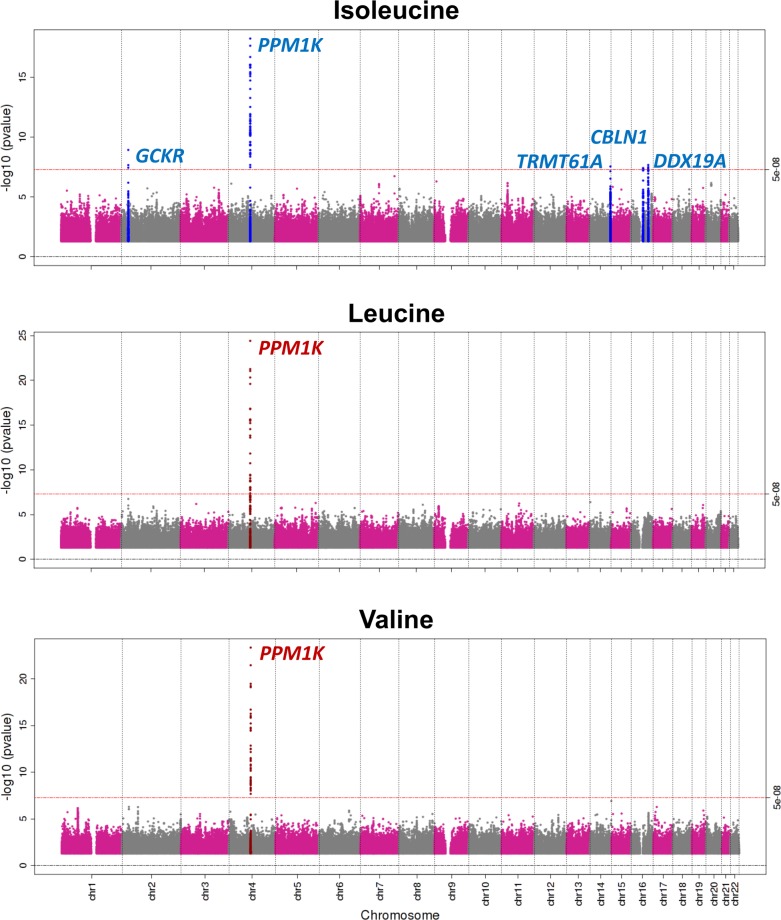
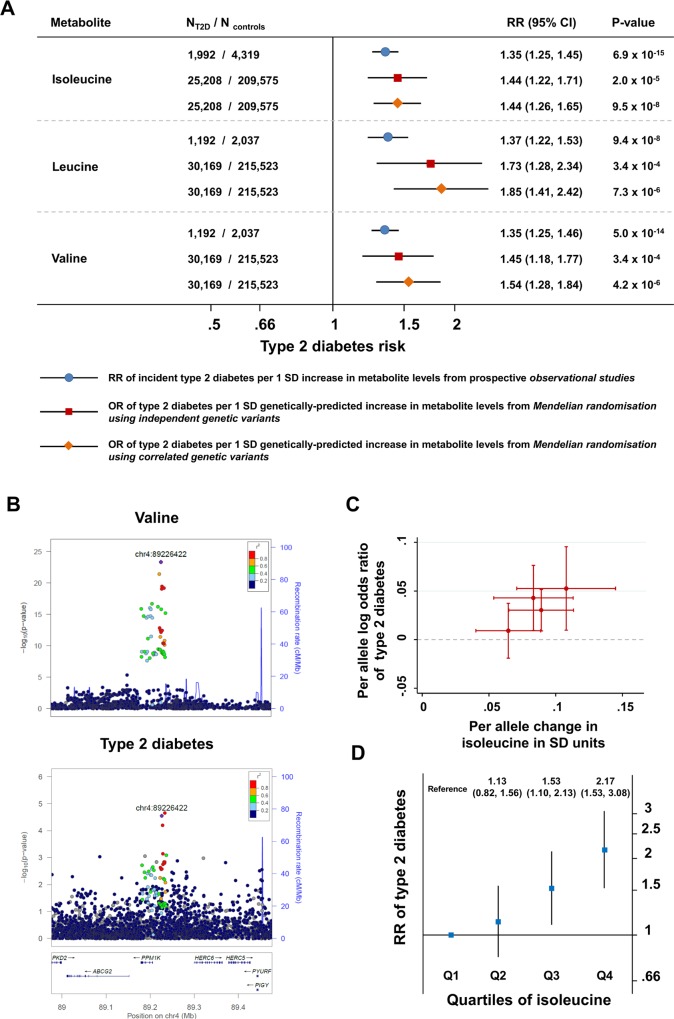
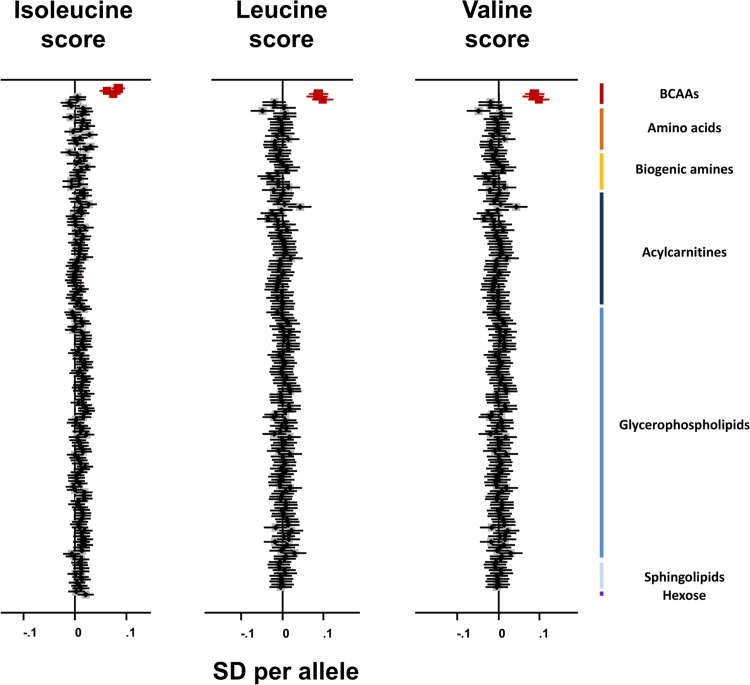
Genome-wide studies of BCAA levels in 16,596 individuals revealed five genomic regions associated at genome-wide levels of significance (p < 5 × 10⁻⁸). The strongest signal was 21 kb upstream of the PPM1K gene (beta in standard deviations [SDs] of leucine per allele = 0.08, p = 3.9 × 10⁻²⁵), encoding an activator of the mitochondrial branched-chain alpha-ketoacid dehydrogenase (BCKD) responsible for the rate-limiting step in BCAA catabolism. In another analysis, in up to 47,877 cases of type 2 diabetes and 267,694 controls, a genetically predicted difference of 1 SD in amino acid level was associated with an odds ratio for type 2 diabetes of 1.44 (95% CI 1.26-1.65, p = 9.5 × 10⁻⁸) for isoleucine, 1.85 (95% CI 1.41-2.42, p = 7.3 × 10⁻⁶) for leucine, and 1.54 (95% CI 1.28-1.84, p = 4.2 × 10⁻⁶) for valine. Estimates were highly consistent with those from prospective observational studies of the association between BCAA levels and incident type 2 diabetes in a meta-analysis of 1,992 cases and 4,319 non-cases. Metabolome-wide association analyses of BCAA-raising alleles revealed high specificity to the BCAA pathway and an accumulation of metabolites upstream of branched-chain alpha-ketoacid oxidation, consistent with reduced BCKD activity. Limitations of this study are that, while the association of genetic variants appeared highly specific, the possibility of pleiotropic associations cannot be entirely excluded. Similar to other complex phenotypes, genetic scores used in the study captured a limited proportion of the heritability in BCAA levels. Therefore, it is possible that only some of the mechanisms that increase BCAA levels or affect BCAA metabolism are implicated in type 2 diabetes.
Evidence from this large-scale human genetic and metabolomic study is consistent with a causal role of BCAA metabolism in the aetiology of type 2 diabetes.
循环中支链氨基酸(BCAAs,即异亮氨酸、亮氨酸和缬氨酸)水平升高与2型糖尿病风险增加密切相关,但这种关联是否具有因果关系尚不清楚。我们进行了大规模人类基因分析以解决这个问题。
对16596名个体的BCAA水平进行全基因组研究,发现了5个在全基因组水平上具有显著相关性的基因组区域(p < 5 × 10⁻⁸)。最强的信号位于PPM1K基因上游21 kb处(每个等位基因的亮氨酸标准差[SDs]中的β = 0.08,p = 3.9 × 10⁻²⁵),该基因编码线粒体支链α-酮酸脱氢酶(BCKD)的激活剂,BCKD负责BCAA分解代谢的限速步骤。在另一项分析中,在多达47877例2型糖尿病病例和267694例对照中,氨基酸水平上遗传预测的1个标准差差异与2型糖尿病的比值比相关,异亮氨酸为1.44(95% CI 1.26 - 1.65,p = 9.5 × 10⁻⁸),亮氨酸为1.85(95% CI 1.41 - 2.42,p = 7.3 × 10⁻⁶),缬氨酸为1.54(95% CI 1.28 - 1.84,p = 4.2 × 10⁻⁶)。在对1992例病例和4319例非病例的荟萃分析中,这些估计值与BCAA水平和2型糖尿病发病之间前瞻性观察研究的结果高度一致。对升高BCAA的等位基因进行的全代谢组关联分析显示对BCAA途径具有高度特异性,并且在支链α-酮酸氧化上游的代谢物积累,这与BCKD活性降低一致。本研究的局限性在于,虽然遗传变异的关联似乎具有高度特异性,但不能完全排除多效性关联的可能性。与其他复杂表型类似,本研究中使用的遗传评分仅捕获了BCAA水平遗传力的有限比例。因此,有可能只有一些增加BCAA水平或影响BCAA代谢的机制与2型糖尿病有关。
这项大规模人类基因和代谢组学研究的证据与BCAA代谢在2型糖尿病病因学中的因果作用一致。