European School of Molecular Medicine (SEMM), IFOM-IEO-Campus, via Adamello 16, Milan 20139, Italy.
Università degli Studi di Milano, Milan 20122, Italy.
Nat Commun. 2016 Nov 30;7:13520. doi: 10.1038/ncomms13520.
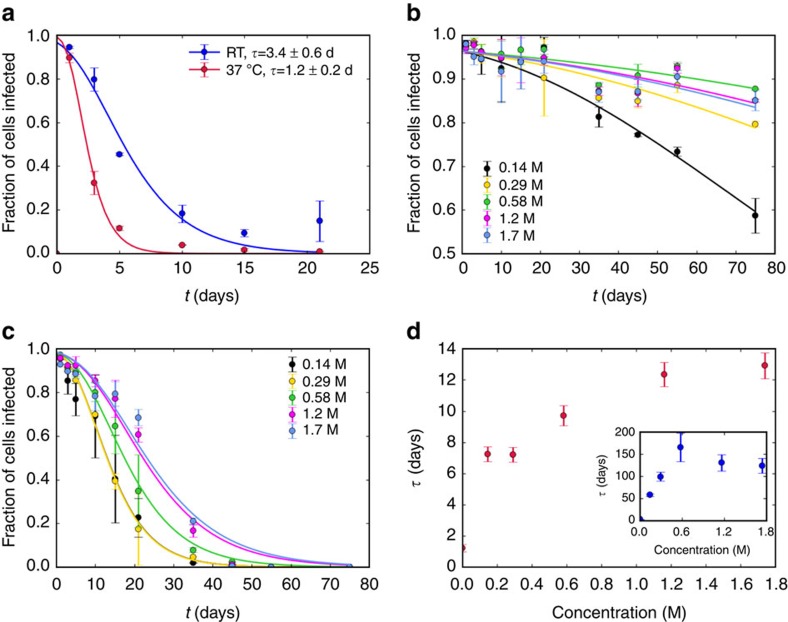
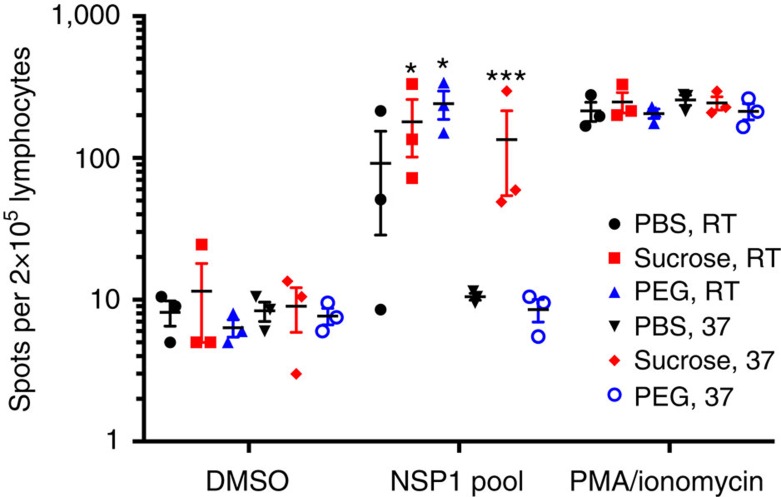
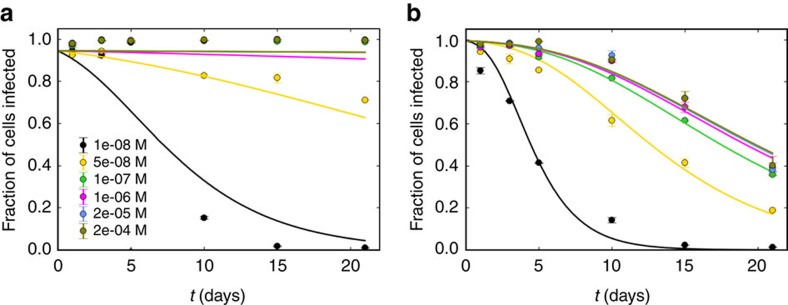
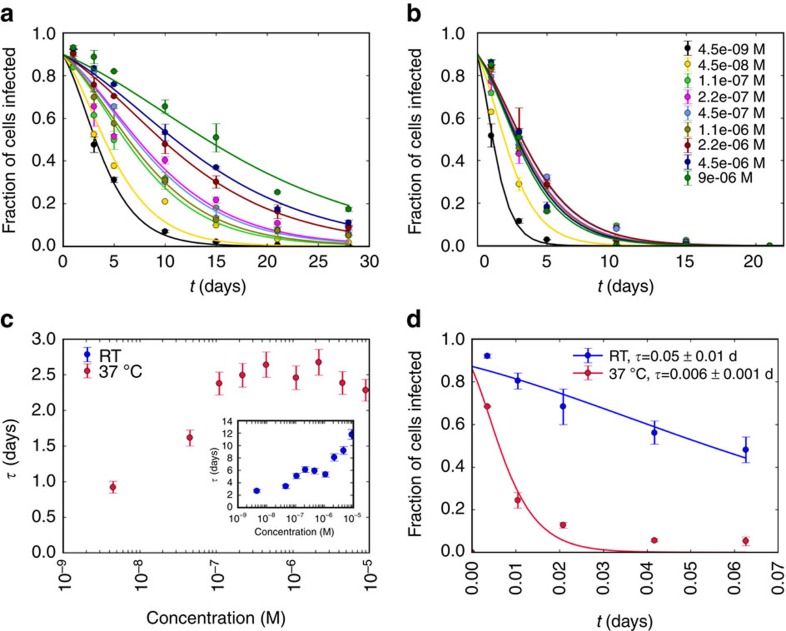
Up to 80% of the cost of vaccination programmes is due to the cold chain problem (that is, keeping vaccines cold). Inexpensive, biocompatible additives to slow down the degradation of virus particles would address the problem. Here we propose and characterize additives that, already at very low concentrations, improve the storage time of adenovirus type 5. Anionic gold nanoparticles (10-10 M) or polyethylene glycol (PEG, molecular weight ∼8,000 Da, 10-10 M) increase the half-life of a green fluorescent protein expressing adenovirus from ∼48 h to 21 days at 37 °C (from 7 to >30 days at room temperature). They replicate the known stabilizing effect of sucrose, but at several orders of magnitude lower concentrations. PEG and sucrose maintained immunogenicity in vivo for viruses stored for 10 days at 37 °C. To achieve rational design of viral-vaccine stabilizers, our approach is aided by simplified quantitative models based on a single rate-limiting step.
高达 80%的疫苗接种计划成本归因于冷链问题(即保持疫苗低温)。廉价、生物相容性的添加剂可以减缓病毒颗粒的降解,从而解决这个问题。在这里,我们提出并描述了添加剂,在非常低的浓度下,这些添加剂就可以提高 5 型腺病毒的储存时间。阴离子金纳米颗粒(10-10 M)或聚乙二醇(PEG,分子量约 8000 Da,10-10 M)可将表达绿色荧光蛋白的腺病毒的半衰期从 37°C 下的约 48 小时延长至 21 天(在室温下从 7 天延长至> 30 天)。它们复制了蔗糖已知的稳定作用,但浓度要低几个数量级。PEG 和蔗糖可保持在 37°C 下储存 10 天的病毒的免疫原性。为了实现病毒疫苗稳定剂的合理设计,我们的方法得到了简化的定量模型的辅助,这些模型基于单一的限速步骤。