Wu Guo-Cui, Yuan Hui, Pan Hai-Feng, Ye Dong-Qing
Department of Epidemiology and Biostatistics, School of Public Health, Anhui Medical University, Hefei, Anhui, China.
Anhui Provincial Laboratory of Population Health and Major Disease Screening and Diagnosis, Hefei, Anhui, China.
Oncotarget. 2017 Jun 20;8(25):40181-40189. doi: 10.18632/oncotarget.13658.
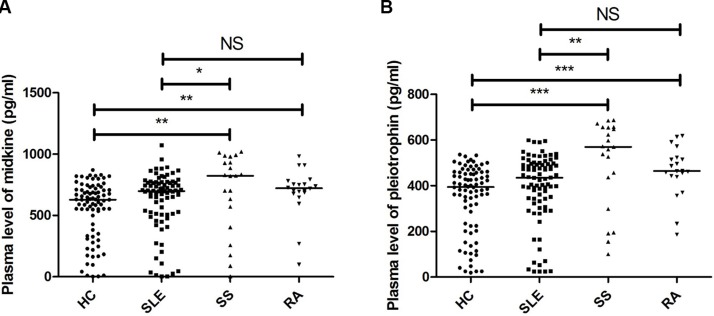
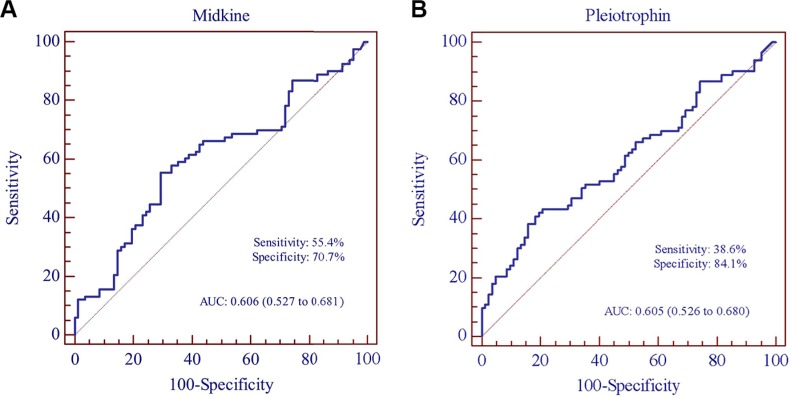
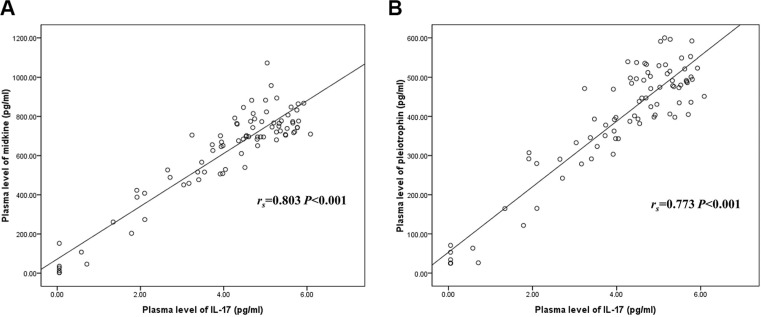
Emerging evidence suggests that two heparin-binding growth factor, midkine and pleiotrophin are implicated in the pathogenesis of autoimmune diseases including SLE. To investigate the plasma midkine and pleiotrophin levels in SLE patients, as well as their correlation with major clinical parameters and interleukin-17 (IL-17) level in SLE, 83 SLE patients and 123 controls including 20 rheumatoid arthritis (RA) patients, 21 Sjögren's syndrome (SS) patients and 82 healthy controls (HCs) were recruited. Plasma midkine, pleiotrophin and IL-17 levels were detected by ELISA. Midkine and pleiotrophin levels were significantly higher in SLE, RA and SS patients compared with HCs (all P < 0.05). There were significantly lower midkine and pleiotrophin levels in SLE compared to SS (P < 0.05 and P < 0.01, respectively). No significant differences in midkine and pleiotrophin levels were found between SLE and RA (P = 0.240 and P = 0.074, respectively). Both plasma midkine and pleiotrophin levels were associated with rash and anti-SSA in SLE. In addition, both midkine and pleiotrophin levels were positively associated with IL-17 level in SLE (both P < 0.001). Area under curve (AUC) of the receiver operating characteristic (ROC) curve for midkine and pleiotrophin were 0.606 (0.527-0.681) and 0.605 (0.526-0.680) respectively. In conclusion, elevated plasma midkine and pleiotrophin levels and their associations with rash, anti-SSA and IL-17 in SLE patients suggest their involvement in this disease.
新出现的证据表明,两种肝素结合生长因子,即中期因子和多效生长因子,与包括系统性红斑狼疮(SLE)在内的自身免疫性疾病的发病机制有关。为了研究SLE患者血浆中期因子和多效生长因子水平,以及它们与SLE主要临床参数和白细胞介素-17(IL-17)水平的相关性,招募了83例SLE患者和123名对照,包括20例类风湿关节炎(RA)患者、21例干燥综合征(SS)患者和82名健康对照(HCs)。采用酶联免疫吸附测定法(ELISA)检测血浆中期因子、多效生长因子和IL-17水平。与HCs相比,SLE、RA和SS患者的中期因子和多效生长因子水平显著更高(所有P<0.05)。与SS相比,SLE患者的中期因子和多效生长因子水平显著更低(分别为P<0.05和P<0.01)。SLE和RA患者的中期因子和多效生长因子水平无显著差异(分别为P=0.240和P=0.074)。SLE患者血浆中期因子和多效生长因子水平均与皮疹和抗SSA相关。此外,SLE患者中期因子和多效生长因子水平均与IL-17水平呈正相关(均P<0.001)。中期因子和多效生长因子的受试者工作特征(ROC)曲线下面积(AUC)分别为0.606(0.527-0.681)和0.605(0.526-0.680)。总之,SLE患者血浆中期因子和多效生长因子水平升高及其与皮疹、抗SSA和IL-17的关联表明它们参与了该疾病。