Makkar Steve R, Howe Megan, Williamson Anna, Gilham Frances
The Sax Institute, Level 13, Building 10, 235 Jones Street, Ultimo, NSW, 2007, Australia.
Health Res Policy Syst. 2016 Dec 1;14(1):85. doi: 10.1186/s12961-016-0157-5.
There is a need to develop innovations that can help bridge the gap between research and policy. Web CIPHER is an online tool designed to help policymakers better engage with research in order to increase its use in health policymaking. The aim of the present study was to test interventions in order to increase policymakers' usage of Web CIPHER. Namely, the impact of posting articles and blogs on topics relevant to the missions and scope of selected policy agencies in the Web CIPHER community.
Five policy agencies were targeted for the intervention. Web CIPHER usage data was gathered over a 30-month period using Google Analytics. Time series analysis was used to evaluate whether publication of tailored articles and blogs led to significant changes in usage for all Web CIPHER members from policy agencies, including those from the five target agencies. We further evaluated whether these users showed greater increases in usage following publication of articles and blogs directly targeted at their agency, and if these effects were moderated by the blog author.
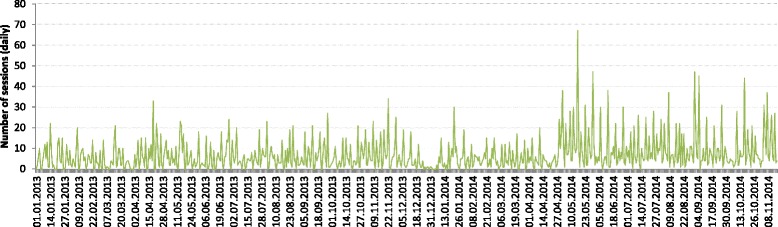
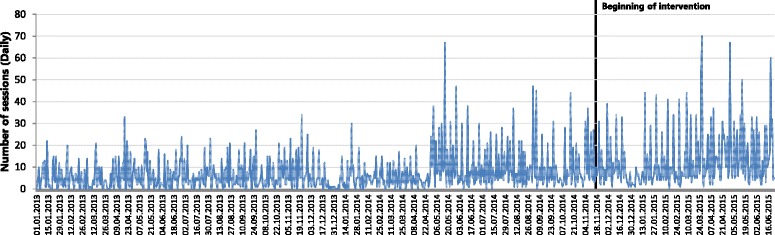
Web CIPHER usage gradually increased over time and was significantly predicted by the number of articles but not blogs that were posted throughout the study period. Publication of articles on sexual and reproductive health was followed by sustained increases in usage among all users, including users from the policy agency that targets this area. This effect of topic relevance did not occur for the four remaining target agencies. Finally, page views were higher for articles targeted at one's agency compared to other agencies. This effect also occurred for blogs, particularly when the author was internal to one's agency.
The findings suggest that Web CIPHER usage in general was motivated by general interest, engagement and appeal, as opposed to the agency specificity of content and work relevance. Blogs in and of themselves may not be effective at promoting usage. Thus, in order to increase policymakers' engagement with research through similar online platforms, a potentially effective approach would be to post abundant, frequently updated, engaging, interesting and widely appealing content irrespective of form.
需要开发能够帮助弥合研究与政策之间差距的创新举措。网络密码信息平台(Web CIPHER)是一款在线工具,旨在帮助政策制定者更好地参与研究,以提高其在卫生政策制定中的应用。本研究的目的是测试干预措施,以增加政策制定者对网络密码信息平台的使用。具体而言,是在网络密码信息平台社区发布与选定政策机构的使命和范围相关主题的文章和博客的影响。
选取了五个政策机构作为干预对象。使用谷歌分析工具在30个月的时间内收集网络密码信息平台的使用数据。采用时间序列分析来评估发布量身定制的文章和博客是否会导致来自政策机构的所有网络密码信息平台成员(包括来自五个目标机构的成员)的使用量发生显著变化。我们进一步评估了这些用户在发布直接针对其机构的文章和博客后使用量是否有更大幅度的增加,以及这些影响是否受博客作者的调节。
随着时间的推移,网络密码信息平台的使用量逐渐增加,并且在整个研究期间发布的文章数量而非博客数量能够显著预测使用量。发布关于性健康和生殖健康的文章后,所有用户(包括针对该领域的政策机构的用户)的使用量持续增加。对于其余四个目标机构,这种主题相关性的影响并未出现。最后,与针对其他机构的文章相比,针对自身机构的文章的页面浏览量更高。这种影响在博客方面也存在,尤其是当博客作者来自自身机构内部时。
研究结果表明,总体而言,网络密码信息平台的使用是由普遍兴趣、参与度和吸引力驱动的,而非内容的机构特定性和工作相关性。博客本身可能在促进使用方面并不有效。因此,为了通过类似的在线平台增加政策制定者对研究的参与度,一种可能有效的方法是发布丰富、频繁更新、引人入胜、有趣且具有广泛吸引力的内容,而不论其形式如何。