Amer Said, ElKhatam Ahmed, Zidan Shereif, Feng Yaoyu, Xiao Lihua
Division of Foodborne, Waterborne and Environmental Diseases, National Center for Emerging and Zoonotic Infectious Diseases, Centers for Disease Control and Prevention, 1600 Clifton Rd, Atlanta, GA, USA.
Department of Zoology, Faculty of Science, Kafr El sheikh University, Kafr El Sheikh, Egypt.
Parasit Vectors. 2016 Dec 1;9(1):623. doi: 10.1186/s13071-016-1898-2.
In Egypt, liver flukes, Fasciola spp. (Digenea: Fasciolidae), have a serious impact on the farming industry and public health. Both Fasciola hepatica and Fasciola gigantica are known to occur in cattle, providing the opportunity for genetic recombination. Little is known on the identity and genetic variability of Fasciola populations in sheep.
This study was performed to determine the prevalence of liver flukes in sheep in Menofia Province as a representative area of the delta region in Egypt, as measured by postmortem examination of slaughtered animals at three abattoirs. The identity and genetic variability of Fasciola spp. in slaughtered animals were determined by PCR-sequence analysis of the nuclear ribosomal internal transcribed spacer 1 (ITS1) and the mitochondrial NADH dehydrogenase subunit 1 (nad1) genes.
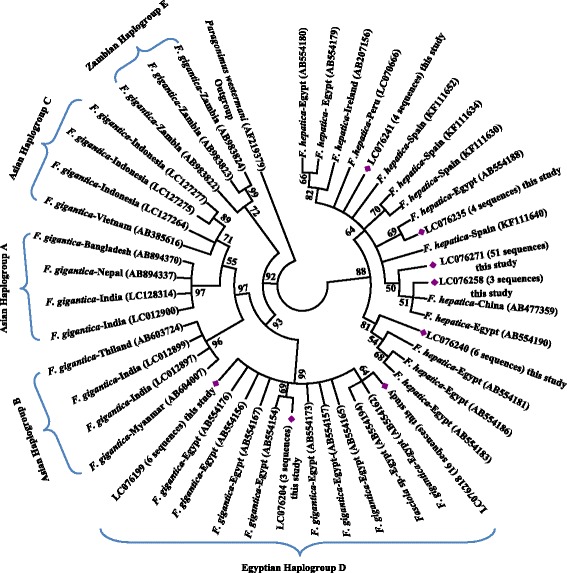
Physical inspection of the liver indicated that 302 of 2058 (14.7%) slaughtered sheep were infected with Fasciola spp. Sequence analysis of the ITS1 and nad1 genes of liver flukes from 17 animals revealed that 11 animals were infected with F. hepatica, four with F. gigantica, and two with both species. Seventy eight of 103 flukes genetically characterized from these animals were F. hepatica, 23 were F. gigantica, and two had ITS1 sequences identical to F. hepatica but nad1 sequences identical to F. gigantica. nad1 sequences of Egyptian isolates of F. gigantica showed pronounced differences from those in the GenBank database. Egyptian F. gigantica haplotypes formed haplogroup D, which clustered in a sister clade with haplogroups A, B and C circulating in Asia, indicating the existence of geographic isolation in the species.
Both F. hepatica and F. gigantica are prevalent in sheep in Egypt and an introgressed form of the two occurs as the result of genetic recombination. In addition, a geographically isolated F. gigantica population is present in the country. The importance of these observations in epidemiology of fascioliasis needs to be examined in future studies.
在埃及,肝吸虫,片形吸虫属(复殖目:片形科),对畜牧业和公众健康产生严重影响。已知肝片形吸虫和巨片形吸虫都存在于牛体内,这为基因重组提供了机会。关于绵羊体内片形吸虫种群的身份和遗传变异性,人们了解甚少。
本研究旨在通过对三个屠宰场宰杀动物的尸体解剖检查,确定埃及三角洲地区代表性区域米努夫省绵羊肝吸虫的感染率。通过对核糖体内部转录间隔区1(ITS1)和线粒体烟酰胺腺嘌呤二核苷酸脱氢酶亚基1(nad1)基因进行PCR序列分析,确定宰杀动物体内片形吸虫属的身份和遗传变异性。
肝脏的肉眼检查表明,2058只宰杀绵羊中有302只(14.7%)感染了片形吸虫属。对17只动物肝脏吸虫的ITS1和nad1基因进行序列分析,结果显示11只动物感染了肝片形吸虫,4只感染了巨片形吸虫,2只同时感染了这两种吸虫。从这些动物中进行基因特征分析的103只吸虫中,78只为肝片形吸虫,23只为巨片形吸虫,2只的ITS1序列与肝片形吸虫相同,但nad1序列与巨片形吸虫相同。埃及巨片形吸虫分离株的nad1序列与GenBank数据库中的序列存在明显差异。埃及巨片形吸虫单倍型形成了单倍群D,它与在亚洲传播的单倍群A、B和C聚集在一个姐妹分支中,表明该物种存在地理隔离。
肝片形吸虫和巨片形吸虫在埃及绵羊中均很普遍,并且由于基因重组出现了这两种吸虫的渐渗形式。此外,该国存在地理隔离的巨片形吸虫种群。这些观察结果在肝吸虫病流行病学中的重要性需要在未来的研究中进行检验。