Li Haisheng, Yao Zhihui, He Weifeng, Gao Hongyan, Bai Yang, Yang Sisi, Zhang Lu, Zhan Rixing, Tan Jianglin, Zhou Junyi, Takata Masao, Wu Jun, Luo Gaoxing
Institute of Burn Research, State Key Laboratory of Trauma, Burn and Combined Injury, Southwest Hospital, Third Military Medical University, Chongqing, China.
People's Liberation Army Hospital 59, Kaiyuan, Yunnan Province, China.
Stem Cell Res Ther. 2016 Dec 1;7(1):175. doi: 10.1186/s13287-016-0421-1.
Epithelial to mesenchymal transition, especially to myofibroblasts, plays an important role in wound healing, fibrosis, and carcinogenesis. Epidermal stem cells (EpSCs) are responsible for epidermal renewal and wound re-epithelialization. However, it remains unclear whether and how EpSCs transdifferentiate into myofibroblasts or myofibroblast-like cells (MFLCs). Here, we provide the first evidence showing that P311 induces EpSC to MFLC transdifferentiation (EpMyT) via TGFβ1/Smad signaling.
Wound healing and mesenchymal features were observed in the P311 KO and P311 WT mouse model of superficial second-degree burns. After the primary human or mouse EpSCs were forced to highly express P311 using an adenoviral vector, EpMyT was observed by immunofluorescence, real-time PCR, and western blot. The activity of TGFβ1 and Smad2/3 in EpSCs with different P311 levels was observed by western blot. The TβRI/II inhibitor LY2109761 and Smad3 siRNA were applied to block the EpMyT in P311-overexpressing EpSCs and exogenous TGFβ1 was to restore the EpMyT in P311 KO EpSCs. Furthermore, the mechanism of P311 regulating TGFβ1 was investigated by bisulfite sequencing PCR, luciferase activity assay, and real-time PCR.
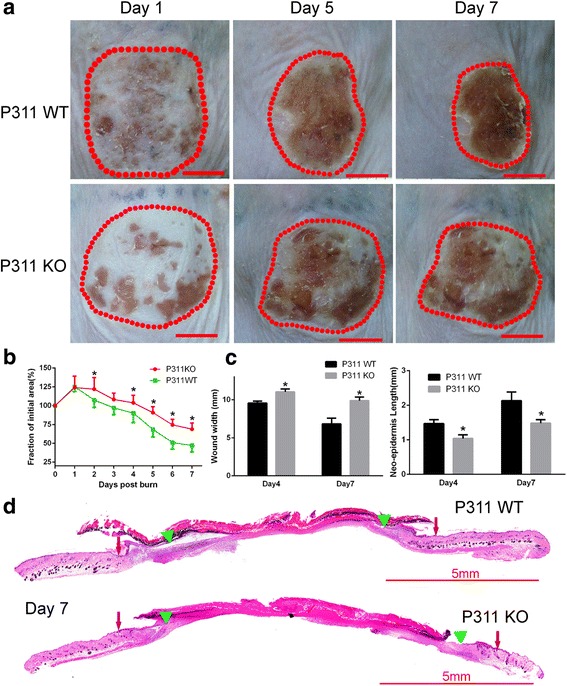
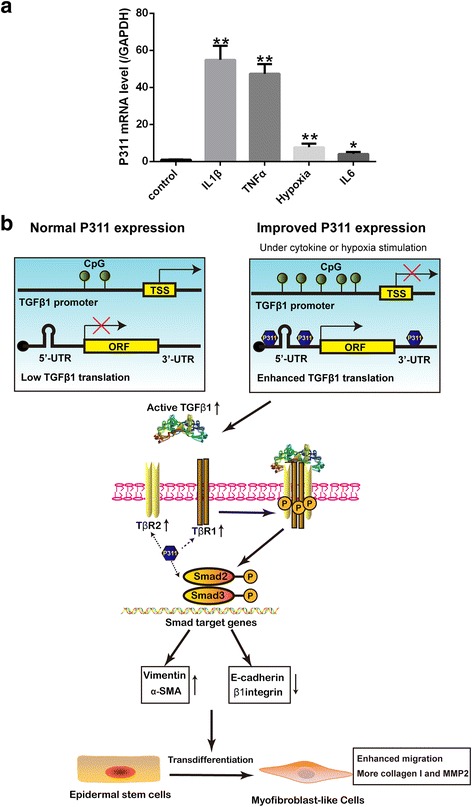
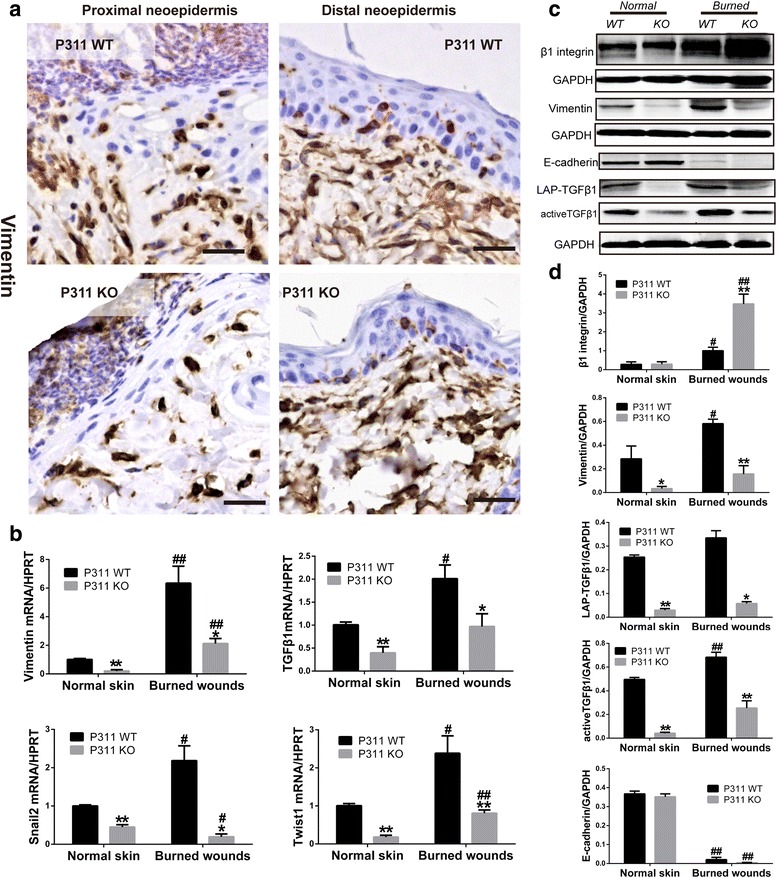
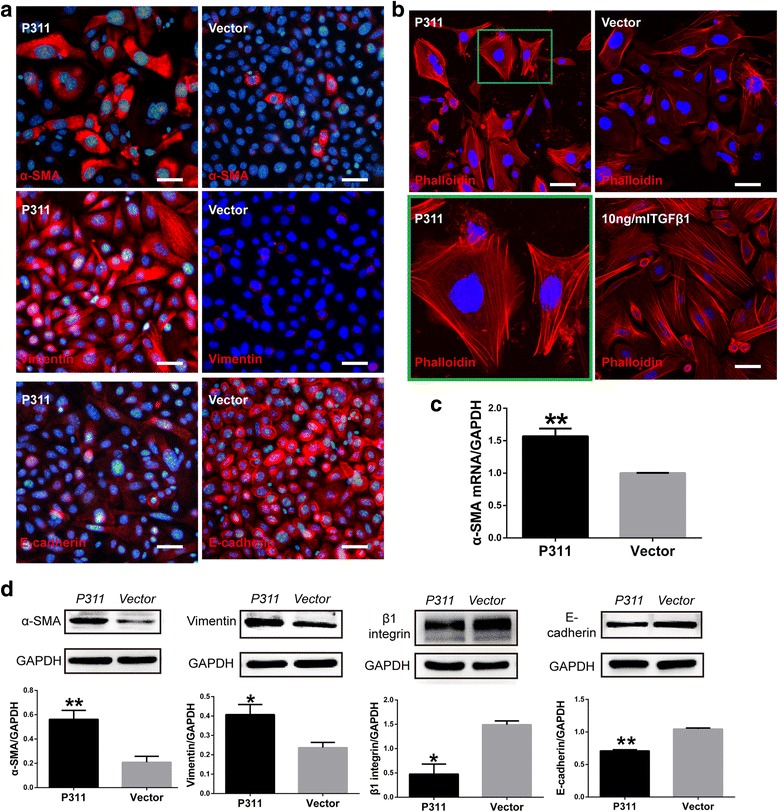
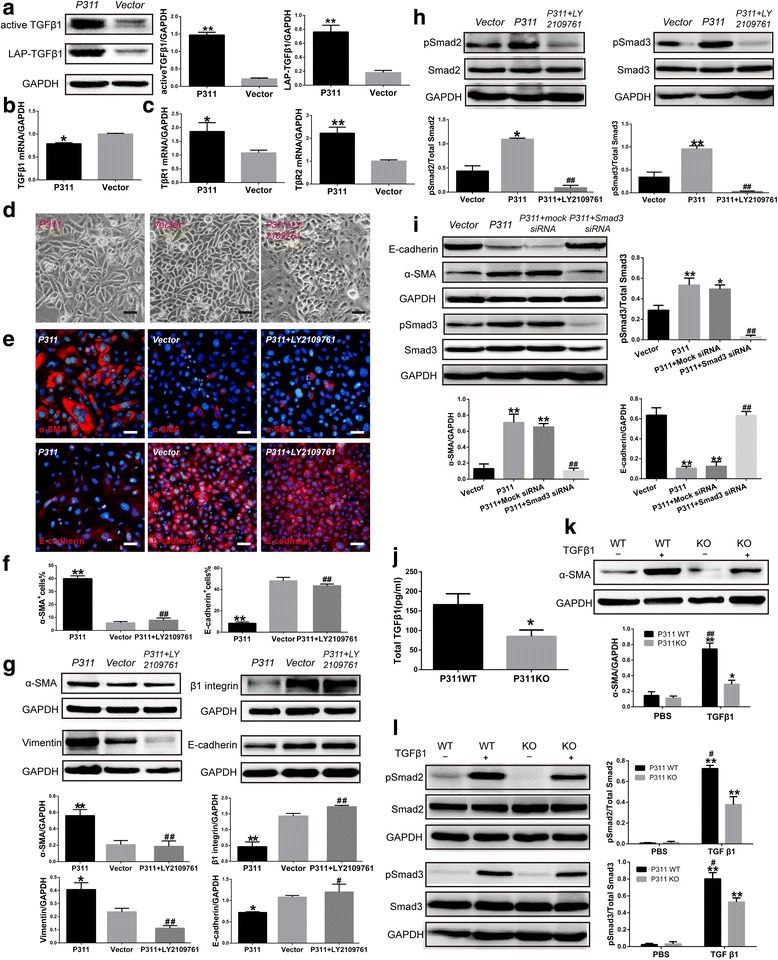
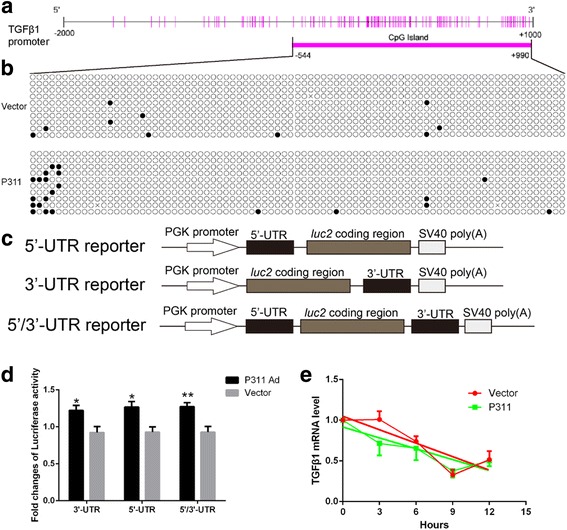
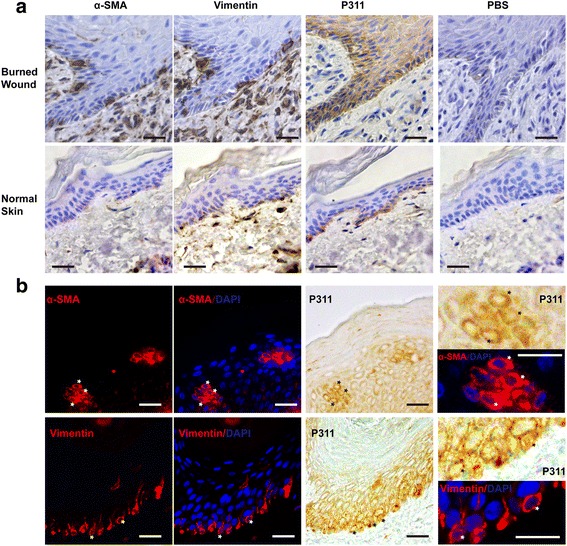
P311 KO mouse wounds showed delayed re-epithelialization and reduced mesenchymal features. The human or mouse EpSCs with overexpressed P311 exhibited fusiform morphological changes, upregulated expression of myofibroblast markers (α-SMA and vimentin), and downregulated expression of EpSC markers (β1-integrin and E-cadherin). P311-expressing EpSCs showed decreased TGFβ1 mRNA and increased TGFβ1 protein, TβRI/II mRNA, and activated Smad2/3. Moreover, LY2109761 and Smad3 siRNA reversed P311-induced EpMyT. Under the stimulation of exogenous TGFβ1, the phosphorylation of Smad2 and Smad3 in P311 KO EpSCs was significantly lower than that in P311 WT EpSCs and the EpMyT in P311 KO EpSCs was restored. Furthermore, P311 enhanced the methylation of TGFβ1 promoter and increased activities of TGFβ1 5'/3' untranslated regions (UTRs) to stimulate TGFβ1 expression. P311α-SMA cells and P311vimentin cells were observed in the epidermis of human burn wounds. Also, P311 was upregulated by IL-1β, IL-6, TNFα, and hypoxia.
P311 is a novel TGFβ1/Smad signaling-mediated regulator of transdifferentiation in EpSCs during cutaneous wound healing. Furthermore, P311 might stimulate TGFβ1 expression by promoting TGFβ1 promoter methylation and by activating the TGFβ1 5'/3' UTR.
上皮-间质转化,尤其是向肌成纤维细胞的转化,在伤口愈合、纤维化和致癌过程中起重要作用。表皮干细胞(EpSCs)负责表皮更新和伤口再上皮化。然而,EpSCs是否以及如何转分化为肌成纤维细胞或肌成纤维细胞样细胞(MFLCs)仍不清楚。在此,我们提供了首个证据,表明P311通过TGFβ1/Smad信号通路诱导EpSC向MFLC转分化(EpMyT)。
在浅表二度烧伤的P311基因敲除(KO)和P311野生型(WT)小鼠模型中观察伤口愈合和间质特征。使用腺病毒载体使原代人或小鼠EpSCs强制高表达P311后,通过免疫荧光、实时PCR和蛋白质印迹法观察EpMyT。通过蛋白质印迹法观察不同P311水平的EpSCs中TGFβ1和Smad2/3的活性。应用TβRI/II抑制剂LY2109761和Smad3小干扰RNA(siRNA)阻断过表达P311的EpSCs中的EpMyT,应用外源性TGFβ1恢复P311 KO EpSCs中的EpMyT。此外,通过亚硫酸氢盐测序PCR、荧光素酶活性测定和实时PCR研究P311调节TGFβ1的机制。
P311 KO小鼠伤口显示再上皮化延迟且间质特征减少。过表达P311的人或小鼠EpSCs表现出梭形形态变化,肌成纤维细胞标志物(α-平滑肌肌动蛋白和波形蛋白)表达上调,EpSC标志物(β1整合素和E-钙黏蛋白)表达下调。表达P311的EpSCs显示TGFβ1 mRNA减少,TGFβ1蛋白、TβRI/II mRNA增加,Smad2/3激活。此外,LY2109761和Smad3 siRNA逆转了P311诱导的EpMyT。在外源性TGFβ1刺激下,P311 KO EpSCs中Smad2和Smad3的磷酸化显著低于P311 WT EpSCs,且P311 KO EpSCs中的EpMyT得以恢复。此外,P311增强了TGFβ1启动子的甲基化并增加了TGFβ1 5'/3'非翻译区(UTRs)的活性以刺激TGFβ1表达。在人烧伤伤口表皮中观察到P311α-平滑肌肌动蛋白细胞和P311波形蛋白细胞。此外,白细胞介素-1β、白细胞介素-6、肿瘤坏死因子-α和缺氧可使P311上调。
P311是皮肤伤口愈合过程中EpSCs转分化的一种新型TGFβ1/Smad信号介导的调节因子。此外,P311可能通过促进TGFβ1启动子甲基化和激活TGFβ1 5'/3' UTR来刺激TGFβ1表达。