Reis Sabrina T, Viana Nayara I, Leite Katia R M, Diogenes Erico, Antunes Alberto A, Iscaife Alexandre, Nesrallah Adriano J, Passerotti Carlo C, Srougi Victor, Pontes-Junior José, Salles Mary Ellen, Nahas William C, Srougi Miguel
Laboratory of Medical Investigation (LIM55), Urology Department, University of Sao Paulo Medical School, Sao Paulo, Brazil.
Uro-Oncology Group, Urology Department, University of Sao Paulo Medical School and Institute of Cancer Estate of Sao Paulo (ICESP), Sao Paulo, Brazil.
PLoS One. 2016 Dec 1;11(12):e0166380. doi: 10.1371/journal.pone.0166380. eCollection 2016.
Our aim was to evaluate the role of 20 genetic polymorphisms in the development and prognosis of sporadic and familial PC. A case-control study of 185 patients who underwent radical prostatectomy from 1997 to 2011. These patients were divided into two groups based on their family history. Gleason grade, PSA value and pathological TNM 2002 stage were used as prognostic factors. Blood samples from 70 men without PC were used as controls. The SNPs were genotyped using a TaqMan® SNP Genotyping Assay Kit.
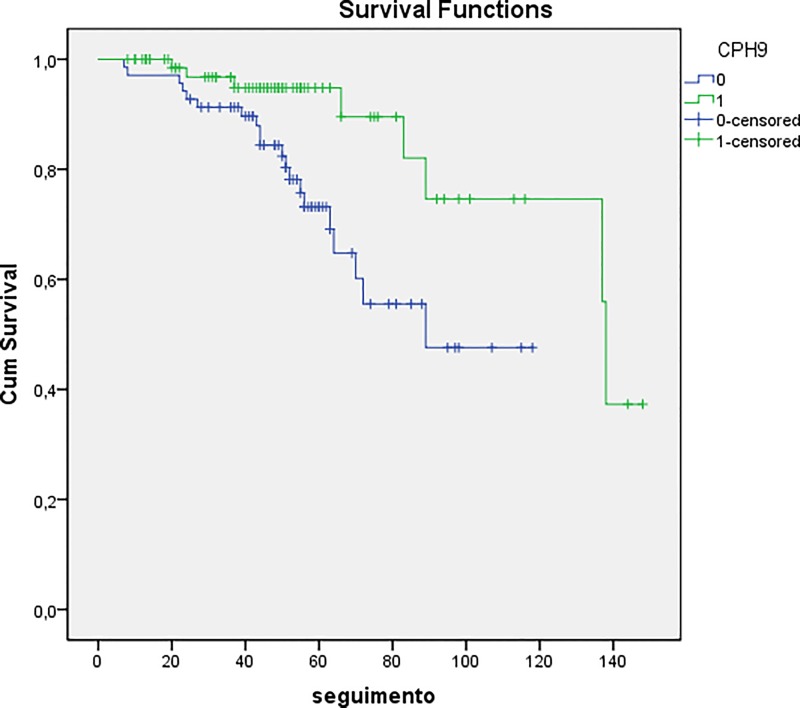
Considering susceptibility, the polymorphic allele in the SNP rs2660753 on chromosome 3 was significantly more prevalent in controls (p = 0.01). For familial clustering, the polymorphic homozygote genotype of the SNP rs7931342 was five times more frequent in patients with familial PC compared to sporadic PC (p = 0.01). Regarding the SNP 1447295, the polymorphic homozygote genotype was more prevalent in patients with organ-confined PC (p = 0.05), and most importantly, the polymorphic allele occurred more frequently in patients without biochemical recurrence (p = 0.01). Kaplan-Meier analysis showed a median biochemical recurrence free survival of 124.2 compared to 85.6 months for patients with the wild-type allele (p = 0.007).
Our findings provide the evidence for the association of 20 recently highlighted SNPs and their susceptibility, familial clustering, staging, Gleason score and biochemical recurrence of PC. We believe that the association between these SNPs and PC may contribute to the development of alternative tools that can facilitate the early detection and prognosis of this disease.
我们的目的是评估20种基因多态性在散发性和家族性前列腺癌(PC)发生发展及预后中的作用。对1997年至2011年期间接受根治性前列腺切除术的185例患者进行了病例对照研究。这些患者根据家族史分为两组。 Gleason分级、前列腺特异性抗原(PSA)值和2002年病理TNM分期用作预后因素。选取70名无PC的男性血液样本作为对照。使用TaqMan® SNP基因分型检测试剂盒对单核苷酸多态性(SNP)进行基因分型。
就易感性而言,3号染色体上SNP rs2660753的多态性等位基因在对照组中显著更常见(p = 0.01)。对于家族聚集性,与散发性PC患者相比,SNP rs7931342的多态性纯合子基因型在家族性PC患者中出现的频率高5倍(p = 0.01)。关于SNP 1447295,多态性纯合子基因型在器官局限性PC患者中更常见(p = 0.05),最重要的是,多态性等位基因在无生化复发的患者中出现的频率更高(p = 0.01)。 Kaplan-Meier分析显示,野生型等位基因患者的生化无复发生存期中位数为124.2个月,而其他患者为85.6个月(p = 0.007)。
我们的研究结果为20种最近备受关注的SNP及其与PC易感性、家族聚集性、分期、Gleason评分和生化复发之间的关联提供了证据。我们认为,这些SNP与PC之间的关联可能有助于开发能够促进该疾病早期检测和预后评估的替代工具。