Kogelman Lisette J A, Fu Jingyuan, Franke Lude, Greve Jan Willem, Hofker Marten, Rensen Sander S, Kadarmideen Haja N
Department of Large Animal Sciences, Faculty of Health and Medical Sciences, University of Copenhagen, Frederiksberg, Denmark.
University of Groningen, University Medical Center Groningen, Department of Genetics, Groningen, The Netherlands.
PLoS One. 2016 Dec 1;11(12):e0167519. doi: 10.1371/journal.pone.0167519. eCollection 2016.
Obesity is associated with severe co-morbidities such as type 2 diabetes and nonalcoholic steatohepatitis. However, studies have shown that 10-25 percent of the severely obese individuals are metabolically healthy. To date, the identification of genetic factors underlying the metabolically healthy obese (MHO) state is limited. Systems genetics approaches have led to the identification of genes and pathways in complex diseases. Here, we have used such approaches across tissues to detect genes and pathways involved in obesity-induced disease development.
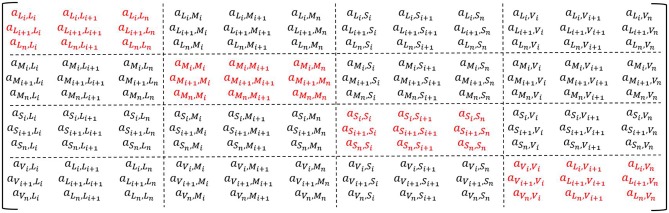
Expression data of 60 severely obese individuals was accessible, of which 28 individuals were MHO and 32 were metabolically unhealthy obese (MUO). A whole genome expression profile of four tissues was available: liver, muscle, subcutaneous adipose tissue and visceral adipose tissue. Using insulin-related genes, we used the weighted gene co-expression network analysis (WGCNA) method to build within- and inter-tissue gene networks. We identified genes that were differentially connected between MHO and MUO individuals, which were further investigated by homing in on the modules they were active in. To identify potentially causal genes, we integrated genomic and transcriptomic data using an eQTL mapping approach.
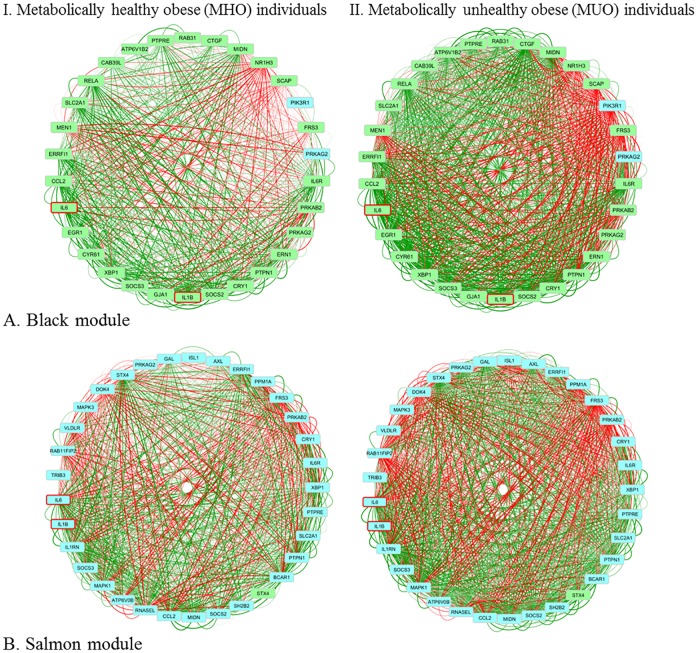
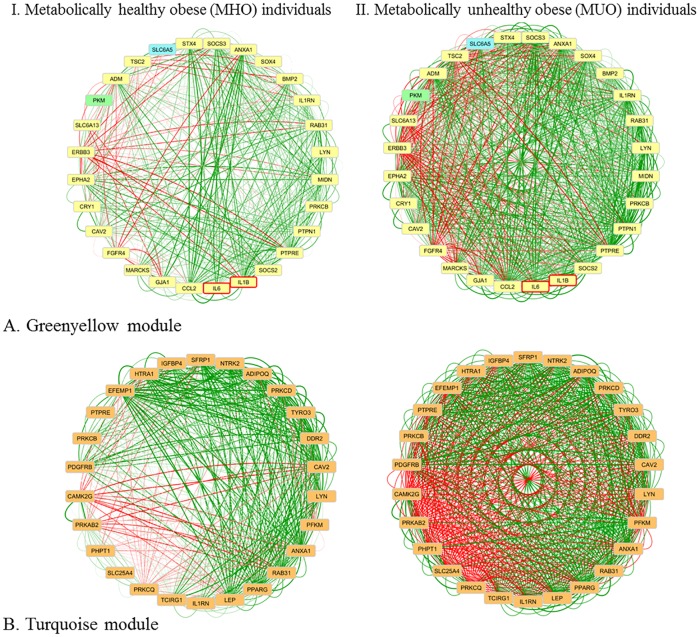
Both IL-6 and IL1B were identified as highly differentially co-expressed genes across tissues between MHO and MUO individuals, showing their potential role in obesity-induced disease development. WGCNA showed that those genes were clustering together within tissues, and further analysis showed different co-expression patterns between MHO and MUO subnetworks. A potential causal role for metabolic differences under similar obesity state was detected for PTPRE, IL-6R and SLC6A5.
We used a novel integrative approach by integration of co-expression networks across tissues to elucidate genetic factors related to obesity-induced metabolic disease development. The identified genes and their interactions give more insight into the genetic architecture of obesity and the association with co-morbidities.
肥胖与2型糖尿病和非酒精性脂肪性肝炎等严重合并症相关。然而,研究表明,10%至25%的重度肥胖个体代谢健康。迄今为止,对代谢健康肥胖(MHO)状态潜在遗传因素的识别有限。系统遗传学方法已促使人们识别复杂疾病中的基因和通路。在此,我们运用此类方法对多种组织进行检测,以发现参与肥胖诱导疾病发展的基因和通路。
获取了60名重度肥胖个体的表达数据,其中28名为MHO个体,32名为代谢不健康肥胖(MUO)个体。有四个组织的全基因组表达谱可供使用:肝脏、肌肉、皮下脂肪组织和内脏脂肪组织。利用胰岛素相关基因,我们采用加权基因共表达网络分析(WGCNA)方法构建组织内和组织间的基因网络。我们识别出MHO和MUO个体之间连接存在差异的基因,并通过聚焦于它们活跃的模块进一步研究这些基因。为了识别潜在的因果基因,我们使用表达定量性状位点(eQTL)定位方法整合基因组和转录组数据。
白细胞介素6(IL-6)和白细胞介素1β(IL1B)均被识别为MHO和MUO个体多种组织间共表达差异极大的基因,表明它们在肥胖诱导疾病发展中具有潜在作用。WGCNA显示这些基因在组织内聚集在一起,进一步分析表明MHO和MUO子网络之间存在不同的共表达模式。对于蛋白酪氨酸磷酸酶受体E(PTPRE)、白细胞介素6受体(IL-6R)和溶质载体家族6成员5(SLC6A5),在相似肥胖状态下检测到其对代谢差异具有潜在因果作用。
我们采用了一种新颖的整合方法,通过整合多种组织的共表达网络来阐明与肥胖诱导代谢疾病发展相关的遗传因素。所识别的基因及其相互作用为肥胖的遗传结构以及与合并症的关联提供了更多见解。