• 文献检索
  • 文档翻译
  • 深度研究
  • 学术资讯
  • Suppr Zotero 插件Zotero 插件
  • 邀请有礼
  • 套餐&价格
  • 历史记录
应用&插件
Suppr Zotero 插件Zotero 插件浏览器插件Mac 客户端Windows 客户端微信小程序
定价
高级版会员购买积分包购买API积分包
服务
文献检索文档翻译深度研究API 文档MCP 服务
关于我们
关于 Suppr公司介绍联系我们用户协议隐私条款
关注我们

Suppr 超能文献

核心技术专利:CN118964589B侵权必究
粤ICP备2023148730 号-1Suppr @ 2026

文献检索

告别复杂PubMed语法,用中文像聊天一样搜索,搜遍4000万医学文献。AI智能推荐,让科研检索更轻松。

立即免费搜索

文件翻译

保留排版,准确专业,支持PDF/Word/PPT等文件格式,支持 12+语言互译。

免费翻译文档

深度研究

AI帮你快速写综述,25分钟生成高质量综述,智能提取关键信息,辅助科研写作。

立即免费体验

医院内非可电击心律的院内心脏骤停患者使用肾上腺素的时间差异

Hospital Variation in Time to Epinephrine for Nonshockable In-Hospital Cardiac Arrest.

作者信息

Khera Rohan, Chan Paul S, Donnino Michael, Girotra Saket

机构信息

From Division of Cardiology, UT Southwestern Medical Center, Dallas, TX (R.K.); Saint Luke's Mid America Heart and Vascular Institute, Kansas City, and University of Missouri-Kansas City (P.S.C.); Department of Emergency Medicine, Beth Israel Deaconess Medical Center, Boston, MA (M.D.); Division of Pulmonary and Critical Care Medicine, Department of Medicine, Beth Israel Deaconess Medical Center, Boston, MA (M.D.); Division of Cardiovascular Medicine, Department of Internal Medicine, University of Iowa Carver College of Medicine, Iowa City (S.G.).

出版信息

Circulation. 2016 Dec 20;134(25):2105-2114. doi: 10.1161/CIRCULATIONAHA.116.025459. Epub 2016 Dec 1.

DOI:10.1161/CIRCULATIONAHA.116.025459
PMID:27908910
原文链接:https://pmc.ncbi.nlm.nih.gov/articles/PMC5173427/
Abstract

BACKGROUND

For patients with in-hospital cardiac arrests attributable to nonshockable rhythms, delays in epinephrine administration beyond 5 minutes is associated with worse survival. However, the extent of hospital variation in delayed epinephrine administration and its effect on hospital-level outcomes is unknown.

METHODS

Within Get With The Guidelines-Resuscitation, we identified 103 932 adult patients (≥18 years) at 548 hospitals with an in-hospital cardiac arrest attributable to a nonshockable rhythm who received at least 1 dose of epinephrine between 2000 and 2014. We constructed 2-level hierarchical regression models to quantify hospital variation in rates of delayed epinephrine administration (>5 minutes) and its association with hospital rates of survival to discharge and survival with functional recovery.

RESULTS

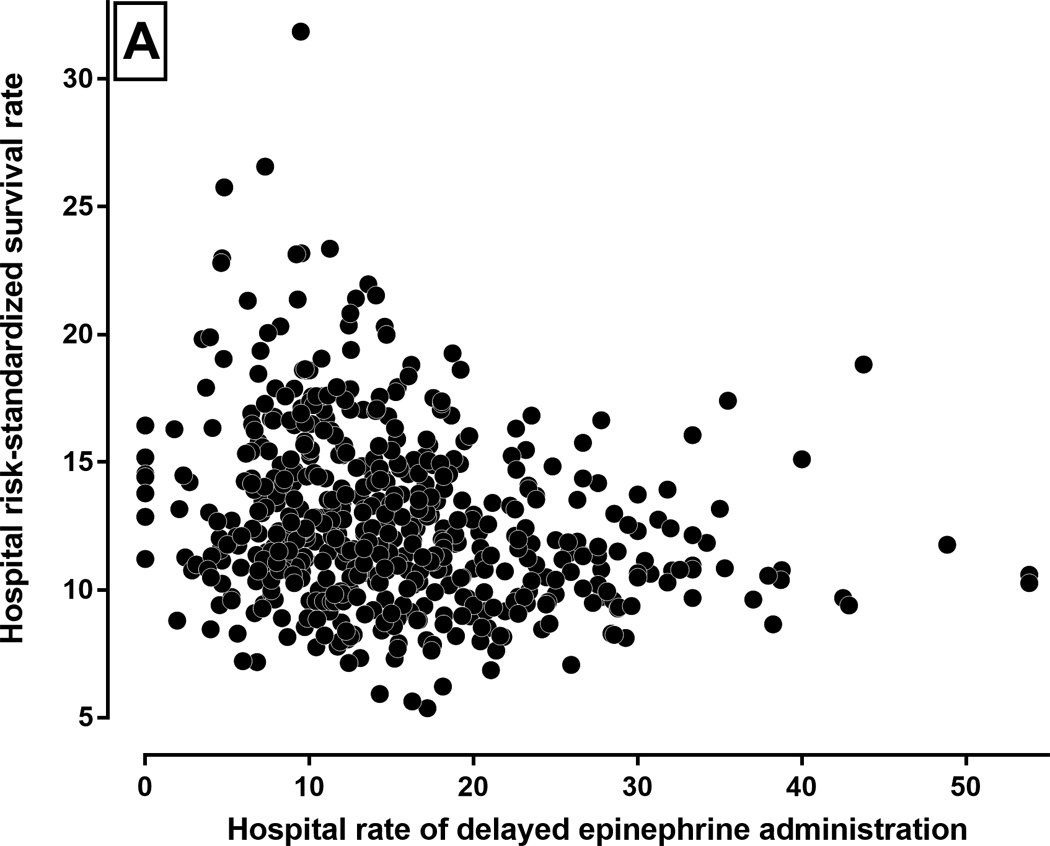
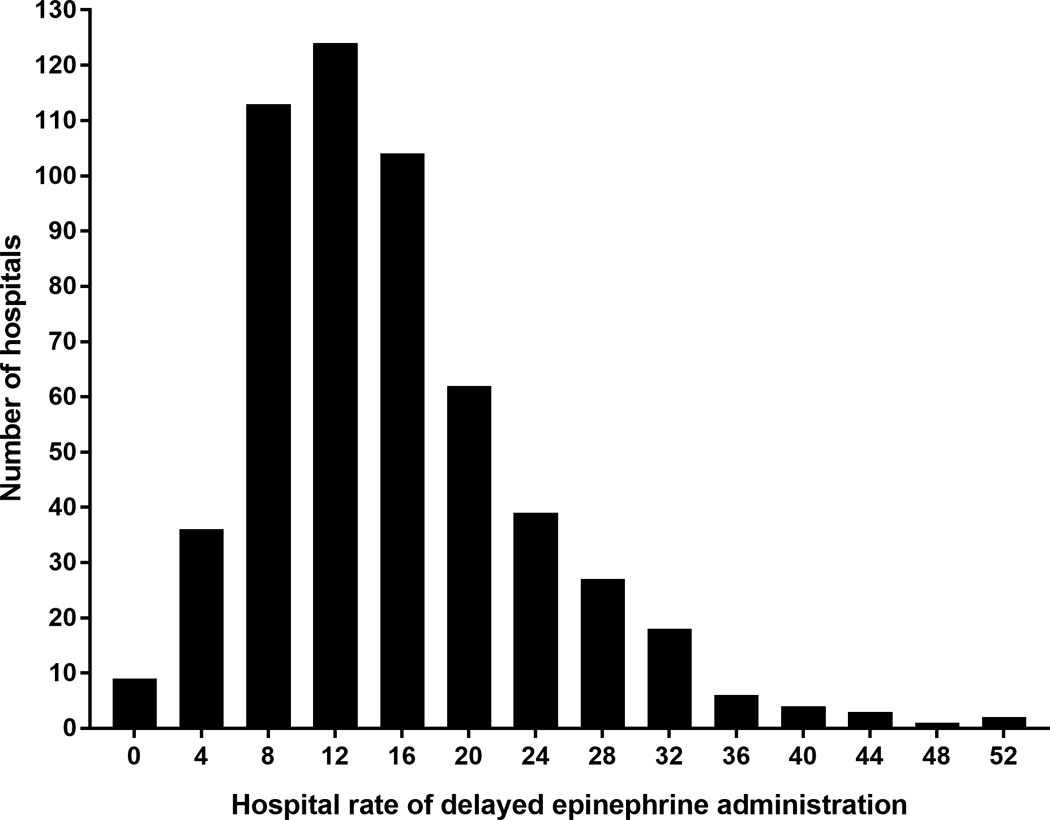
Overall, 13 213 (12.7%) patients had delays to epinephrine, and this rate varied markedly across hospitals (range, 0%-53.8%). The odds of delay in epinephrine administration were 58% higher at 1 randomly selected hospital in comparison with a similar patient at another randomly selected hospital (median odds ratio, 1.58; 95% confidence interval, 1.51-1.64). The median risk-standardized survival rate was 12.0% (range, 5.4%-31.9%), and the risk-standardized survival with functional recovery was 7.4% (range, 0.9%-30.8%). There was an inverse correlation between a hospital's rate of delayed epinephrine administration and its risk-standardized rate of survival to discharge (ρ=-0.22, P<0.0001) and survival with functional recovery (ρ=-0.14, P=0.001). In comparison with a median survival rate of 12.9% (interquartile range, 11.1%-15.4%) at hospitals in the lowest quartile of epinephrine delay, risk-standardized survival was 16% lower at hospitals in the quartile with the highest rate of epinephrine delays (10.8%; interquartile range, 9.7%-12.7%).

CONCLUSIONS

Delays in epinephrine administration following in-hospital cardiac arrest are common and variy across hospitals. Hospitals with high rates of delayed epinephrine administration had lower rates of overall survival for in-hospital cardiac arrest attributable to nonshockable rhythm. Further studies are needed to determine whether improving hospital performance on time to epinephrine administration, especially at hospitals with poor performance on this metric, will lead to improved outcomes.

摘要

背景

对于因不可电击心律导致的院内心脏骤停患者,肾上腺素给药延迟超过5分钟与较差的生存率相关。然而,医院在肾上腺素给药延迟方面的差异程度及其对医院层面结局的影响尚不清楚。

方法

在“遵循指南-复苏”项目中,我们在548家医院识别出103932例成年患者(≥18岁),这些患者因不可电击心律导致院内心脏骤停,且在2000年至2014年期间接受了至少一剂肾上腺素治疗。我们构建了两级分层回归模型,以量化肾上腺素给药延迟率(>5分钟)的医院差异及其与出院生存率和功能恢复后生存率的医院发生率之间的关联。

结果

总体而言,13213例(12.7%)患者存在肾上腺素给药延迟,且该比率在各医院之间差异显著(范围为0%至53.8%)。与另一家随机选择医院的类似患者相比,在一家随机选择医院中肾上腺素给药延迟的几率高58%(中位数优势比,1.58;95%置信区间,1.51至1.64)。风险标准化生存率中位数为12.0%(范围为5.4%至31.9%),功能恢复后风险标准化生存率为7.4%(范围为0.9%至30.8%)。医院的肾上腺素给药延迟率与其风险标准化出院生存率(ρ=-0.22,P<0.0001)和功能恢复后生存率(ρ=-0.14,P=0.001)之间存在负相关。与肾上腺素延迟率处于最低四分位数的医院的生存率中位数12.9%(四分位间距,11.1%至15.4%)相比,肾上腺素延迟率最高四分位数的医院的风险标准化生存率低16%(10.8%;四分位间距,9.7%至12.7%)。

结论

院内心脏骤停后肾上腺素给药延迟很常见,且各医院之间存在差异。肾上腺素给药延迟率高的医院,因不可电击心律导致的院内心脏骤停的总体生存率较低。需要进一步研究以确定改善医院在肾上腺素给药及时性方面的表现,尤其是在该指标表现较差的医院,是否会导致结局改善。
https://cdn.ncbi.nlm.nih.gov/pmc/blobs/5531/5173427/fd3508463fd8/nihms829706f2a.jpg
https://cdn.ncbi.nlm.nih.gov/pmc/blobs/5531/5173427/40e4ce6413b2/nihms829706f1.jpg
https://cdn.ncbi.nlm.nih.gov/pmc/blobs/5531/5173427/fd3508463fd8/nihms829706f2a.jpg
https://cdn.ncbi.nlm.nih.gov/pmc/blobs/5531/5173427/40e4ce6413b2/nihms829706f1.jpg
https://cdn.ncbi.nlm.nih.gov/pmc/blobs/5531/5173427/fd3508463fd8/nihms829706f2a.jpg

相似文献

1
Hospital Variation in Time to Epinephrine for Nonshockable In-Hospital Cardiac Arrest.医院内非可电击心律的院内心脏骤停患者使用肾上腺素的时间差异
Circulation. 2016 Dec 20;134(25):2105-2114. doi: 10.1161/CIRCULATIONAHA.116.025459. Epub 2016 Dec 1.
2
The Association of Hospital Rate of Delayed Epinephrine Administration With Survival to Discharge for Pediatric Nonshockable In-Hospital Cardiac Arrest.医院延迟给予肾上腺素治疗与儿科非心源性院内心跳骤停患者出院存活率的关联。
Pediatr Crit Care Med. 2019 May;20(5):405-416. doi: 10.1097/PCC.0000000000001863.
3
Time to Epinephrine Administration and Survival From Nonshockable Out-of-Hospital Cardiac Arrest Among Children and Adults.肾上腺素给药时间与儿童和成人非心源性院外心脏骤停的生存关系。
Circulation. 2018 May 8;137(19):2032-2040. doi: 10.1161/CIRCULATIONAHA.117.033067. Epub 2018 Mar 6.
4
Time to Epinephrine and Survival After Pediatric In-Hospital Cardiac Arrest.小儿院内心脏骤停后使用肾上腺素的时间与生存率
JAMA. 2015 Aug 25;314(8):802-10. doi: 10.1001/jama.2015.9678.
5
Hospital Variation in Epinephrine Administration Before Defibrillation for Cardiac Arrest Due to Shockable Rhythm.因可除颤节律导致心搏骤停时肾上腺素给药在医院间的差异。
Crit Care Med. 2024 Jun 1;52(6):878-886. doi: 10.1097/CCM.0000000000006203. Epub 2024 Feb 7.
6
Time to administration of epinephrine and outcome after in-hospital cardiac arrest with non-shockable rhythms: retrospective analysis of large in-hospital data registry.肾上腺素给药时间与院内非心搏骤停节律患者预后的关系:大型院内数据注册的回顾性分析。
BMJ. 2014 May 20;348:g3028. doi: 10.1136/bmj.g3028.
7
Delays in Cardiopulmonary Resuscitation, Defibrillation, and Epinephrine Administration All Decrease Survival in In-hospital Cardiac Arrest.心肺复苏、除颤和肾上腺素给药的延迟均降低院内心搏骤停患者的生存率。
Anesthesiology. 2019 Mar;130(3):414-422. doi: 10.1097/ALN.0000000000002563.
8
Association of Hospital-Level Acute Resuscitation and Postresuscitation Survival With Overall Risk-Standardized Survival to Discharge for In-Hospital Cardiac Arrest.医院层面的急救复苏和复苏后存活与院内心脏骤停患者总体风险标准化出院后存活率的关联。
JAMA Netw Open. 2020 Jul 1;3(7):e2010403. doi: 10.1001/jamanetworkopen.2020.10403.
9
Association of Timing of Epinephrine Administration With Outcomes in Adults With Out-of-Hospital Cardiac Arrest.院外心脏骤停成年患者肾上腺素给药时机与预后的关联
JAMA Netw Open. 2021 Aug 2;4(8):e2120176. doi: 10.1001/jamanetworkopen.2021.20176.
10
Survival outcomes and resuscitation process measures in maternal in-hospital cardiac arrest.产妇院内心搏骤停的生存结局和复苏过程措施。
Am J Obstet Gynecol. 2022 Mar;226(3):401.e1-401.e10. doi: 10.1016/j.ajog.2021.09.046. Epub 2021 Oct 22.

引用本文的文献

1
Survival Differences in Asian and Hispanic Patients With In-Hospital Cardiac Arrest.亚洲和西班牙裔住院心脏骤停患者的生存差异
J Am Heart Assoc. 2025 Jan 7;14(1):e037876. doi: 10.1161/JAHA.124.037876. Epub 2024 Dec 18.
2
Correlation between hospital rates of survival to discharge and long-term survival for in-hospital cardiac arrest: Insights from Get With The Guidelines®-Resuscitation registry.住院心脏骤停患者出院生存率与长期生存率之间的相关性:来自“遵循指南®-复苏”注册研究的见解
Resuscitation. 2024 Sep;202:110322. doi: 10.1016/j.resuscitation.2024.110322. Epub 2024 Jul 18.
3
Heart Disease and Stroke Statistics-2023 Update: A Report From the American Heart Association.

本文引用的文献

1
Regional Variation in Out-of-Hospital Cardiac Arrest Survival in the United States.美国院外心脏骤停生存率的地区差异。
Circulation. 2016 May 31;133(22):2159-68. doi: 10.1161/CIRCULATIONAHA.115.018175. Epub 2016 Apr 14.
2
Part 7: Adult Advanced Cardiovascular Life Support: 2015 American Heart Association Guidelines Update for Cardiopulmonary Resuscitation and Emergency Cardiovascular Care.第7部分:成人高级心血管生命支持:2015年美国心脏协会心肺复苏及心血管急救指南更新
Circulation. 2015 Nov 3;132(18 Suppl 2):S444-64. doi: 10.1161/CIR.0000000000000261.
3
Time to Epinephrine and Survival After Pediatric In-Hospital Cardiac Arrest.
《心脏病与卒中统计数据-2023 更新:美国心脏协会报告》。
Circulation. 2023 Feb 21;147(8):e93-e621. doi: 10.1161/CIR.0000000000001123. Epub 2023 Jan 25.
4
Time in therapeutic range for targeted temperature management and outcomes following out-of-hospital cardiac arrest.目标温度管理的治疗时间窗与院外心脏骤停后结局。
Resuscitation. 2023 Jan;182:109650. doi: 10.1016/j.resuscitation.2022.11.016. Epub 2022 Nov 25.
5
Delayed administration of epinephrine is associated with worse neurological outcomes in patients with out-of-hospital cardiac arrest and initial pulseless electrical activity: insight from the nationwide multicentre observational JAAM-OHCA (Japan Association for Acute Medicine) registry.延迟肾上腺素给药与院外心脏骤停和初始无脉电活动患者的神经功能预后较差相关:来自全国多中心观察性 JAAM-OHCA(日本急救医学协会)登记研究的见解。
Eur Heart J Acute Cardiovasc Care. 2022 Jun 14;11(5):389-396. doi: 10.1093/ehjacc/zuac026.
6
Outcomes of Early versus Late Endotracheal Intubation in Patients with Initial Non-Shockable Rhythm Cardiopulmonary Arrest in the Emergency Department.急诊科初始非可电击心律心肺骤停患者早期与晚期气管插管的结局
Emerg Med Int. 2021 Dec 28;2021:2112629. doi: 10.1155/2021/2112629. eCollection 2021.
7
Epinephrine before defibrillation in patients with shockable in-hospital cardiac arrest: propensity matched analysis.院内可电击心律心脏骤停患者除颤前使用肾上腺素:倾向匹配分析
BMJ. 2021 Nov 10;375:e066534. doi: 10.1136/bmj-2021-066534.
8
Immediate intravenous epinephrine versus early intravenous epinephrine for in-hospital cardiopulmonary arrest.院内心搏骤停时即刻静脉内给予肾上腺素与早期静脉内给予肾上腺素的比较。
BMC Anesthesiol. 2021 May 13;21(1):147. doi: 10.1186/s12871-021-01346-1.
9
Association of Hospital-Level Acute Resuscitation and Postresuscitation Survival With Overall Risk-Standardized Survival to Discharge for In-Hospital Cardiac Arrest.医院层面的急救复苏和复苏后存活与院内心脏骤停患者总体风险标准化出院后存活率的关联。
JAMA Netw Open. 2020 Jul 1;3(7):e2010403. doi: 10.1001/jamanetworkopen.2020.10403.
10
Mobile App to Improve House Officers' Adherence to Advanced Cardiac Life Support Guidelines: Quality Improvement Study.移动应用程序改善住院医师对高级心脏生命支持指南的依从性:质量改进研究。
JMIR Mhealth Uhealth. 2020 May 19;8(5):e15762. doi: 10.2196/15762.
小儿院内心脏骤停后使用肾上腺素的时间与生存率
JAMA. 2015 Aug 25;314(8):802-10. doi: 10.1001/jama.2015.9678.
4
Strategies to Improve Survival From Cardiac Arrest: A Report From the Institute of Medicine.提高心脏骤停存活率的策略:美国国家医学院报告
JAMA. 2015 Jul 21;314(3):223-4. doi: 10.1001/jama.2015.8454.
5
Is epinephrine during cardiac arrest associated with worse outcomes in resuscitated patients?心肺复苏期间使用肾上腺素是否会导致复苏患者的预后更差?
J Am Coll Cardiol. 2014 Dec 9;64(22):2360-7. doi: 10.1016/j.jacc.2014.09.036. Epub 2014 Dec 1.
6
Simulation exercise to improve retention of cardiopulmonary resuscitation priorities for in-hospital cardiac arrests: A randomized controlled trial.提高院内心脏骤停心肺复苏优先顺序记忆的模拟演练:一项随机对照试验。
Resuscitation. 2015 Jan;86:6-13. doi: 10.1016/j.resuscitation.2014.10.021. Epub 2014 Nov 11.
7
Time to administration of epinephrine and outcome after in-hospital cardiac arrest with non-shockable rhythms: retrospective analysis of large in-hospital data registry.肾上腺素给药时间与院内非心搏骤停节律患者预后的关系:大型院内数据注册的回顾性分析。
BMJ. 2014 May 20;348:g3028. doi: 10.1136/bmj.g3028.
8
Evaluation of pre-hospital administration of adrenaline (epinephrine) by emergency medical services for patients with out of hospital cardiac arrest in Japan: controlled propensity matched retrospective cohort study.日本院外心脏骤停患者的急救医疗服务中肾上腺素(去甲肾上腺素)的院前给药评估:对照倾向评分匹配回顾性队列研究。
BMJ. 2013 Dec 10;347:f6829. doi: 10.1136/bmj.f6829.
9
Effects of prehospital epinephrine during out-of-hospital cardiac arrest with initial non-shockable rhythm: an observational cohort study.院外心脏骤停初始为不可电击心律时院前使用肾上腺素的效果:一项观察性队列研究
Crit Care. 2013 Sep 3;17(5):R188. doi: 10.1186/cc12872.
10
Risk-standardizing survival for in-hospital cardiac arrest to facilitate hospital comparisons.风险校正院内心脏骤停的生存率,以促进医院间比较。
J Am Coll Cardiol. 2013 Aug 13;62(7):601-9. doi: 10.1016/j.jacc.2013.05.051. Epub 2013 Jun 13.