Bertrand Elodie, Landeira-Fernandez Jesus, Mograbi Daniel C
Department of Psychology, Pontifícia Universidade Católica do Rio de Janeiro Rio de Janeiro, Brazil.
Department of Psychology, Pontifícia Universidade Católica do Rio de JaneiroRio de Janeiro, Brazil; Institute of Psychiatry, Psychology and Neuroscience, King's College LondonLondon, UK.
Front Psychol. 2016 Nov 17;7:1812. doi: 10.3389/fpsyg.2016.01812. eCollection 2016.
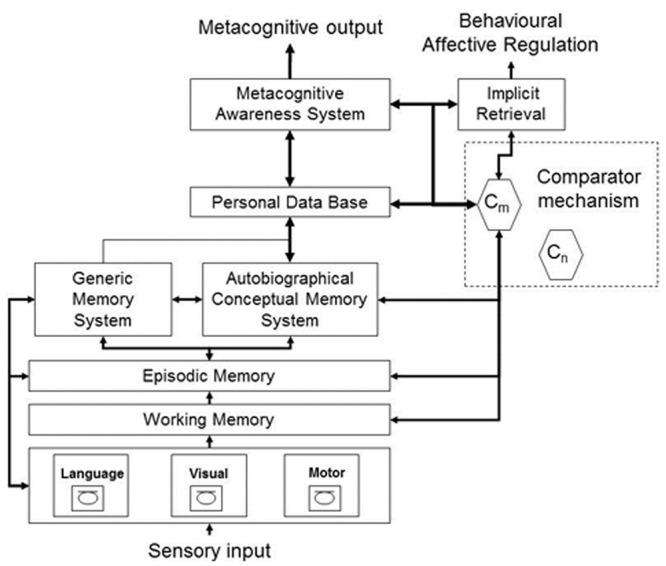
Metacognition refers to the monitoring and regulation of cognitive processes and its impairment can lead to a lack of self-awareness of deficits, or anosognosia. In the context of different neurological and psychiatric disorders (e.g., traumatic brain injury, dementia, and schizophrenia), studies have shown that patients who present impairments in metacognitive abilities may be able to recognize such difficulties in others and in themselves when exposed to material in a third-person perspective. Considering that metacognitive impairments are an important characteristic of dementia, especially in Alzheimer's Disease (AD), studies of the relationship between metacognition and perspective-taking may be relevant to improve the quality of life of people with dementia. The current paper first briefly addresses the theme of metacognition and the impact of metacognitive deficits in people with AD. The focus then turns to the relationship between metacognition and perspective-taking in different neurological and psychiatric disorders, particularly AD. This relationship is also discussed based on theoretical models, particularly the Cognitive Awareness Model (CAM). Specifically, the CAM suggests the existence of distinct memory systems for self- and other-information, an idea which is supported by neuroimaging findings. We suggest that the Default Mode Network, as it has been shown to be implicated in self vs. other processing and is affected early in AD, could explain the impact of perspective-taking on awareness of deficits in AD. Finally, we present possible clinical implications of the relationship between metacognition and perspective-taking in AD. Indeed, we considered the possibility of improving patient's awareness through the use of a third-person perspective, which, consequently, may decrease the negative impacts of anosognosia in AD.
元认知是指对认知过程的监测和调节,其受损会导致对缺陷缺乏自我意识,即疾病感缺失。在不同的神经和精神疾病(如创伤性脑损伤、痴呆症和精神分裂症)背景下,研究表明,元认知能力受损的患者在以第三人称视角接触相关材料时,可能能够识别他人和自己身上的此类困难。鉴于元认知受损是痴呆症尤其是阿尔茨海默病(AD)的一个重要特征,对元认知与换位思考之间关系的研究可能有助于提高痴呆症患者的生活质量。本文首先简要阐述元认知主题以及元认知缺陷对AD患者的影响。接着重点转向不同神经和精神疾病尤其是AD中,元认知与换位思考之间的关系。这种关系也基于理论模型进行讨论,特别是认知意识模型(CAM)。具体而言,CAM表明存在用于自我和他人信息的不同记忆系统,这一观点得到了神经影像学研究结果的支持。我们认为,默认模式网络因其已被证明与自我与他人加工有关且在AD早期就受到影响,可能解释了换位思考对AD患者缺陷意识的影响。最后,我们阐述了AD中元认知与换位思考之间关系可能的临床意义。事实上,我们考虑了通过使用第三人称视角来提高患者意识的可能性,这可能会减少AD中疾病感缺失的负面影响。