Dahlbäck Cecilia, Manjer Jonas, Rehn Martin, Ringberg Anita
Department of Plastic and Reconstructive Surgery, Skåne University Hospital, Jan Waldenströmsgata 18, 205 02, Malmö, Sweden.
Department of Clinical Sciences, Lund University, Malmö, Sweden.
World J Surg Oncol. 2016 Dec 7;14(1):303. doi: 10.1186/s12957-016-1053-8.
With the development of new surgical techniques in breast cancer, such as oncoplastic breast surgery, increased knowledge of risk factors for poor satisfaction with conventional breast-conserving surgery (BCS) is needed in order to determine which patients to offer these techniques to. The aim of this study was to investigate patient satisfaction regarding aesthetic result and skin sensitivity in relation to patient, tumour, and treatment factors, in a consecutive sample of patients undergoing conventional BCS.
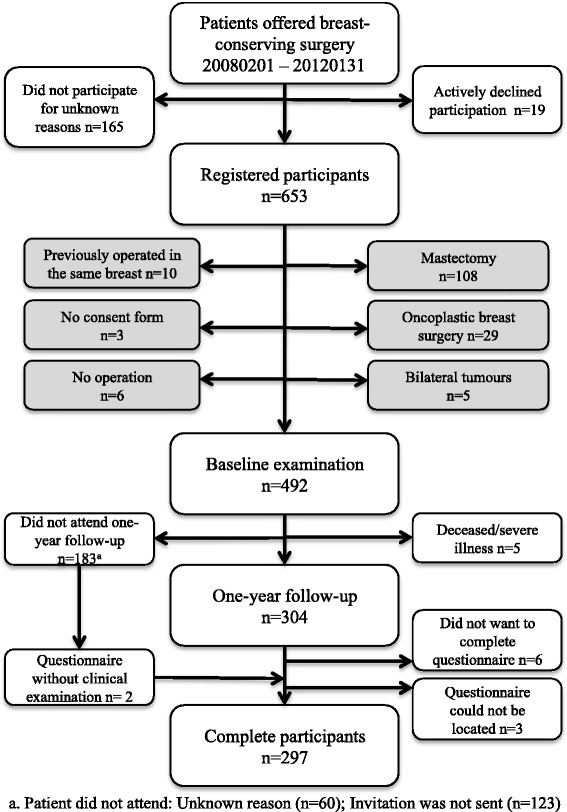
Women eligible for BCS were recruited between February 1, 2008 and January 31, 2012 in a prospective setup. In all, 297 women completed a study-specific questionnaire 1 year after conventional BCS and radiotherapy. Potential risk factors for poor satisfaction were investigated using logistic regression analysis.
The great majority of the women, 84%, were satisfied or very satisfied with the overall aesthetic result. The rate of satisfaction regarding symmetry between the breasts was 68% and for skin sensitivity in the operated breast it was 67%. Excision of more than 20% of the preoperative breast volume was associated with poor satisfaction regarding overall aesthetic outcome, as was axillary clearance. A high BMI (≥30 kg/m) seemed to affect satisfaction with symmetry negatively. Factors associated with less satisfied patients regarding skin sensitivity in the operated breast were an excision of ≥20% of preoperative breast volume, a BMI of 25-30 kg/m, axillary clearance, and radiotherapy. Re-excision and postoperative infection were associated with lower rates of satisfaction regarding both overall aesthetic outcome and symmetry, as well as with skin sensitivity.
Several factors affect patient satisfaction after BCS. A major determinant of poor satisfaction in this study was a large excision of breast volume. If the percentage of breast volume excised is estimated to exceed 20%, other techniques, such as oncoplastic breast surgery, with or without contralateral surgery, or mastectomy with reconstruction, may be considered.
随着乳腺癌新手术技术的发展,如肿瘤整形乳房手术,为了确定哪些患者适合采用这些技术,需要更多地了解传统保乳手术(BCS)患者满意度低的风险因素。本研究的目的是在接受传统BCS的连续患者样本中,调查患者对美学效果和皮肤敏感性的满意度与患者、肿瘤及治疗因素之间的关系。
在2008年2月1日至2012年1月31日期间,以前瞻性研究的方式招募符合BCS条件的女性。共有297名女性在接受传统BCS和放疗1年后完成了一份针对该研究的问卷。使用逻辑回归分析研究满意度低的潜在风险因素。
绝大多数女性(84%)对整体美学效果感到满意或非常满意。乳房对称性的满意度为68%,手术侧乳房皮肤敏感性的满意度为67%。术前乳房体积切除超过20%与整体美学效果满意度低相关,腋窝清扫也是如此。高体重指数(≥30kg/m²)似乎对对称性满意度有负面影响。手术侧乳房皮肤敏感性方面,与满意度较低的患者相关的因素包括术前乳房体积切除≥20%、体重指数为25 - 30kg/m²、腋窝清扫和放疗。再次切除和术后感染与整体美学效果、对称性以及皮肤敏感性的较低满意度相关。
BCS术后有几个因素会影响患者满意度。本研究中满意度低的一个主要决定因素是乳房体积切除量大。如果估计乳房体积切除百分比超过20%,可考虑其他技术,如肿瘤整形乳房手术(有或无对侧手术),或乳房切除术后重建,或乳房切除术。