Huang Jeng-Yi, Hsu Ching-Wei, Yang Chih-Wei, Hung Cheng-Chieh, Huang Wen-Hung
Kidney Research Center, Department of Nephrology, Chang Gung Memorial Hospital, Linkou Branch, Taipei; Chang Gung University School of Medicine, Taoyuan, Taiwan.
Ther Clin Risk Manag. 2016 Nov 28;12:1797-1803. doi: 10.2147/TCRM.S120012. eCollection 2016.
Experimental evidence suggests that indoxyl sulfate (IS) is associated with chronic kidney disease-related anemia. However, clinical studies are limited, and few have explored the potential confounding effect of anuria. This study, thus, evaluated the association between IS and anemia in both non-anuric and anuric peritoneal dialysis (PD) patients.
This cross-sectional and observational study included 165 chronic PD patients aged 19-84 years. Their serum IS levels in total and free forms were measured by ultra performance liquid chromatography. Correlations between serum IS and hemoglobin (Hb) were performed in both non-anuric and anuric groups.
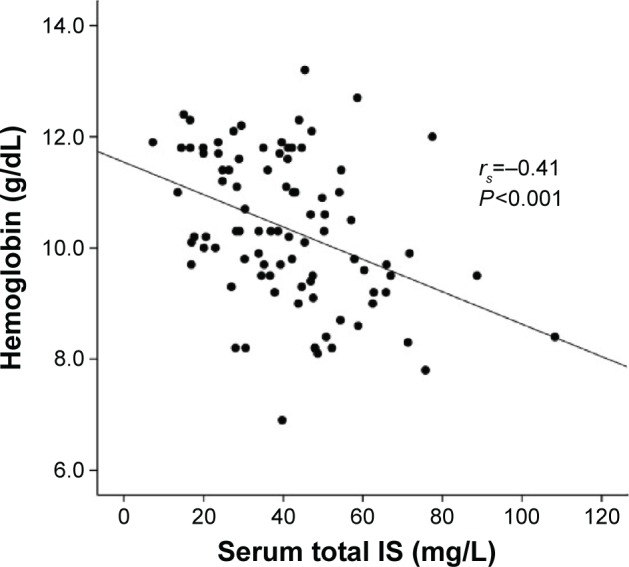
Among the study subjects, 90 were non-anuric and 75 were anuric. As a whole, there was no correlation between IS and Hb. Nonetheless, subsequent analysis of the non-anuric patients showed that Hb is negatively correlated with IS levels ( =-0.405, <0.001 for total form and =-0.296, =0.005 for free form). Factors that significantly affected Hb levels in the stepwise multiple regression analysis include total IS and iron saturation. In contrast for anuric patients, serum ferritin, albumin, iron saturation, use of angiotensin-converting enzyme inhibitor/angiotensin II receptor blocker, but not serum IS, were predictors for anemia in the multiple regression model.
Serum IS is associated with an increased severity of anemia in non-anuric PD patients and not in anuric ones, indicating anuria could be a confounding factor in such association.
实验证据表明,硫酸吲哚酚(IS)与慢性肾脏病相关贫血有关。然而,临床研究有限,且很少有研究探讨无尿的潜在混杂效应。因此,本研究评估了非无尿和无尿腹膜透析(PD)患者中IS与贫血之间的关联。
这项横断面观察性研究纳入了165例年龄在19至84岁之间的慢性PD患者。通过超高效液相色谱法测量其血清中总形式和游离形式的IS水平。在非无尿组和无尿组中分别进行血清IS与血红蛋白(Hb)之间的相关性分析。
在研究对象中,90例为非无尿患者,75例为无尿患者。总体而言,IS与Hb之间无相关性。尽管如此,对非无尿患者的后续分析表明,Hb与IS水平呈负相关(总形式:r = -0.405,P < 0.001;游离形式:r = -0.296,P = 0.005)。逐步多元回归分析中显著影响Hb水平的因素包括总IS和铁饱和度。相比之下,对于无尿患者,血清铁蛋白、白蛋白、铁饱和度、使用血管紧张素转换酶抑制剂/血管紧张素II受体阻滞剂是多元回归模型中贫血的预测因素,而血清IS不是。
血清IS与非无尿PD患者贫血严重程度增加相关,而与无尿患者无关,表明无尿可能是这种关联中的一个混杂因素。