
一个极度贫金属星系中的一氧化碳。
Carbon monoxide in an extremely metal-poor galaxy.
机构信息
School of Astronomy and Space Science, Nanjing University, Nanjing 210093, China.
Key Laboratory of Modern Astronomy and Astrophysics (Nanjing University), Ministry of Education, Nanjing 210093, China.
出版信息
Nat Commun. 2016 Dec 9;7:13789. doi: 10.1038/ncomms13789.
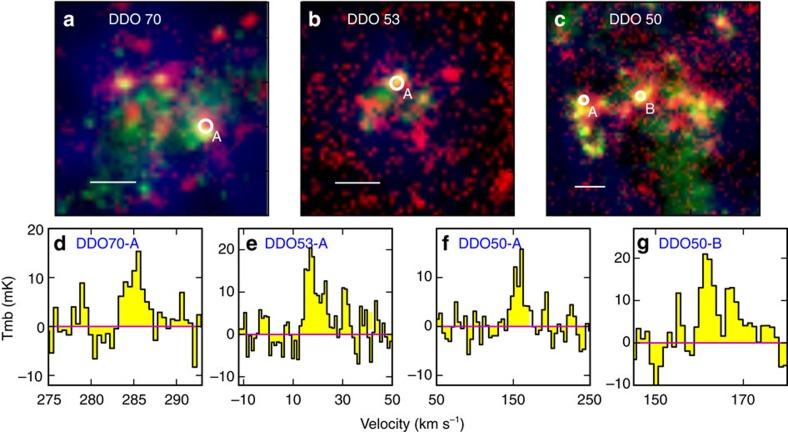
Extremely metal-poor galaxies with metallicity below 10% of the solar value in the local universe are the best analogues to investigating the interstellar medium at a quasi-primitive environment in the early universe. In spite of the ongoing formation of stars in these galaxies, the presence of molecular gas (which is known to provide the material reservoir for star formation in galaxies such as our Milky Way) remains unclear. Here we report the detection of carbon monoxide (CO), the primary tracer of molecular gas, in a galaxy with 7% solar metallicity, with additional detections in two galaxies at higher metallicities. Such detections offer direct evidence for the existence of molecular gas in these galaxies that contain few metals. Using archived infrared data, it is shown that the molecular gas mass per CO luminosity at extremely low metallicity is approximately one-thousand times the Milky Way value.
在本地宇宙中,金属丰度低于太阳值 10%的极度贫金属星系是研究早期宇宙中星际介质的最佳类似物。尽管这些星系中仍在持续形成恒星,但分子气体的存在(众所周知,分子气体是银河系等星系中恒星形成的物质储备)仍不清楚。在这里,我们报告了在一个金属丰度为 7%的太阳星系中检测到了一氧化碳(CO),这是分子气体的主要示踪剂,并且在两个金属丰度更高的星系中也有额外的检测结果。这些检测结果为这些金属含量很少的星系中存在分子气体提供了直接证据。利用存档的红外数据,表明在极低金属丰度下,每单位 CO 光度的分子气体质量大约是银河系的一千倍。


 Zotero 插件