Mattson Christine L, Bradley Heather, Beer Linda, Johnson Christopher, Pearson William S, Shouse R Luke
Division of HIV/AIDS Prevention, Centers for Disease Control, 1600 Clifton Road NE, MS E-46, Atlanta, GA, USA.
Division of STD Prevention, National Center for HIV/AIDS, Viral Hepatitis, STD, and TB Prevention, Centers for Disease Control and Prevention, Atlanta, Georgia, USA.
Clin Infect Dis. 2017 Mar 1;64(5):629-634. doi: 10.1093/cid/ciw834.
Current guidelines recommend that all sexually active human immunodeficiency virus (HIV)-infected persons be tested at least annually for syphilis, chlamydia, and gonorrhea. We examined temporal trends in syphilis, chlamydia, and gonorrhea testing among sexually active HIV-infected adults receiving medical care in the United States during 2009-2013.
Using medical record data from the Medical Monitoring Project, a population-based HIV surveillance system, we assessed the proportion of adults receiving HIV medical care who were tested for syphilis, chlamydia, and gonorrhea in the past 12 months by year and stratified by sex and sexual behavior, age, and race/ethnicity.
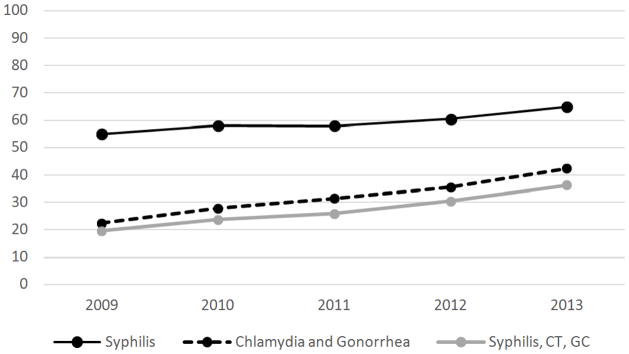
During 2009-2013, the proportion of sexually active HIV-infected adults receiving medical care who were tested in the past year for all 3 examined sexually transmitted diseases (STDs) increased from 20% to 36% (PTREND < .01). Overall testing for syphilis increased from 55% to 65% (PTREND < .01), and significant increases were noted for the following subgroups: men who have sex with men (58% to 69%), non-Hispanic whites (48% to 64%), and all age groups with the exception of persons aged 18-29 year. Overall testing for chlamydia and gonorrhea increased from 22% to 42% (PTREND < .01), and significant increases were noted for most subgroups.
STD testing significantly increased among sexually active HIV-infected adults receiving medical care; however, the majority of persons were not tested for all 3 STDs in 2013. While increased testing indicates progress, testing remained far below recommended guidelines. Our findings suggest enhanced efforts may be warranted to screen all sexually active HIV-infected adults for syphilis, chlamydia, and gonorrhea.
当前指南建议,所有有性行为的人类免疫缺陷病毒(HIV)感染者应至少每年接受梅毒、衣原体和淋病检测。我们研究了2009年至2013年期间在美国接受医疗护理的有性行为的HIV感染成年人中梅毒、衣原体和淋病检测的时间趋势。
利用基于人群的HIV监测系统——医疗监测项目的病历数据,我们评估了接受HIV医疗护理的成年人中,在过去12个月内按年份、性别和性行为、年龄以及种族/民族分层接受梅毒、衣原体和淋病检测的比例。
在2009年至2013年期间,接受医疗护理的有性行为的HIV感染成年人中,过去一年接受所有3种检测的性传播疾病(STD)检测的比例从20%增至36%(P趋势<.01)。梅毒总体检测率从55%增至65%(P趋势<.01),以下亚组有显著增加:男男性行为者(58%至69%)、非西班牙裔白人(48%至64%)以及除18至29岁人群外的所有年龄组。衣原体和淋病总体检测率从22%增至42%(P趋势<.01),大多数亚组有显著增加。
在接受医疗护理的有性行为的HIV感染成年人中,STD检测显著增加;然而,2013年大多数人并未接受所有3种STD检测。虽然检测增加表明有进展,但检测率仍远低于推荐指南。我们的研究结果表明,可能需要加大力度对所有有性行为的HIV感染成年人进行梅毒、衣原体和淋病筛查。