Department of Biostatistics, University of Alabama at Birmingham School of Public Health, Birmingham, AL.
Sex Transm Dis. 2018 Nov;45(11):762-769. doi: 10.1097/OLQ.0000000000000852.
Rates of sexually transmitted infections (STIs) and HIV are highest in the southern United States but vary widely by sex, age, and risk behavior. Current guidelines recommend annual screening for chlamydia, gonorrhea, syphilis, and trichomoniasis in all sexually active women with HIV.
Screening rates and test positivity for chlamydia, gonorrhea, syphilis, and trichomoniasis were determined per calendar year in this retrospective cohort study of women in care at an urban HIV clinic in Birmingham, Alabama, from 2013 to 2015. Chlamydia, gonorrhea, and trichomonas infections were detected by molecular diagnostics and syphilis by serology. A combined end point for chlamydia/gonorrhea/syphilis (STI-3) was created based on similar test positivity and predictors. Predictors of STI-3 were identified using logistic regression and generalized estimating equations.
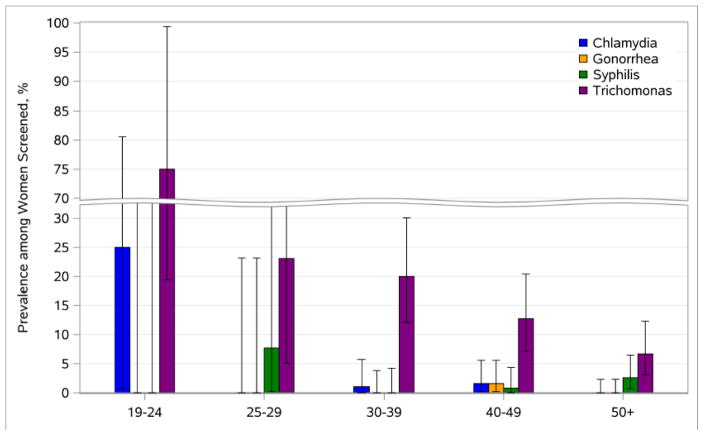
Among 745 women with HIV, median age was 46.8 years, 78.8% were black, and 61% were sexually active. In 2015, 83.7% of women were tested for STI. Test positivity was 1.0% for chlamydia, 0.5% for gonorrhea, 1.6% for syphilis, and 13.3% for trichomoniasis. Independent predictors of STI-3 were recent chlamydia or gonorrhea (odds ratio [OR], 3.7; 95% confidence interval [CI], 1-13.4; P = 0.047), public insurance compared with private (OR, 3.5; CI, 1-11.8; P = 0.048), and sex after drugs/alcohol (OR, 3.0; CI, 1.2-8.0; P = 0.025). Women 50 years or older were less likely to have STI (OR, 0.3; CI, 0.1-1; P = 0.040).
In a cohort of women engaged in HIV care in the southern United States, detection of chlamydia, gonorrhea, and syphilis was infrequent but trichomoniasis was common. Many women screened for STI were low risk and universal testing strategies warrant evaluation.
性传播感染(STI)和 HIV 的发病率在美国南部最高,但因性别、年龄和风险行为而异。目前的指南建议所有 HIV 活跃的女性每年都要进行衣原体、淋病、梅毒和滴虫病的筛查。
本回顾性队列研究纳入了 2013 年至 2015 年在阿拉巴马州伯明翰市一家城市 HIV 诊所接受治疗的女性,按日历年度确定了衣原体、淋病、梅毒和滴虫病的筛查率和阳性率。采用分子诊断方法检测衣原体、淋病和滴虫病,采用血清学方法检测梅毒。根据相似的阳性率和预测因素,创建了衣原体/淋病/梅毒三联检测(STI-3)的综合终点。使用逻辑回归和广义估计方程确定 STI-3 的预测因素。
在 745 名 HIV 阳性女性中,中位年龄为 46.8 岁,78.8%为黑人,61%为性活跃人群。2015 年,83.7%的女性接受了 STI 检测。衣原体检测阳性率为 1.0%,淋病为 0.5%,梅毒为 1.6%,滴虫病为 13.3%。STI-3 的独立预测因素包括近期的衣原体或淋病(比值比[OR],3.7;95%置信区间[CI],1-13.4;P = 0.047)、公共保险而非私人保险(OR,3.5;CI,1-11.8;P = 0.048),以及性活动后使用药物/酒精(OR,3.0;CI,1.2-8.0;P = 0.025)。50 岁及以上的女性发生 STI 的可能性较小(OR,0.3;CI,0.1-1;P = 0.040)。
在美国南部接受 HIV 治疗的女性队列中,衣原体、淋病和梅毒的检测率较低,但滴虫病的检测率较高。许多接受 STI 筛查的女性风险较低,因此需要评估普遍筛查策略。