Kridel Robert, Chan Fong Chun, Mottok Anja, Boyle Merrill, Farinha Pedro, Tan King, Meissner Barbara, Bashashati Ali, McPherson Andrew, Roth Andrew, Shumansky Karey, Yap Damian, Ben-Neriah Susana, Rosner Jamie, Smith Maia A, Nielsen Cydney, Giné Eva, Telenius Adele, Ennishi Daisuke, Mungall Andrew, Moore Richard, Morin Ryan D, Johnson Nathalie A, Sehn Laurie H, Tousseyn Thomas, Dogan Ahmet, Connors Joseph M, Scott David W, Steidl Christian, Marra Marco A, Gascoyne Randy D, Shah Sohrab P
Centre for Lymphoid Cancer, BC Cancer Agency, Vancouver, British Columbia, Canada.
Bioinformatics Graduate Program, University of British Columbia, Vancouver, British Columbia, Canada.
PLoS Med. 2016 Dec 13;13(12):e1002197. doi: 10.1371/journal.pmed.1002197. eCollection 2016 Dec.
Follicular lymphoma (FL) is an indolent, yet incurable B cell malignancy. A subset of patients experience an increased mortality rate driven by two distinct clinical end points: histological transformation and early progression after immunochemotherapy. The nature of tumor clonal dynamics leading to these clinical end points is poorly understood, and previously determined genetic alterations do not explain the majority of transformed cases or accurately predict early progressive disease. We contend that detailed knowledge of the expansion patterns of specific cell populations plus their associated mutations would provide insight into therapeutic strategies and disease biology over the time course of FL clinical histories.
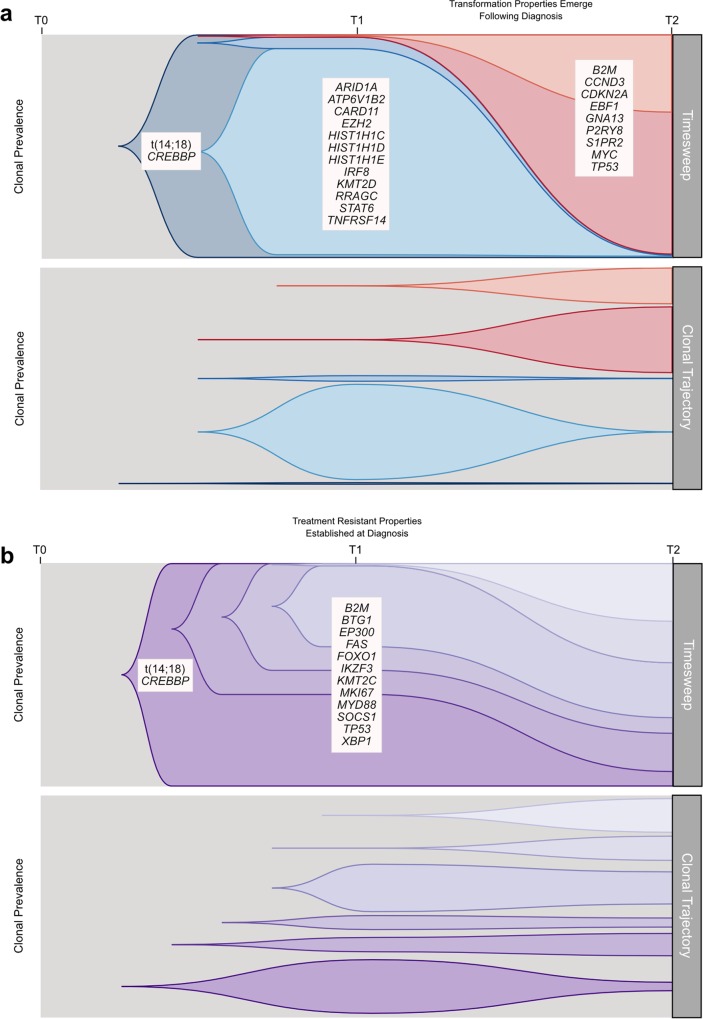
Using a combination of whole genome sequencing, targeted deep sequencing, and digital droplet PCR on matched diagnostic and relapse specimens, we deciphered the constituent clonal populations in 15 transformation cases and 6 progression cases, and measured the change in clonal population abundance over time. We observed widely divergent patterns of clonal dynamics in transformed cases relative to progressed cases. Transformation specimens were generally composed of clones that were rare or absent in diagnostic specimens, consistent with dramatic clonal expansions that came to dominate the transformation specimens. This pattern was independent of time to transformation and treatment modality. By contrast, early progression specimens were composed of clones that were already present in the diagnostic specimens and exhibited only moderate clonal dynamics, even in the presence of immunochemotherapy. Analysis of somatic mutations impacting 94 genes was undertaken in an extension cohort consisting of 395 samples from 277 patients in order to decipher disrupted biology in the two clinical end points. We found 12 genes that were more commonly mutated in transformed samples than in the preceding FL tumors, including TP53, B2M, CCND3, GNA13, S1PR2, and P2RY8. Moreover, ten genes were more commonly mutated in diagnostic specimens of patients with early progression, including TP53, BTG1, MKI67, and XBP1.
Our results illuminate contrasting modes of evolution shaping the clinical histories of transformation and progression. They have implications for interpretation of evolutionary dynamics in the context of treatment-induced selective pressures, and indicate that transformation and progression will require different clinical management strategies.
滤泡性淋巴瘤(FL)是一种惰性但无法治愈的B细胞恶性肿瘤。一部分患者的死亡率增加是由两个不同的临床终点驱动的:组织学转化和免疫化疗后的早期进展。导致这些临床终点的肿瘤克隆动力学的本质了解甚少,先前确定的基因改变并不能解释大多数转化病例,也不能准确预测早期进展性疾病。我们认为,详细了解特定细胞群体的扩增模式及其相关突变,将有助于深入了解FL临床病程中的治疗策略和疾病生物学。
我们对匹配的诊断和复发标本进行了全基因组测序、靶向深度测序和数字液滴PCR,以破译15例转化病例和6例进展病例中的组成克隆群体,并测量克隆群体丰度随时间的变化。我们观察到转化病例与进展病例的克隆动力学模式差异很大。转化标本通常由诊断标本中罕见或不存在的克隆组成,这与显著的克隆扩增一致,这些扩增后来主导了转化标本。这种模式与转化时间和治疗方式无关。相比之下,早期进展标本由诊断标本中已经存在的克隆组成,即使在免疫化疗的情况下,克隆动力学也仅表现为中等程度。在一个扩展队列中对影响94个基因的体细胞突变进行了分析,该队列包括来自277名患者的395个样本,以破译这两个临床终点中被破坏的生物学机制。我们发现12个基因在转化样本中比在先前的FL肿瘤中更常见突变,包括TP53、B2M、CCND3、GNA13、S1PR2和P2RY8。此外,10个基因在早期进展患者的诊断标本中更常见突变,包括TP53、BTG1、MKI67和XBP1。
我们的结果揭示了塑造转化和进展临床病程的两种截然不同的进化模式。它们对于在治疗诱导的选择压力背景下解释进化动力学具有启示意义,并表明转化和进展需要不同的临床管理策略。