Grauman Sven, Boethius Jakob, Johansson Joakim
Department of Anaesthesia and Intensive Care, Östersund Hospital, Östersund, Sweden.
Department of Anaesthesia and Intensive Care, Östersund Hospital, Östersund, Sweden; Department of Surgical and Perioperative Sciences, Anesthesiology and Intensive Care, Unit of Research, Education and Development-Östersund, Umeå University, Umeå, Sweden.
Anesthesiol Res Pract. 2016;2016:6308371. doi: 10.1155/2016/6308371. Epub 2016 Nov 16.
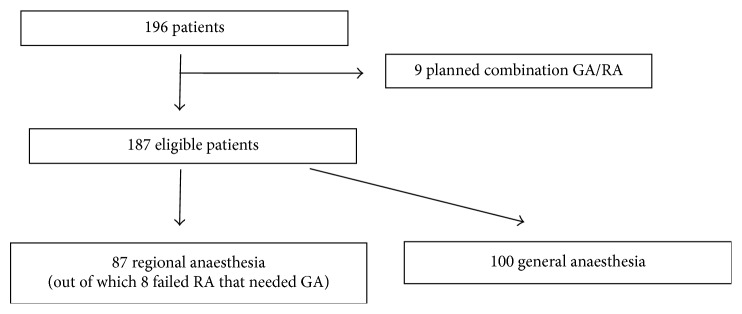
. For surgery on the upper extremity, the anaesthetist often has a choice between regional anaesthesia (RA) and general anaesthesia (GA). We sought to investigate the possible differences between RA and GA after upper extremity surgery with regard to postoperative patient comfort. . This is a retrospective observational study that was performed at an acute care secondary referral centre. One hundred and eighty-seven procedures involving orthopaedic surgery on the upper extremity were included. The different groups (RA and GA) were compared regarding the primary outcome variable, length of stay in Postanaesthesia Unit, and secondary outcome variables, opioid consumption and nausea treatment. . RA was associated with significantly shorter median length of stay (99 versus 171 minutes). In the GA group, 32% of the patients received opioid analgesics and 21% received antiemetics. In the RA group, none received opioid analgesics and 3% received antiemetics. . In this observational study, RA was superior to GA for surgery of the upper extremity regarding Postanaesthesia Care Unit length of stay, number of doses of analgesic, and number of doses of antiemetic administered.
对于上肢手术,麻醉医生通常可以在区域麻醉(RA)和全身麻醉(GA)之间做出选择。我们试图研究上肢手术后区域麻醉和全身麻醉在术后患者舒适度方面可能存在的差异。 这是一项在急性护理二级转诊中心进行的回顾性观察研究。纳入了187例涉及上肢骨科手术的病例。比较了不同组(区域麻醉和全身麻醉)的主要结局变量,即麻醉后监护病房的住院时间,以及次要结局变量,即阿片类药物消耗量和恶心治疗情况。 区域麻醉与显著更短的中位住院时间相关(99分钟对171分钟)。在全身麻醉组中,32%的患者接受了阿片类镇痛药,21%的患者接受了止吐药。在区域麻醉组中,无人接受阿片类镇痛药,3%的患者接受了止吐药。 在这项观察性研究中,就麻醉后监护病房的住院时间、镇痛药剂量和止吐药剂量而言,区域麻醉在上肢手术方面优于全身麻醉。