Berridge Kent C, Robinson Terry E
Department of Psychology, University of Michigan.
Am Psychol. 2016 Nov;71(8):670-679. doi: 10.1037/amp0000059.
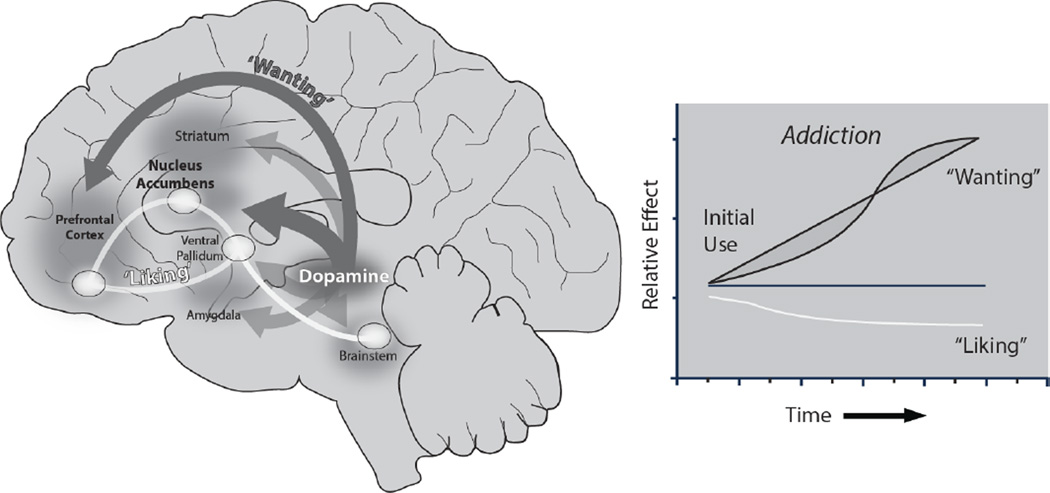
Rewards are both "liked" and "wanted," and those 2 words seem almost interchangeable. However, the brain circuitry that mediates the psychological process of "wanting" a particular reward is dissociable from circuitry that mediates the degree to which it is "liked." Incentive salience or "wanting," a form of motivation, is generated by large and robust neural systems that include mesolimbic dopamine. By comparison, "liking," or the actual pleasurable impact of reward consumption, is mediated by smaller and fragile neural systems, and is not dependent on dopamine. The incentive-sensitization theory posits the essence of drug addiction to be excessive amplification specifically of psychological "wanting," especially triggered by cues, without necessarily an amplification of "liking." This is because of long-lasting changes in dopamine-related motivation systems of susceptible individuals, called "neural sensitization." A quarter-century after its proposal, evidence has continued to grow in support the incentive-sensitization theory. Further, its scope is now expanding to include diverse behavioral addictions and other psychopathologies. (PsycINFO Database Record
奖赏既让人“喜欢”又让人“渴望”,这两个词似乎几乎可以互换。然而,介导对特定奖赏产生“渴望”这一心理过程的大脑神经回路,与介导对其“喜欢”程度的神经回路是可分离的。动机的一种形式——动机显著性或“渴望”,是由包括中脑边缘多巴胺系统在内的庞大而强健的神经系统产生的。相比之下,“喜欢”,即奖赏消费所带来的实际愉悦感,是由较小且脆弱的神经系统介导的,并且不依赖于多巴胺。动机敏感化理论认为,药物成瘾的本质是心理上的“渴望”过度增强,特别是由线索引发的,而不一定是“喜欢”的增强。这是由于易感个体中与多巴胺相关的动机系统发生了持久变化,即“神经敏感化”。该理论提出25年后,支持它的证据持续增加。此外,其范围现在正在扩大,以涵盖各种行为成瘾和其他精神病理学问题。(《心理学文摘数据库记录》 )