Justice Anne E, Howard Annie Green, Chittoor Geetha, Fernandez-Rhodes Lindsay, Graff Misa, Voruganti V Saroja, Diao Guoqing, Love Shelly-Ann M, Franceschini Nora, O'Connell Jeffrey R, Avery Christy L, Young Kristin L, North Kari E
Department of Epidemiology, University of North Carolina, Chapel Hill, NC 27514 USA.
Department of Biostatistics, University of North Carolina, Chapel Hill, NC 27514 USA.
BMC Proc. 2016 Oct 18;10(Suppl 7):321-327. doi: 10.1186/s12919-016-0050-9. eCollection 2016.
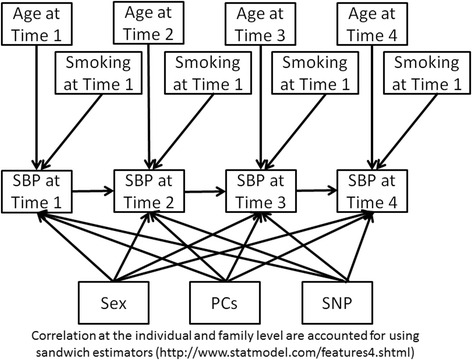
There is great interindividual variation in systolic blood pressure (SBP) as a result of the influences of several factors, including sex, ancestry, smoking status, medication use, and, especially, age. The majority of genetic studies have examined SBP measured cross-sectionally; however, SBP changes over time, and not necessarily in a linear fashion. Therefore, this study conducted a genome-wide association (GWA) study of SBP change trajectories using data available through the Genetic Analysis Workshop 19 (GAW19) of 959 individuals from 20 extended Mexican American families from the San Antonio Family Studies with up to 4 measures of SBP. We performed structural equation modeling (SEM) while taking into account potential genetic effects to identify how, if at all, to include covariates in estimating the SBP change trajectories using a mixture model based latent class growth modeling (LCGM) approach for use in the GWA analyses.
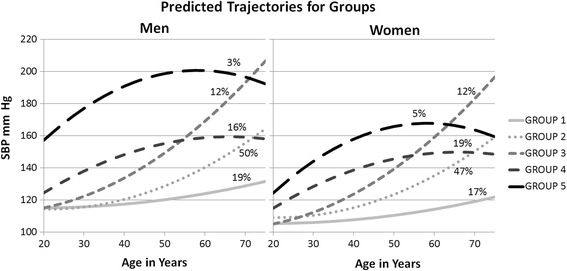
The semiparametric LCGM approach identified 5 trajectory classes that captured SBP changes across age. Each LCGM identified trajectory group was ranked based on the average number of cumulative years as hypertensive. Using a pairwise comparison of these classes the heritability estimates range from 12 to 94 % (SE = 17 to 40 %).
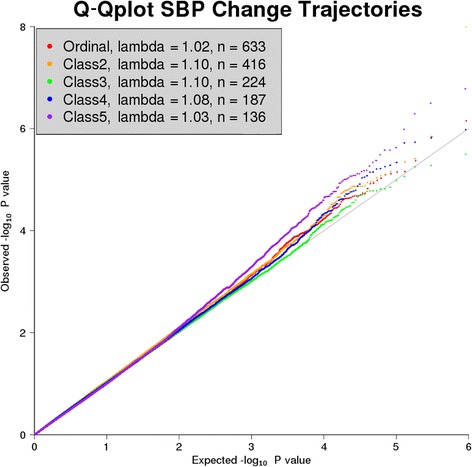
These identified trajectories are significantly heritable, and we identified a total of 8 promising loci that influence one's trajectory in SBP change across age. Our results demonstrate the potential utility of capitalizing on extant genetic data and longitudinal SBP assessments available through GAW19 to explore novel analytical methods with promising results.
由于包括性别、血统、吸烟状况、药物使用,尤其是年龄等多种因素的影响,收缩压(SBP)存在很大的个体差异。大多数基因研究考察的是横断面测量的收缩压;然而,收缩压会随时间变化,且不一定呈线性变化。因此,本研究利用来自圣安东尼奥家族研究的20个墨西哥裔美国家庭的959名个体的遗传分析研讨会19(GAW19)数据,进行了一项关于收缩压变化轨迹的全基因组关联(GWA)研究,这些个体有多达4次收缩压测量值。我们在考虑潜在基因效应的同时进行了结构方程建模(SEM),以确定在使用基于混合模型的潜在类别增长建模(LCGM)方法估计收缩压变化轨迹时如何(如果有的话)纳入协变量,以便用于GWA分析。
半参数LCGM方法识别出5种轨迹类别,这些类别反映了不同年龄段收缩压的变化情况。每个LCGM识别出的轨迹组根据高血压累积年数的平均值进行排序。通过对这些类别进行两两比较,遗传度估计范围为12%至94%(标准误=17%至40%)。
这些识别出的轨迹具有显著的遗传性,我们总共识别出8个有前景的基因座,它们会影响个体在不同年龄阶段收缩压变化的轨迹。我们的结果表明,利用GAW19提供的现有遗传数据和纵向收缩压评估来探索具有前景结果的新分析方法具有潜在的实用性。