• 文献检索
  • 文档翻译
  • 深度研究
  • 学术资讯
  • Suppr Zotero 插件Zotero 插件
  • 邀请有礼
  • 套餐&价格
  • 历史记录
应用&插件
Suppr Zotero 插件Zotero 插件浏览器插件Mac 客户端Windows 客户端微信小程序
定价
高级版会员购买积分包购买API积分包
服务
文献检索文档翻译深度研究API 文档MCP 服务
关于我们
关于 Suppr公司介绍联系我们用户协议隐私条款
关注我们

Suppr 超能文献

核心技术专利:CN118964589B侵权必究
粤ICP备2023148730 号-1Suppr @ 2026

文献检索

告别复杂PubMed语法,用中文像聊天一样搜索,搜遍4000万医学文献。AI智能推荐,让科研检索更轻松。

立即免费搜索

文件翻译

保留排版,准确专业,支持PDF/Word/PPT等文件格式,支持 12+语言互译。

免费翻译文档

深度研究

AI帮你快速写综述,25分钟生成高质量综述,智能提取关键信息,辅助科研写作。

立即免费体验

针对伴有和不伴有既往反复消极思维的解释进行认知偏差修正,以减少广泛性焦虑症和抑郁症中的担忧和沉思:一项带有积极对照条件的多阶段实验研究方案

Cognitive bias modification for interpretation with and without prior repetitive negative thinking to reduce worry and rumination in generalised anxiety disorder and depression: protocol for a multisession experimental study with an active control condition.

作者信息

Krahé Charlotte, Mathews Andrew, Whyte Jessica, Hirsch Colette R

机构信息

Department of Psychology, Institute of Psychiatry, Psychology and Neuroscience, King's College London, London, UK.

Department of Psychology, University of California, Davis, California, USA.

出版信息

BMJ Open. 2016 Dec 16;6(12):e013404. doi: 10.1136/bmjopen-2016-013404.

DOI:10.1136/bmjopen-2016-013404
PMID:27986741
原文链接:https://pmc.ncbi.nlm.nih.gov/articles/PMC5168672/
Abstract

INTRODUCTION

Worry and rumination are two forms of repetitive thinking characterised by their negative content and apparently uncontrollable nature. Although worry and rumination share common features and have been conceptualised as part of a transdiagnostic repetitive negative thinking (RNT) process, it remains unclear whether they share the same underlying cognitive mechanisms. This multisession experimental study investigates the tendency to make negative interpretations regarding ambiguous information as a cognitive mechanism underlying RNT. We compare multisession cognitive bias modification for interpretations (CBM-I) with an active control condition to examine whether repeatedly training positive interpretations reduces worry and rumination in individuals with generalised anxiety disorder or depression, respectively. Further, we examine the potential modulatory effects of engaging in RNT immediately prior to CBM-I.

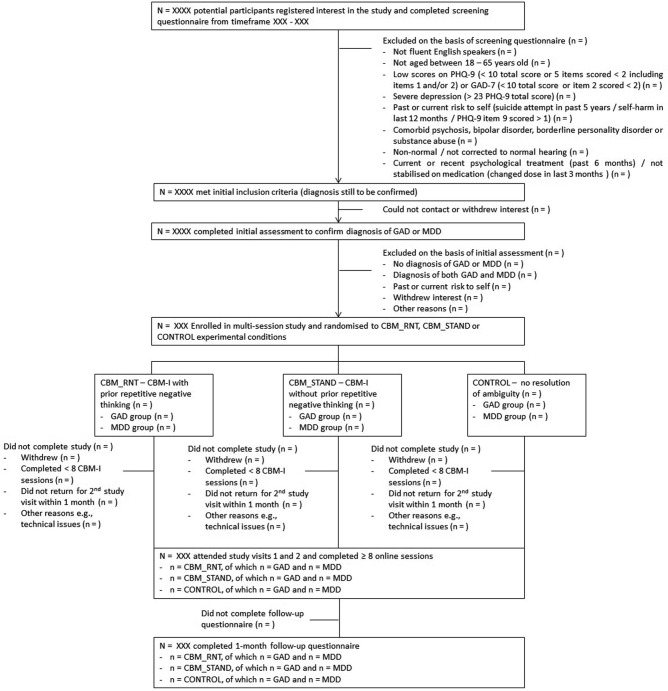
DESIGN, METHODS AND ANALYSIS: A community sample of individuals meeting diagnostic criteria for either generalised anxiety disorder (n=60) or current major depressive episode (n=60) will be randomly allocated to CBM-I with prior RNT, CBM-I without prior RNT (ie, standard CBM-I), or an active control (no resolution of ambiguity) condition. All conditions receive a 3-week internet-based intervention consisting of one initial session at the first study visit and nine home-based sessions of CBM-I training (or active control). We will assess and compare the effects of CBM-I with and without prior RNT on 'near-transfer' measures of interpretation bias closely related to the training as well as 'far-transfer' outcomes related to RNT and emotional distress. Impact on questionnaire measures will additionally be assessed at 1-month follow-up. Multigroup analyses will be conducted to assess the impact of CBM-I on near-transfer and far-transfer outcome measures.

摘要

引言

担忧和沉思是重复思维的两种形式,其特点是内容消极且明显具有无法控制的性质。尽管担忧和沉思有共同特征,并且已被概念化为跨诊断重复消极思维(RNT)过程的一部分,但它们是否具有相同的潜在认知机制仍不清楚。这项多阶段实验研究调查了对模糊信息做出消极解释的倾向,将其作为RNT的一种潜在认知机制。我们将对解释的多阶段认知偏差修正(CBM-I)与积极对照条件进行比较,以检验反复训练积极解释是否分别减少广泛性焦虑症或抑郁症患者的担忧和沉思。此外,我们还将研究在进行CBM-I之前立即进行RNT的潜在调节作用。

设计、方法与分析:一个符合广泛性焦虑症诊断标准(n = 60)或当前重度抑郁发作诊断标准(n = 60)的社区样本将被随机分配到先进行RNT的CBM-I组、不进行先验RNT 的CBM-I组(即标准CBM-I组)或积极对照(不解决模糊性)组。所有组都接受为期3周的基于互联网的干预,包括在首次研究访问时的一次初始会话和九次基于家庭的CBM-I训练会话(或积极对照)。我们将评估并比较有无先验RNT的CBM-I对与训练密切相关的解释偏差的“近迁移”测量指标以及与RNT和情绪困扰相关的“远迁移”结果的影响。在1个月的随访中还将评估对问卷测量指标的影响。将进行多组分析以评估CBM-I对近迁移和远迁移结果测量指标的影响。
https://cdn.ncbi.nlm.nih.gov/pmc/blobs/6f25/5168672/b44b90bb3859/bmjopen2016013404f02.jpg
https://cdn.ncbi.nlm.nih.gov/pmc/blobs/6f25/5168672/aa0188c6d9e7/bmjopen2016013404f01.jpg
https://cdn.ncbi.nlm.nih.gov/pmc/blobs/6f25/5168672/b44b90bb3859/bmjopen2016013404f02.jpg
https://cdn.ncbi.nlm.nih.gov/pmc/blobs/6f25/5168672/aa0188c6d9e7/bmjopen2016013404f01.jpg
https://cdn.ncbi.nlm.nih.gov/pmc/blobs/6f25/5168672/b44b90bb3859/bmjopen2016013404f02.jpg

相似文献

1
Cognitive bias modification for interpretation with and without prior repetitive negative thinking to reduce worry and rumination in generalised anxiety disorder and depression: protocol for a multisession experimental study with an active control condition.针对伴有和不伴有既往反复消极思维的解释进行认知偏差修正,以减少广泛性焦虑症和抑郁症中的担忧和沉思:一项带有积极对照条件的多阶段实验研究方案
BMJ Open. 2016 Dec 16;6(12):e013404. doi: 10.1136/bmjopen-2016-013404.
2
Effects of modifying interpretation bias on transdiagnostic repetitive negative thinking.修正解释偏差对跨诊断重复性消极思维的影响。
J Consult Clin Psychol. 2020 Mar;88(3):226-239. doi: 10.1037/ccp0000455.
3
Interpretation training to target repetitive negative thinking in generalized anxiety disorder and depression.针对广泛性焦虑障碍和抑郁症的重复消极思维进行解释性训练。
J Consult Clin Psychol. 2018 Dec;86(12):1017-1030. doi: 10.1037/ccp0000310.
4
Internet-delivered interpretation training reduces worry and anxiety in individuals with generalized anxiety disorder: A randomized controlled experiment.互联网提供的口译训练可减轻广泛性焦虑症患者的担忧和焦虑:一项随机对照实验。
J Consult Clin Psychol. 2021 Jul;89(7):575-589. doi: 10.1037/ccp0000660.
5
The relationship between worry, rumination, and comorbidity: evidence for repetitive negative thinking as a transdiagnostic construct.担忧、反刍与共病之间的关系:重复消极思维作为一种跨诊断结构的证据。
J Affect Disord. 2013 Oct;151(1):313-20. doi: 10.1016/j.jad.2013.06.014. Epub 2013 Jul 16.
6
Reductions in negative repetitive thinking and metacognitive beliefs during transdiagnostic internet cognitive behavioural therapy (iCBT) for mixed anxiety and depression.混合焦虑和抑郁的跨诊断网络认知行为疗法(iCBT)中消极重复思维和元认知信念的减少。
Behav Res Ther. 2014 Aug;59:52-60. doi: 10.1016/j.brat.2014.05.009. Epub 2014 Jun 2.
7
Repetitive negative thinking as a predictor of depression and anxiety: A longitudinal cohort study.重复性消极思维对抑郁和焦虑的预测作用:一项纵向队列研究。
J Affect Disord. 2018 Dec 1;241:216-225. doi: 10.1016/j.jad.2018.08.037. Epub 2018 Aug 10.
8
Common rather than unique aspects of repetitive negative thinking are related to depressive and anxiety disorders and symptoms.重复性消极思维的常见而非独特方面与抑郁和焦虑障碍及症状有关。
J Anxiety Disord. 2015 Jun;33:45-52. doi: 10.1016/j.janxdis.2015.05.001. Epub 2015 May 11.
9
Impact of imagery-enhanced interpretation training on offline and online interpretations in worry.想象增强解释训练对担忧的离线和在线解释的影响。
Behav Res Ther. 2020 Jan;124:103497. doi: 10.1016/j.brat.2019.103497. Epub 2019 Oct 26.
10
Reducing worry and rumination in young adults via a mobile phone app: study protocol of the ECoWeB (Emotional Competence for Well-Being in Young Adults) randomised controlled trial focused on repetitive negative thinking.通过手机应用程序减少年轻成年人的担忧和沉思:关注重复消极思维的 ECoWeB(年轻人幸福感的情绪能力)随机对照试验研究方案。
BMC Psychiatry. 2021 Oct 21;21(1):519. doi: 10.1186/s12888-021-03536-0.

引用本文的文献

1
Suppression May Improve Adaptation to Worry When Facing Uncertainty: Studying COVID-19 Pandemic.面对不确定性时,抑制可能会改善对担忧的适应:关于新冠疫情的研究
Front Psychiatry. 2021 Nov 26;12:778375. doi: 10.3389/fpsyt.2021.778375. eCollection 2021.
2
Innovations in digital interventions for psychological trauma: harnessing advances in cognitive science.心理创伤数字干预的创新:利用认知科学的进展
Mhealth. 2018 Oct 19;4:47. doi: 10.21037/mhealth.2018.09.11. eCollection 2018.
3
Cognitive Interpretation Bias: The Effect of a Single Session Moderate Exercise Protocol on Anxiety and Depression.

本文引用的文献

1
Resolving Ambiguity in Emotional Disorders: The Nature and Role of Interpretation Biases.解决情绪障碍中的歧义:解释偏差的性质和作用。
Annu Rev Clin Psychol. 2016;12:281-305. doi: 10.1146/annurev-clinpsy-021815-093436.
2
Rumination and Worry in Daily Life: Examining the Naturalistic Validity of Theoretical Constructs.日常生活中的反刍思维与担忧:检验理论构念的自然主义效度
Clin Psychol Sci. 2015 Nov 1;3(6):926-939. doi: 10.1177/2167702614566603. Epub 2015 Apr 2.
3
Cognitive Bias Modification: Past Perspectives, Current Findings, and Future Applications.
认知解释偏差:单次中等强度运动方案对焦虑和抑郁的影响。
Front Psychol. 2018 Aug 8;9:1363. doi: 10.3389/fpsyg.2018.01363. eCollection 2018.
认知偏差修正:过去的观点、当前的发现和未来的应用。
Perspect Psychol Sci. 2011 Nov;6(6):521-36. doi: 10.1177/1745691611421205.
4
Rethinking Rumination.重新思考沉思。
Perspect Psychol Sci. 2008 Sep;3(5):400-24. doi: 10.1111/j.1745-6924.2008.00088.x.
5
Computer Game Play Reduces Intrusive Memories of Experimental Trauma via Reconsolidation-Update Mechanisms.玩电脑游戏通过重新巩固-更新机制减少实验性创伤的侵入性记忆。
Psychol Sci. 2015 Aug;26(8):1201-15. doi: 10.1177/0956797615583071. Epub 2015 Jul 1.
6
Positive Imagery-Based Cognitive Bias Modification as a Web-Based Treatment Tool for Depressed Adults: A Randomized Controlled Trial.基于积极意象的认知偏差修正作为成年抑郁症患者的网络治疗工具:一项随机对照试验。
Clin Psychol Sci. 2015 Jan;3(1):91-111. doi: 10.1177/2167702614560746.
7
Positive imagery cognitive bias modification (CBM) and internet-based cognitive behavioral therapy (iCBT): a randomized controlled trial.积极意象认知偏差矫正(CBM)与基于互联网的认知行为疗法(iCBT):一项随机对照试验。
J Affect Disord. 2015 Jun 1;178:131-41. doi: 10.1016/j.jad.2015.02.026. Epub 2015 Mar 5.
8
Cognitive Bias Modification for Interpretation in Major Depression: Effects on Memory and Stress Reactivity.针对重度抑郁症中解释偏差的认知偏差矫正:对记忆和应激反应性的影响
Clin Psychol Sci. 2015 Jan 1;3(1):126-139. doi: 10.1177/2167702614560748.
9
Repetitive negative thinking as a transdiagnostic factor in depression and anxiety: A conceptual replication.重复性消极思维作为抑郁和焦虑的一种跨诊断因素:一项概念性复现研究
Behav Res Ther. 2014 Dec;63:177-83. doi: 10.1016/j.brat.2014.06.004. Epub 2014 Aug 27.
10
Are attentional control resources reduced by worry in generalized anxiety disorder?广泛性焦虑障碍中的担忧是否会减少注意力控制资源?
J Abnorm Psychol. 2014 May;123(2):330-335. doi: 10.1037/a0036343.
