Yu Yang, Liang Xinyu, Yu Haikuo, Zhao Weina, Lu Yan, Huang Yue, Yin Changhao, Gong Gaolang, Han Ying
Department of Neurology, Hongqi Hospital of Mudanjiang Medical University, Mudanjiang, Heilongjiang, China.
State Key Laboratory of Cognitive Neuroscience and Learning & IDG/McGovern Institute for Brain Research, Beijing Normal University, Beijing, China.
Oncotarget. 2017 Jan 3;8(1):42-50. doi: 10.18632/oncotarget.13960.
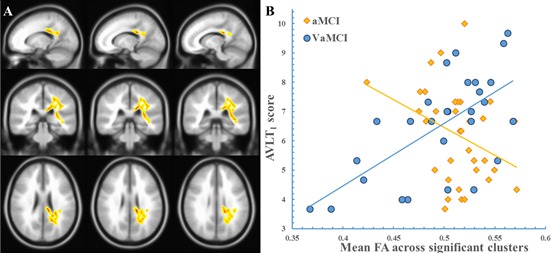
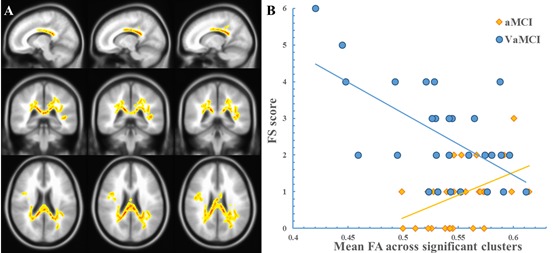
Changes in white matter (WM) microstructure may relate to the pathophysiology of cognitive impairment. Whether WM microstructure differs in two common pre-dementia subtypes, vascular mild cognitive impairment (VaMCI) and amnestic mild cognitive impairment (aMCI), is largely unknown. This study included 28 VaMCI (12 men, age: 46 ~ 77 years) and 34 aMCI patients (14 men, age: 51 ~ 79 years). All patients underwent a battery of neuropsychological tests and structural and diffusion magnetic resonance imaging (MRI) scanning. WM microstructure was quantified using diffusion MRI parameters: fractional anisotropy (FA), mean diffusivity (MD), axial diffusivity (AxD) and radial diffusivity (RD). These parameters were compared between the two patient groups using tract-based spatial statistics (TBSS) after controlling for age, gender, and education. No significant differences in FA/MD/AxD/RD were observed between the VaMCI and aMCI groups, which suggests a similar pattern of WM microstructure in the early stage of cognitive impairment for different dementia types. However, the two groups exhibited significant differences in the relationship between FA and the Auditory Verbal Learning Test (AVLT), which were primarily located around the corona radiate and corpus callosum. Specifically, there were significant positive correlations (R = 0.64, P < 0.001) between the FA and AVLT in the VaMCI group, but the opposite trend was observed in the aMCI group (R = -0.34, P = 0.047). The differential relationship between WM and memory between VaMCI and aMCI indicates an independent neuropathology for specific memory deficits in different types of dementia.
白质(WM)微观结构的变化可能与认知障碍的病理生理学有关。在两种常见的痴呆前期亚型,即血管性轻度认知障碍(VaMCI)和遗忘型轻度认知障碍(aMCI)中,WM微观结构是否存在差异在很大程度上尚不清楚。本研究纳入了28例VaMCI患者(12例男性,年龄:4677岁)和34例aMCI患者(14例男性,年龄:5179岁)。所有患者均接受了一系列神经心理学测试以及结构和扩散磁共振成像(MRI)扫描。使用扩散MRI参数对白质微观结构进行量化:各向异性分数(FA)、平均扩散率(MD)、轴向扩散率(AxD)和径向扩散率(RD)。在控制年龄、性别和教育程度后,使用基于体素的空间统计学(TBSS)对两组患者的这些参数进行比较。在VaMCI组和aMCI组之间未观察到FA/MD/AxD/RD的显著差异,这表明不同痴呆类型在认知障碍早期的WM微观结构模式相似。然而,两组在FA与听觉言语学习测试(AVLT)之间的关系上存在显著差异,主要位于放射冠和胼胝体周围。具体而言,VaMCI组中FA与AVLT之间存在显著正相关(R = 0.64,P < 0.001),但在aMCI组中观察到相反的趋势(R = -0.34,P = 0.047)。VaMCI和aMCI之间WM与记忆的差异关系表明不同类型痴呆中特定记忆缺陷存在独立的神经病理学机制。