Tomadesso Clémence, Perrotin Audrey, Mutlu Justine, Mézenge Florence, Landeau Brigitte, Egret Stéphanie, de la Sayette Vincent, Jonin Pierre-Yves, Eustache Francis, Desgranges Béatrice, Chételat Gaël
INSERM, Caen, U1077, France ; Université de Caen Basse-Normandie, UMR-S1077, Caen, France ; École Pratique des Hautes Etudes, UMR-S1077, Caen, France ; CHU de Caen, Caen, U1077, France.
INSERM, Caen, U1077, France ; Université de Caen Basse-Normandie, UMR-S1077, Caen, France ; École Pratique des Hautes Etudes, UMR-S1077, Caen, France ; CHU de Caen, Service de Neurologie, Caen, France.
Neuroimage Clin. 2015 May 28;8:473-82. doi: 10.1016/j.nicl.2015.05.010. eCollection 2015.
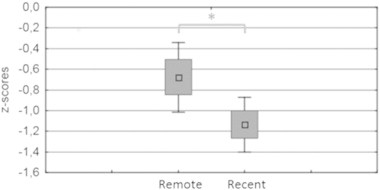
Deficits in autobiographical memory appear earlier for recent than for remote life periods over the course of Alzheimer's disease (AD). The present study aims to further our understanding of this graded effect by investigating the cognitive and neural substrates of recent versus remote autobiographical memories in patients with amnestic Mild Cognitive Impairment (aMCI) thanks to an autobiographical fluency task. 20 aMCI patients and 25 Healthy elderly Controls (HC) underwent neuropsychological tests assessing remote (20-to-30 years old) and recent (the ten last years) autobiographical memory as well as episodic and semantic memory, executive function and global cognition. All patients also had a structural MRI and an FDG-PET scan. Correlations were assessed between each autobiographical memory score and the other tests as well as grey matter volume and metabolism. Within the aMCI, performances for the remote period correlated with personal semantic memory and episodic memory retrieval whereas performances for the recent period only correlated with episodic memory retrieval. Neuroimaging analyses revealed significant correlations between performances for the remote period and temporal pole and temporo-parietal cortex volumes and anterior cingulate gyrus metabolism, while performances for the recent period correlated with hippocampal volume and posterior cingulate, medial prefrontal and hippocampus metabolism. The brain regions related with the retrieval of events from the recent period showed greater atrophy/hypometabolism in aMCI patients compared to HC than those involved in remote memories. Recall of recent memories essentially relies on episodic memory processes and brain network while remote memories also involve other processes such as semantic memory. This is consistent with the semanticization of memories with time and may explain the better resistance of remote memory in AD.
在阿尔茨海默病(AD)病程中,自传体记忆缺陷在近期生活阶段比远期生活阶段出现得更早。本研究旨在通过一项自传体流畅性任务,调查遗忘型轻度认知障碍(aMCI)患者近期与远期自传体记忆的认知和神经基础,以进一步了解这种分级效应。20名aMCI患者和25名健康老年对照者(HC)接受了神经心理学测试,评估远期(20至30岁)和近期(过去十年)的自传体记忆以及情景记忆和语义记忆、执行功能和整体认知。所有患者还进行了结构MRI和FDG-PET扫描。评估了每个自传体记忆分数与其他测试以及灰质体积和代谢之间的相关性。在aMCI患者中,远期表现与个人语义记忆和情景记忆提取相关,而近期表现仅与情景记忆提取相关。神经影像学分析显示,远期表现与颞极、颞顶叶皮质体积以及前扣带回代谢之间存在显著相关性,而近期表现与海马体积以及后扣带回、内侧前额叶和海马代谢相关。与HC相比,aMCI患者中与近期事件提取相关的脑区萎缩/代谢减退程度比与远期记忆相关的脑区更大。近期记忆的回忆主要依赖于情景记忆过程和脑网络,而远期记忆还涉及其他过程,如语义记忆。这与记忆随时间的语义化一致,可能解释了AD中远期记忆更好的抗性。