Roos Leonie, Sandling Johanna K, Bell Christopher G, Glass Daniel, Mangino Massimo, Spector Tim D, Deloukas Panos, Bataille Veronique, Bell Jordana T
Department of Twin Research and Genetic Epidemiology, King's College London, London, UK; MRC London Institute of Medical Sciences, London, UK; Institute of Clinical Sciences, Faculty of Medicine, Imperial College London, London, UK.
Department of Medical Sciences, Molecular Medicine and Science for Life Laboratory, Uppsala University, Uppsala, Sweden.
J Invest Dermatol. 2017 Apr;137(4):910-920. doi: 10.1016/j.jid.2016.11.029. Epub 2016 Dec 18.
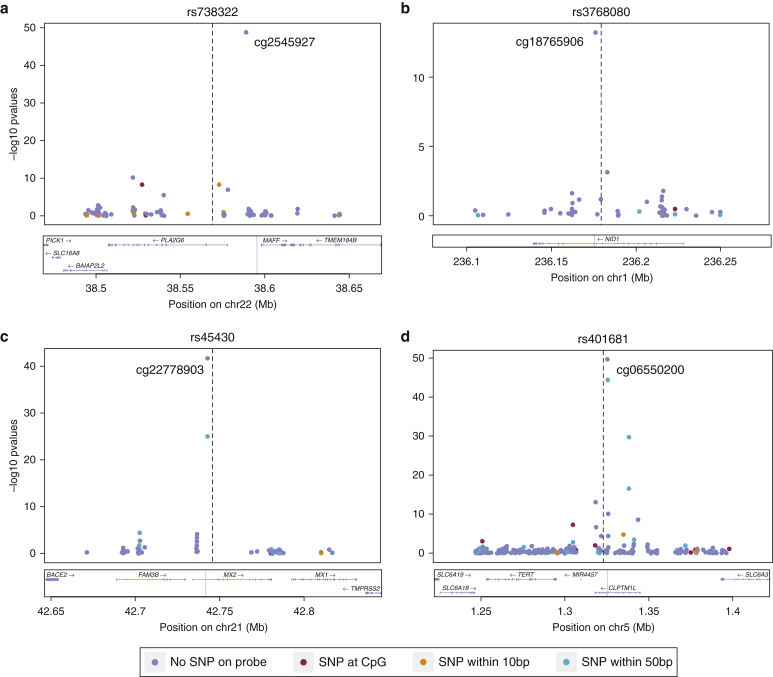
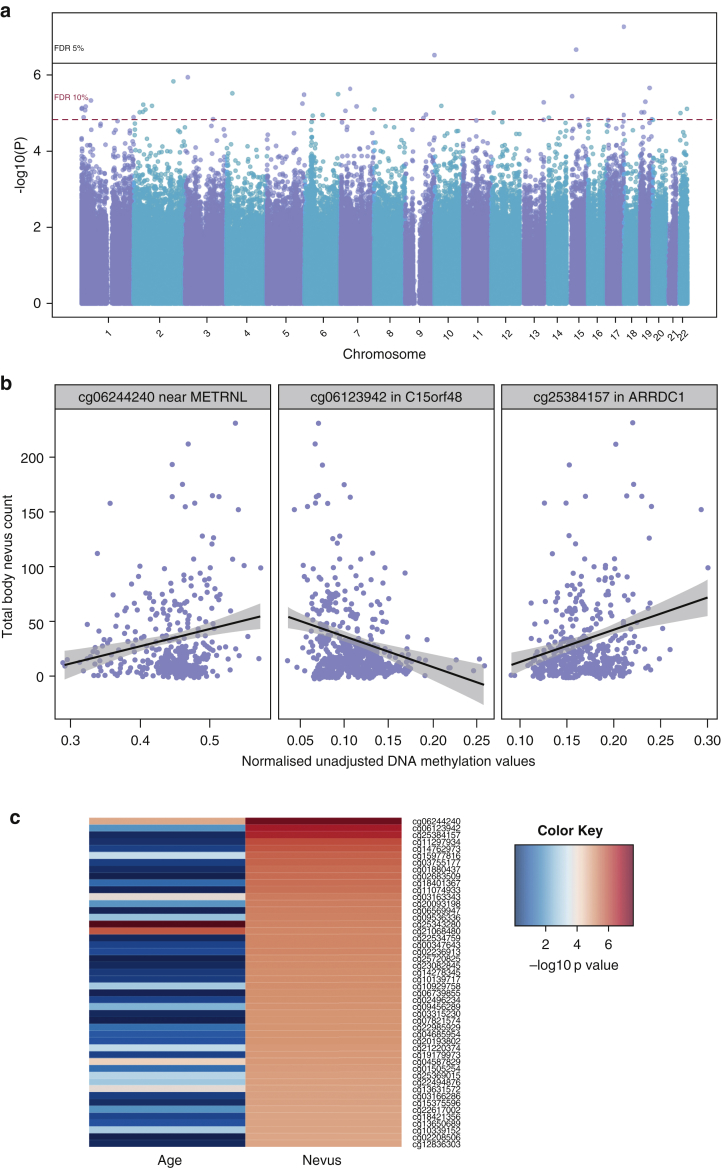
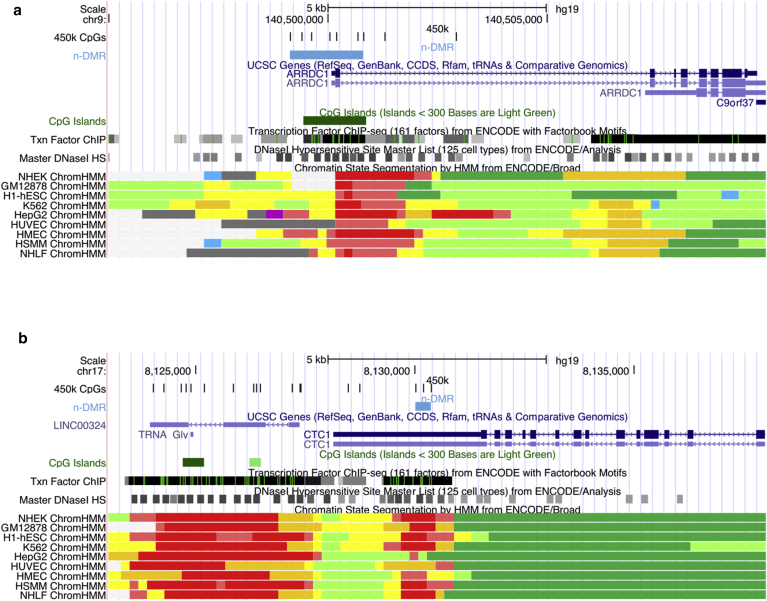
High nevus count is the strongest risk factor for melanoma, and although gene variants have been discovered for both traits, epigenetic variation is unexplored. We investigated 322 healthy human skin DNA methylomes associated with total body nevi count, incorporating genetic and transcriptomic variation. DNA methylation changes were identified at genes involved in melanocyte biology, such as RAF1 (P = 1.2 × 10) and CTC1 (region: P = 6.3 × 10), and other genes including ARRDC1 (P = 3.1 × 10). A subset exhibited coordinated methylation and transcription changes within the same biopsy. The total analysis was also enriched for melanoma-associated DNA methylation variation (P = 6.33 × 10). In addition, we show that skin DNA methylation is associated in cis with known genome-wide association study single nucleotide polymorphisms for nevus count, at PLA2G6 (P = 1.7 × 10) and NID1 (P = 6.4 × 10), as well as melanoma risk, including in or near MC1R, MX2, and TERT/CLPTM1L (P < 1 × 10). Our analysis using a uniquely large dataset comprising healthy skin DNA methylomes identified known and additional regulatory loci and pathways in nevi and melanoma biology. This integrative study improves our understanding of predisposition to nevi and their potential contribution to melanoma pathogenesis.
高痣计数是黑色素瘤最强的风险因素,尽管已经发现了与这两个特征相关的基因变异,但表观遗传变异尚未得到探索。我们研究了322个与全身痣计数相关的健康人皮肤DNA甲基化组,并纳入了基因和转录组变异。在参与黑素细胞生物学的基因中发现了DNA甲基化变化,如RAF1(P = 1.2×10)和CTC1(区域:P = 6.3×10),以及包括ARRDC1(P = 3.1×10)在内的其他基因。一个子集在同一次活检中表现出协调的甲基化和转录变化。总体分析还富集了与黑色素瘤相关的DNA甲基化变异(P = 6.33×10)。此外,我们表明皮肤DNA甲基化在顺式中与已知的全基因组关联研究中痣计数的单核苷酸多态性相关,在PLA2G6(P = 1.7×10)和NID1(P = 6.4×10),以及黑色素瘤风险相关,包括在MC1R、MX2和TERT/CLPTM1L内或附近(P < 1×10)。我们使用包含健康皮肤DNA甲基化组的独特大型数据集进行的分析,确定了痣和黑色素瘤生物学中已知的和额外的调控位点及途径。这项综合研究增进了我们对痣易感性及其对黑色素瘤发病机制潜在贡献的理解。