Tucker Abigail S
Department of Craniofacial Development and Stem Cell Biology, King's College London, Floor 27 Guy's Hospital, London Bridge, London SE1 9RT, UK
Philos Trans R Soc Lond B Biol Sci. 2017 Feb 5;372(1713). doi: 10.1098/rstb.2015.0483.
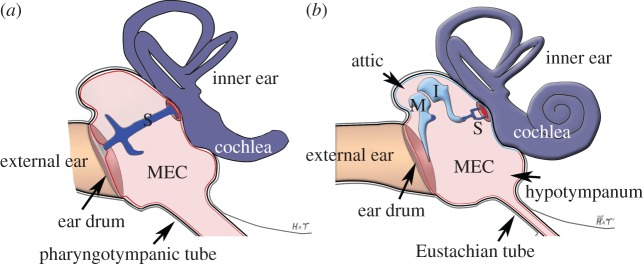
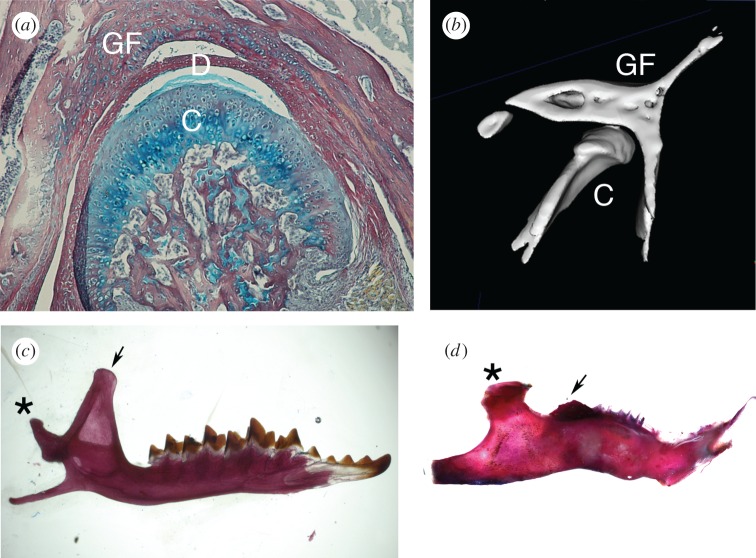
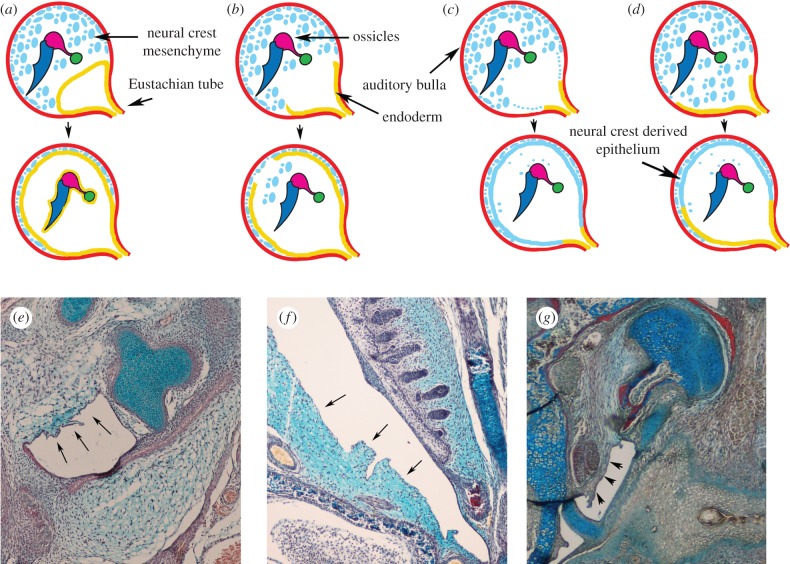
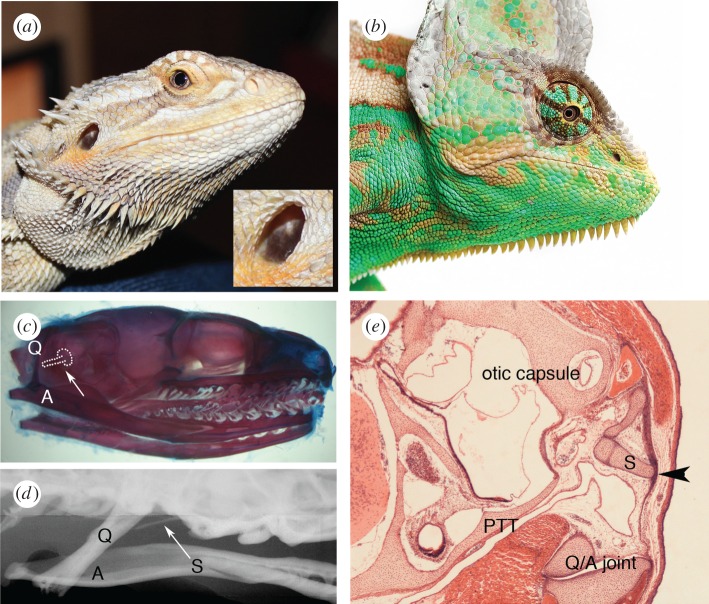
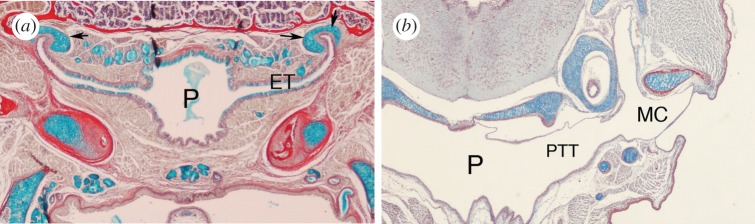
One of the most amazing transitions and innovations during the evolution of mammals was the formation of a novel jaw joint and the incorporation of the original jaw joint into the middle ear to create the unique mammalian three bone/ossicle ear. In this review, we look at the key steps that led to this change and other unusual features of the middle ear and how developmental biology has been providing an understanding of the mechanisms involved. This starts with an overview of the tympanic (air-filled) middle ear, and how the ear drum (tympanic membrane) and the cavity itself form during development in amniotes. This is followed by an investigation of how the ear is connected to the pharynx and the relationship of the ear to the bony bulla in which it sits. Finally, the novel mammalian jaw joint and versatile dentary bone will be discussed with respect to evolution of the mammalian middle ear.This article is part of the themed issue 'Evo-devo in the genomics era, and the origins of morphological diversity'.
哺乳动物进化过程中最惊人的转变和创新之一,是形成了一个全新的颌关节,并将原来的颌关节纳入中耳,从而创造出独特的哺乳动物三骨/听小骨耳朵。在这篇综述中,我们将探讨导致这一变化的关键步骤以及中耳的其他异常特征,以及发育生物学如何帮助我们理解其中涉及的机制。这首先要概述鼓室(充满空气的)中耳,以及在羊膜动物发育过程中鼓膜(耳膜)和中耳腔本身是如何形成的。接下来要研究耳朵如何与咽部相连,以及耳朵与容纳它的骨泡之间的关系。最后,将结合哺乳动物中耳的进化来讨论全新的哺乳动物颌关节和多功能齿骨。本文是主题为“基因组学时代的进化发育生物学与形态多样性的起源”特刊的一部分。