Waszak Przemyslaw M, Modrić Marta, Paturej Agnieszka, Malyshev Stanislav M, Przygocka Agnieszka, Garnier Hanna, Szmuda Tomasz
Janusz Korczak Memorial Voivodeship Hospital, Słupsk, Poland.
Varaždin General Hospital, Varaždin, Croatia.
Asian Spine J. 2016 Dec;10(6):1195-1204. doi: 10.4184/asj.2016.10.6.1195. Epub 2016 Dec 8.
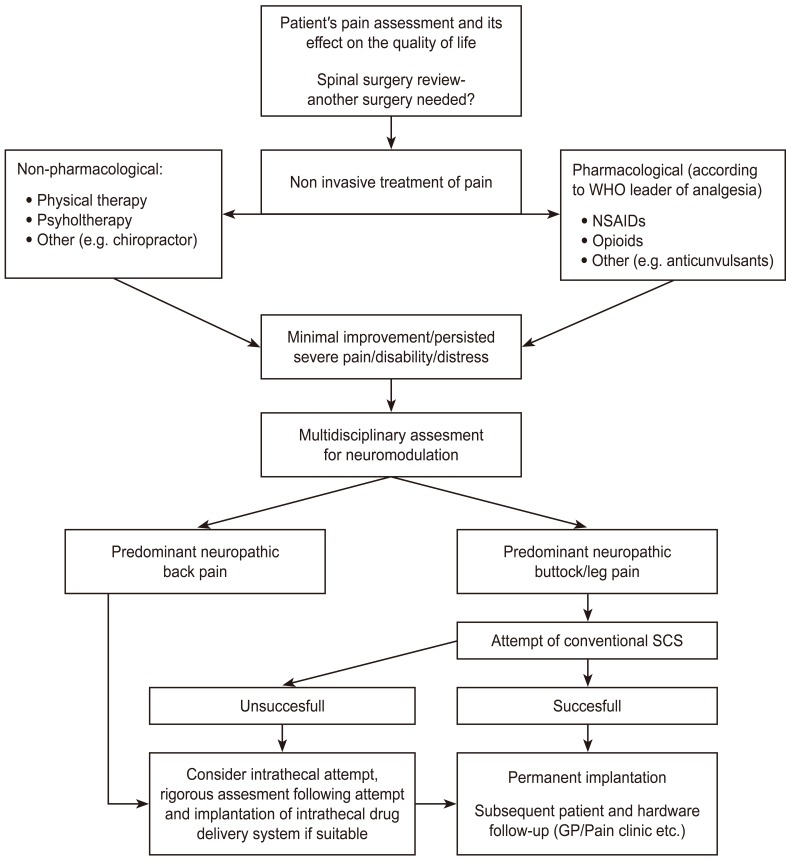
Failed back surgery syndrome (FBSS) is complex and recurrent chronic pain after spinal surgery. Several important patient and surgery related risk factors play roles in development of FBSS. Inadequate selection of the candidates for the spinal surgeries is one of the most crucial causes. The guidelines suggest that conservative management featuring pharmacologic approaches and rehabilitation should be introduced first. For therapy-refractory FBSS, spinal cord stimulation (SCS) is recommended in selected patients. Treatment efficacy for FBSS has increased over the years with the majority of patients experiencing pain relief and reduced medicinal load. Improved quality of life can also be achieved using SCS. Cost-effectiveness of SCS still remains unclear. However evidence for SCS role in FBSS is controversial, SCS can be beneficial for carefully classified patients.
腰椎手术失败综合征(FBSS)是脊柱手术后复杂且反复发作的慢性疼痛。几个重要的患者及手术相关风险因素在FBSS的发生中起作用。脊柱手术候选者选择不当是最关键的原因之一。指南建议首先采用以药物治疗和康复为主的保守治疗。对于治疗难治性FBSS,建议在特定患者中采用脊髓刺激(SCS)。多年来,FBSS的治疗效果有所提高,大多数患者疼痛缓解且药物用量减少。使用SCS还可改善生活质量。SCS的成本效益仍不明确。然而,尽管SCS在FBSS中的作用存在争议,但对经过仔细分类的患者可能有益。