Goudman Lisa, Rigoard Philippe, Billot Maxime, Duarte Rui V, Eldabe Sam, Moens Maarten
Department of Neurosurgery, Universitair Ziekenhuis Brussel, Jette, 1090, Belgium.
STIMULUS Consortium (Research and Teaching Neuromodulation VUB/UZ Brussel), Vrije Universiteit Brussel, Brussels, 1090, Belgium.
J Pain Res. 2022 Apr 20;15:1163-1171. doi: 10.2147/JPR.S250455. eCollection 2022.
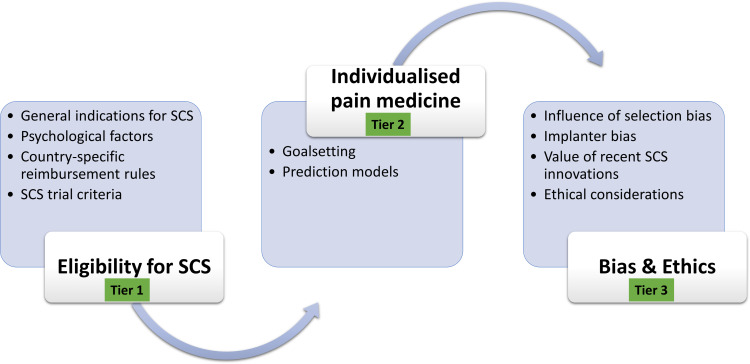
Despite the well-known efficacy of spinal cord stimulation (SCS) in chronic pain management, patient selection in clinical practice remains challenging. The aim of this review is to provide an overview of the factors that can influence the process of patient selection for SCS treatment. A sequential decision-making model is presented within a tier system that operates in clinical practice. The first level incorporates the underlying disease as a primary indication for SCS, country-related reimbursement rules, and SCS screening-trial criteria in combination with underlying psychological factors as initial selection criteria in evaluating patient eligibility for SCS. The second tier is aligned with the individualized approach within precision pain medicine, whereby individual goals and expectations and the potential need for preoperative optimizations are emphasized. Additionally, this tier relies on results from prediction models to provide an estimate of the efficacy of SCS in the long term. In the third tier, selection bias, MRI compatibility, and ethical beliefs are included, together with recent technological innovations, superiority of specific stimulation paradigms, and new feedback systems that could indirectly influence the decision-making of the physician. Both patients and physicians should be aware of the different aspects that influence patient selection in relation to SCS for pain management to make an independent decision on whether or not to initiate a treatment trajectory with SCS.
尽管脊髓刺激(SCS)在慢性疼痛管理方面的疗效已广为人知,但临床实践中的患者选择仍然具有挑战性。本综述的目的是概述可能影响SCS治疗患者选择过程的因素。在临床实践中运行的分层系统内提出了一个序贯决策模型。第一层将基础疾病作为SCS的主要指征、国家相关的报销规则以及SCS筛查试验标准,并结合基础心理因素,作为评估患者SCS资格的初始选择标准。第二层与精准疼痛医学中的个体化方法相一致,强调个体目标和期望以及术前优化的潜在需求。此外,这一层级依靠预测模型的结果来估计SCS的长期疗效。在第三层中,纳入了选择偏倚、MRI兼容性和伦理观念,以及近期的技术创新、特定刺激模式的优越性和可能间接影响医生决策的新反馈系统。患者和医生都应了解与SCS用于疼痛管理相关的影响患者选择的不同方面,以便就是否启动SCS治疗轨迹做出独立决策。