Safari Saeed, Shojaee Majid, Rahmati Farhad, Barartloo Alireza, Hahshemi Behrooz, Forouzanfar Mohammad Mehdi, Mohammadi Elham
Emergency Department, Shohadaye Tajrish Hospital, Shahid Beheshti University of Medical Sciences, Tehran, Iran.
Emergency Department, Imam Hossein Hospital, Shahid Beheshti University of Medical Sciences, Tehran, Iran.
Turk J Emerg Med. 2016 Nov 19;16(4):146-150. doi: 10.1016/j.tjem.2016.09.005. eCollection 2016 Dec.
Researchers have attempted to design various scoring systems to determine the severity and predict the outcome of critically ill patients. The present study aimed to evaluate the accuracy of SOFA score in predicting 1-month outcome of these patients in emergency department.
The present study is a prospective cross-sectional study of >18 year old non-trauma critically ill patients presented to EDs of 3 hospitals, Tehran, Iran, during October 2014 to October 2015. Baseline characteristics, SOFA score variables, and 1-month outcome of patients were recorded and screening performance characteristics of the score were calculated using STATA 11 software.
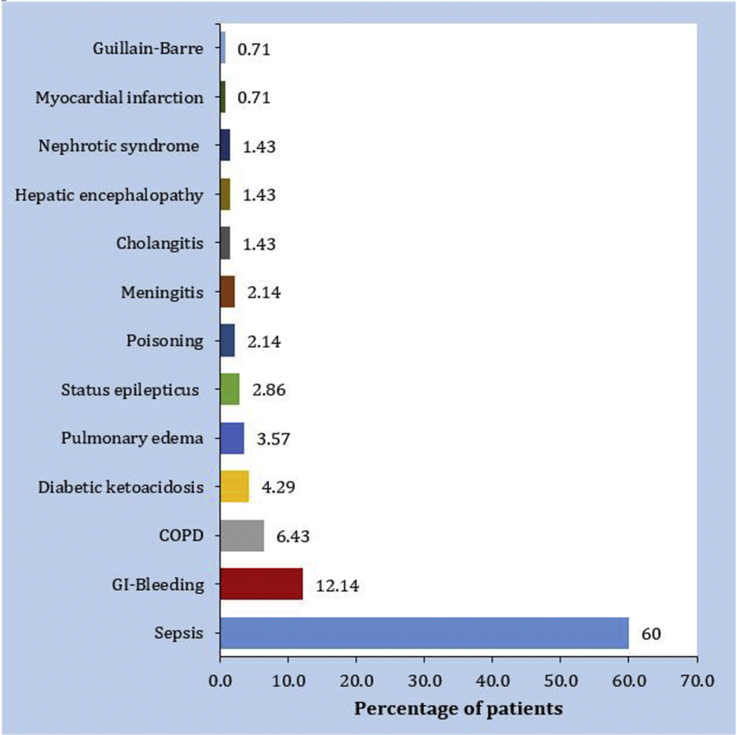
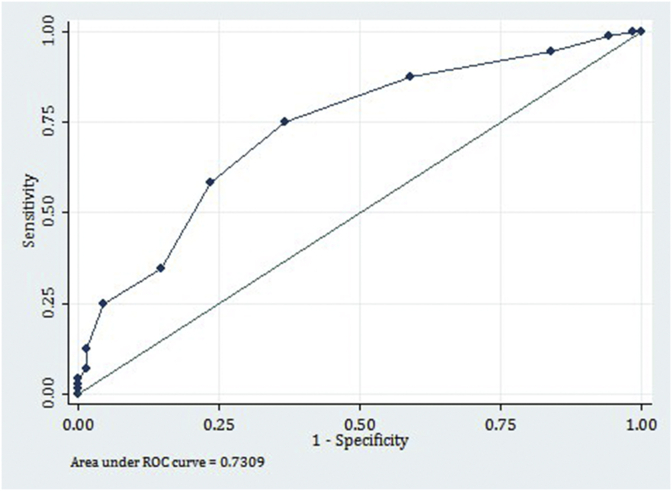
140 patients with the mean age of 68.36 ± 18.62 years (18-95) were included (53.5% male). The most common complaints were decrease in level of consciousness (76.43%) and sepsis (60.0%), were the most frequent final diagnoses. Mean SOFA score of the patients was 7.13 ± 2.36 (minimum 2 and maximum 16). 72 (51.43%) patients died during the following 30 days and 16 (11.43%) patients were affected with multiple organ failure. Area under the ROC curve of SOFA score in predicting mortality of studied patients was 0.73 (95%CI: 0.65-0.81) (Fig. 2). Table 2 depicts screening performance characteristics of this scale in prediction of 1-month mortality in the best cut-off point of ≥7. At this cut-off point, sensitivity and specificity of SOFA in predicting 1-month mortality were 75% and 63.23%, respectively.
Findings of the present study showed that SOFA scoring system has fair accuracy in predicting 1-month mortality of critically ill patients. However, until a more reliable scoring system is developed, SOFA might be useful for narrative prediction of patient outcome considering its acceptable likelihood ratios.
研究人员试图设计各种评分系统来确定危重症患者的严重程度并预测其预后。本研究旨在评估序贯器官衰竭评估(SOFA)评分在预测急诊科这些患者1个月预后方面的准确性。
本研究是一项前瞻性横断面研究,研究对象为2014年10月至2015年10月期间在伊朗德黑兰3家医院急诊科就诊的18岁以上非创伤性危重症患者。记录患者的基线特征、SOFA评分变量和1个月预后,并使用STATA 11软件计算该评分的筛查性能特征。
纳入140例患者,平均年龄68.36±18.62岁(18 - 95岁),其中男性占53.5%。最常见的主诉是意识水平下降(76.43%)和脓毒症(60.0%),这也是最常见的最终诊断。患者的平均SOFA评分为7.13±2.36(最低2分,最高16分)。72例(51.43%)患者在接下来的30天内死亡,16例(11.43%)患者发生多器官功能衰竭。SOFA评分预测研究患者死亡率的ROC曲线下面积为0.73(95%CI:0.65 - 0.81)(图2)。表2描述了该量表在预测1个月死亡率时最佳截断点≥7时的筛查性能特征。在此截断点,SOFA预测1个月死亡率的敏感性和特异性分别为75%和63.23%。
本研究结果表明,SOFA评分系统在预测危重症患者1个月死亡率方面具有一定准确性。然而,在开发出更可靠的评分系统之前,考虑到其可接受的似然比,SOFA可能有助于对患者预后进行描述性预测。