Stockfleth Eggert, von Kiedrowski Ralph, Dominicus Rolf, Ryan John, Ellery Adam, Falqués Meritxell, Ivanoff Nathalie, Azeredo Rosario Rodriguez
Department of Dermatology, Ruhr-University, Bochum, Germany.
Dermatological Practice, Selters, Germany.
Dermatol Ther (Heidelb). 2017 Mar;7(1):81-96. doi: 10.1007/s13555-016-0161-2. Epub 2016 Dec 19.
Due to the high prevalence of actinic keratosis (AK) and potential for lesions to become cancerous, clinical guidelines recommend that all are treated. The objective of this study was to evaluate the efficacy and safety of 5-fluorouracil (5-FU) 0.5%/salicylic acid 10% as field-directed treatment of AK lesions.
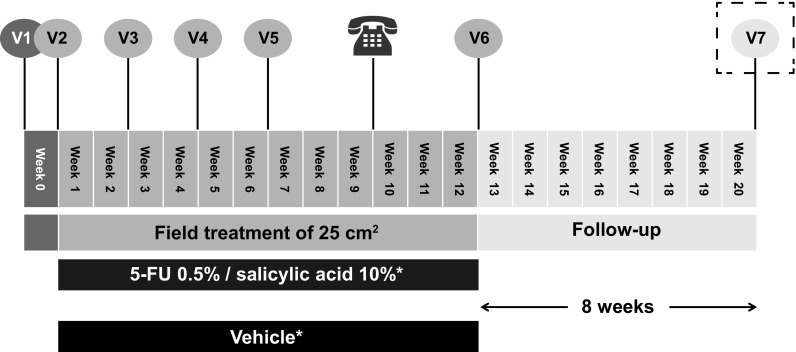
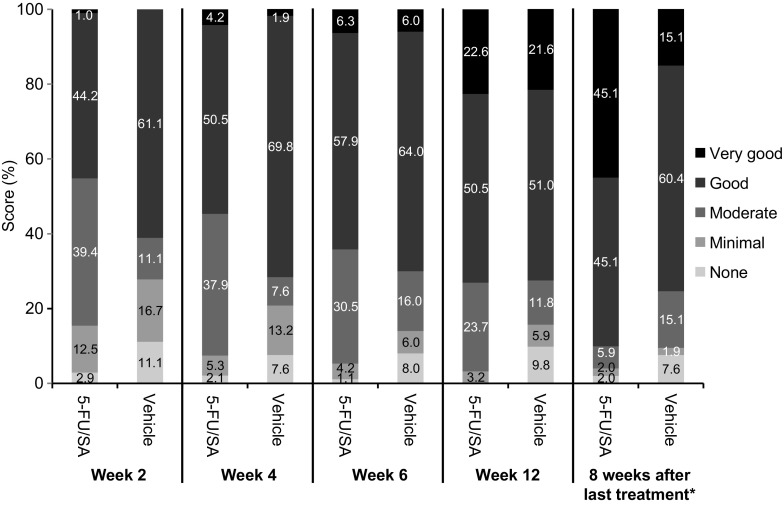
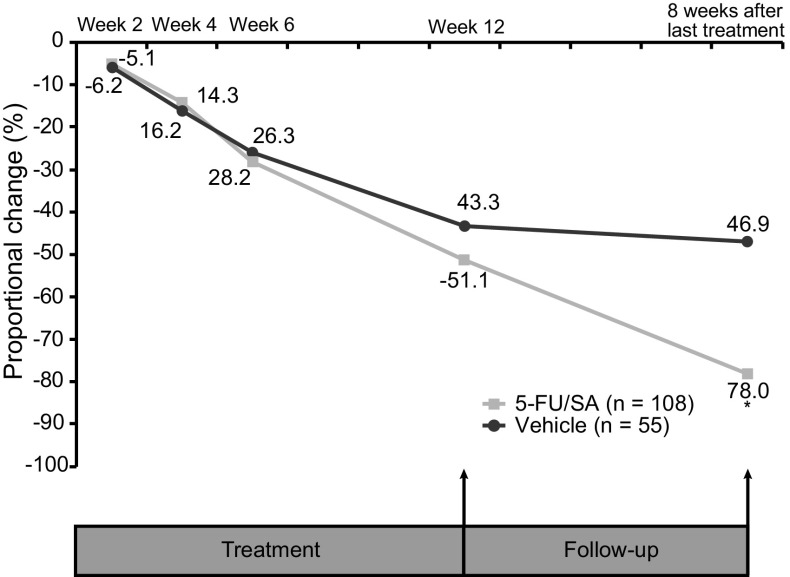
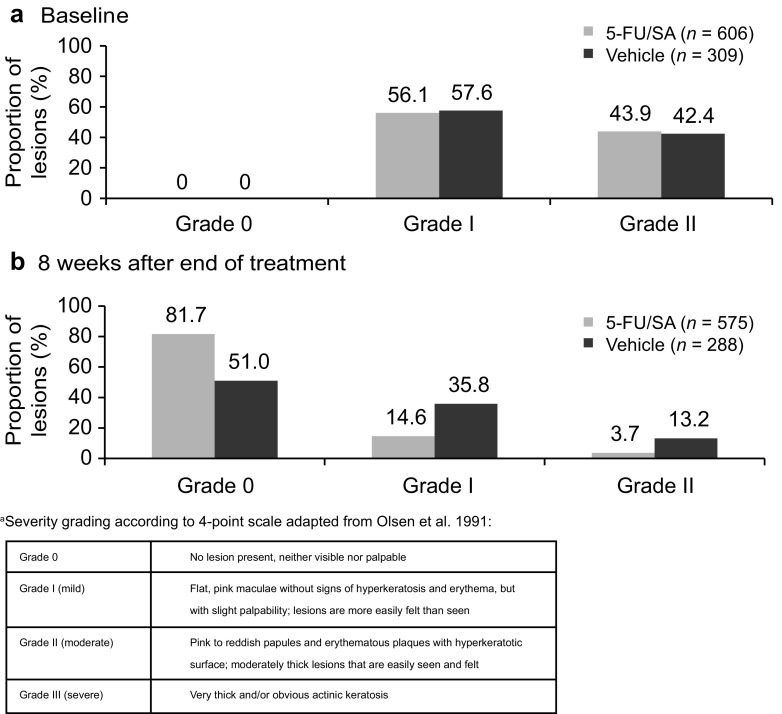
This multicenter, double-blind, vehicle-controlled study (NCT02289768) randomized adults, with a 25 cm area of skin on their face, bald scalp, or forehead covering 4-10 clinically confirmed AK lesions (grade I/II), 2:1 to treatment or vehicle applied topically once daily for 12 weeks. The primary endpoint was the proportion of patients with complete clinical clearance (CCC) of lesions in the treatment field 8 weeks after the end of treatment. Secondary endpoints included partial clearance (PC; ≥75% reduction) of lesions. Safety outcomes were assessed.
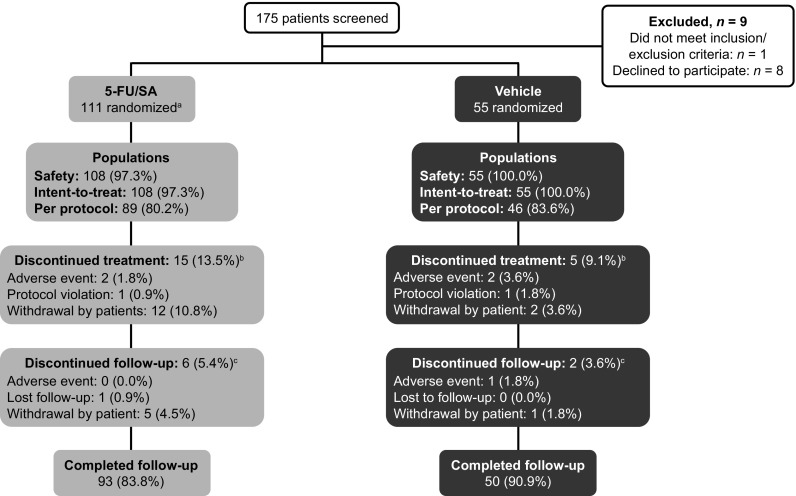
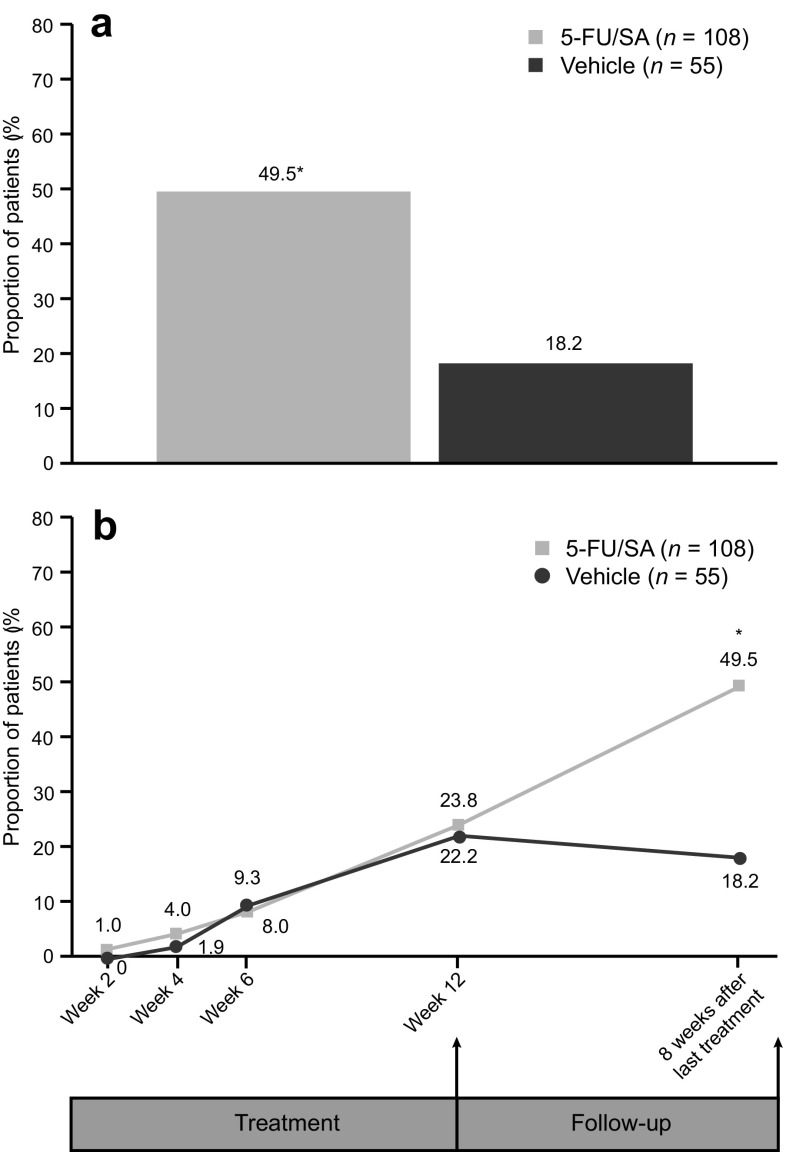
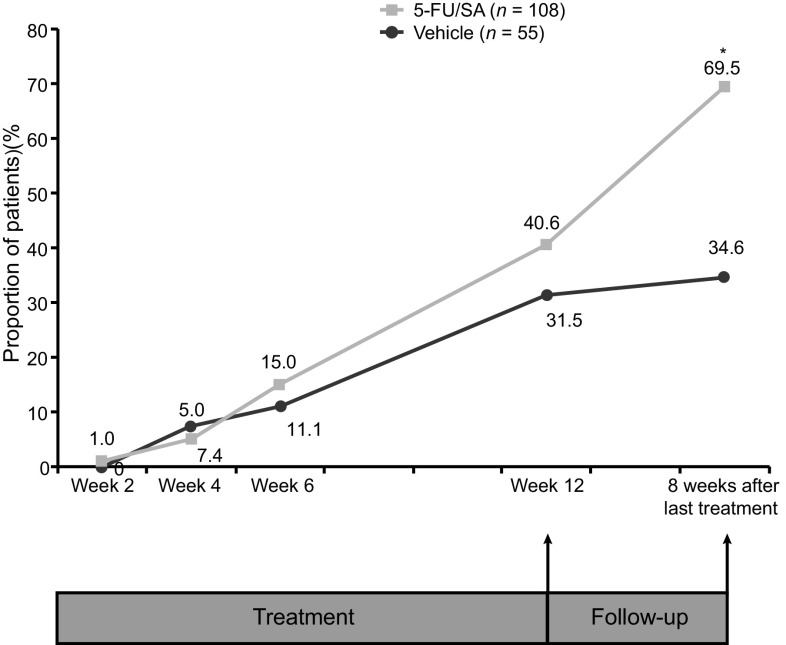
Of 166 patients randomized, 111 received 5-FU 0.5%/salicylic acid 10% and 55 received vehicle. At 8 weeks after the end of treatment, CCC was significantly higher with 5-FU 0.5%/salicylic acid 10% than with vehicle [49.5% vs. 18.2%, respectively; odds ratio (OR) 3.9 (95% CI) 1.7, 8.7; P = 0.0006]. Significantly more patients achieved PC of lesions with treatment than with vehicle [69.5% vs. 34.6%, respectively; OR 4.9 (95% CI 2.3, 10.5); P < 0.0001]. Treatment-emergent adverse events, predominantly related to application- and administration-site reactions, were more common with 5-FU 0.5%/salicylic acid 10% than with vehicle (99.1% vs. 83.6%).
Compared with vehicle, field-directed treatment of AK lesions with 5-FU 0.5%/salicylic acid 10% was effective in terms of CCC. Safety outcomes were consistent with the known and predictable safety profile.
NCT02289768.
Almirall S.A.
由于光化性角化病(AK)的高发病率以及病变有癌变的可能性,临床指南建议对所有患者进行治疗。本研究的目的是评估0.5% 5-氟尿嘧啶(5-FU)/10%水杨酸作为AK病变区域定向治疗的疗效和安全性。
这项多中心、双盲、赋形剂对照研究(NCT02289768)将面部、秃头皮或前额有25平方厘米皮肤区域且覆盖4-10个临床确诊的AK病变(I/II级)的成年人按2:1随机分为治疗组或赋形剂组,每天局部应用一次,持续12周。主要终点是治疗结束后8周治疗区域病变完全临床清除(CCC)的患者比例。次要终点包括病变部分清除(PC;减少≥75%)。评估安全性结果。
166例随机分组的患者中,111例接受0.5% 5-FU/10%水杨酸治疗,55例接受赋形剂治疗。治疗结束后8周,0.5% 5-FU/10%水杨酸组的CCC显著高于赋形剂组[分别为49.5%和18.2%;优势比(OR)3.9(95%CI)1.7,8.7;P = 0.0006]。与赋形剂组相比,治疗组实现病变PC的患者明显更多[分别为69.5%和34.6%;OR 4.9(95%CI 2.3,10.5);P < 0.0001]。0.5% 5-FU/10%水杨酸组比赋形剂组更常见与治疗相关的不良事件,主要与应用和给药部位反应有关(99.1%对83.6%)。
与赋形剂相比,0.5% 5-FU/10%水杨酸对AK病变进行区域定向治疗在CCC方面是有效的。安全性结果与已知和可预测的安全性特征一致。
NCT02289768。
Almirall S.A.