Department of Biomedical and Specialty Surgical Sciences, University of Ferrara, Ferrara, 44121, Italy.
Fondazione Banca degli Occhi del Veneto, Venice, 30174, Italy.
Sci Rep. 2016 Dec 20;6:39179. doi: 10.1038/srep39179.
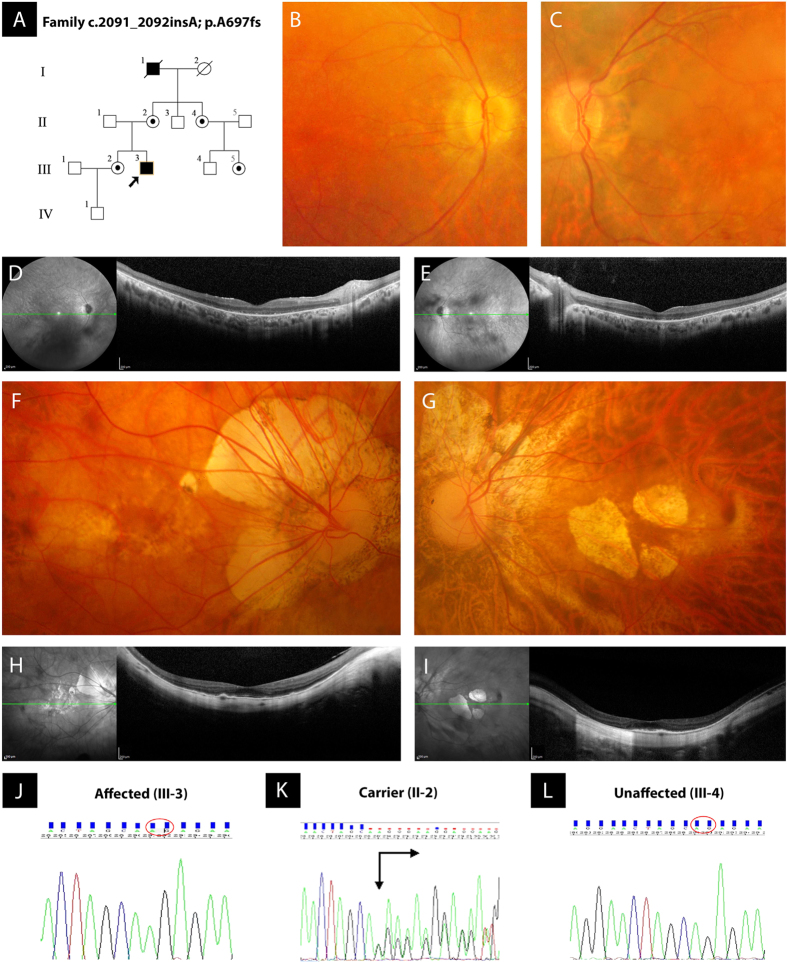
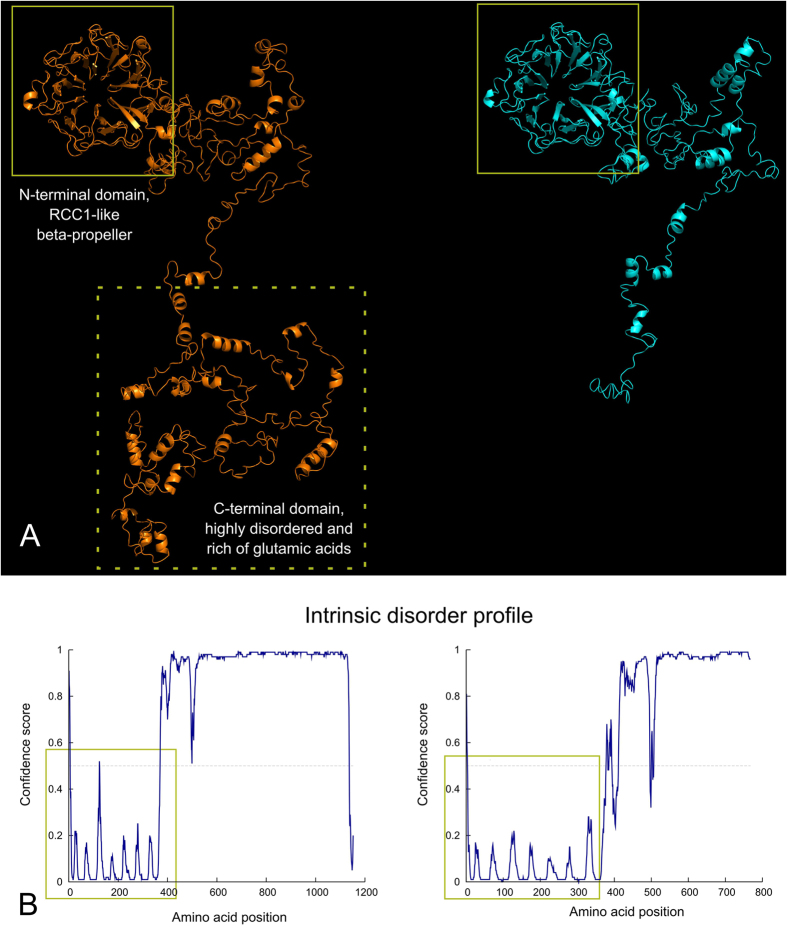
The aim of this study was to describe a new pathogenic variant in the mutational hot spot exon ORF15 of retinitis pigmentosa GTPase regulator (RPGR) gene within an Italian family with X-linked retinitis pigmentosa (RP), detailing its distinctive genotype-phenotype correlation with pathologic myopia (PM). All members of this RP-PM family underwent a complete ophthalmic examination. The entire open reading frames of RPGR and retinitis pigmentosa 2 genes were analyzed by Sanger sequencing. A novel frame-shift mutation in exon ORF15 of RPGR gene (c.2091_2092insA; p.A697fs) was identified as hemizygous variant in the male proband with RP, and as heterozygous variant in the females of this pedigree who invariably exhibited symmetrical PM in both eyes. The c.2091_2092insA mutation coherently co-segregated with the observed phenotypes. These findings expand the spectrum of X-linked RP variants. Interestingly, focusing on Caucasian ethnicity, just three RPGR mutations are hitherto reported in RP-PM families: one of these is located in exon ORF15, but none appears to be characterized by a high penetrance of PM trait as observed in the present, relatively small, pedigree. The geno-phenotypic attributes of this heterozygosity suggest that gain-of-function mechanism could give rise to PM via a degenerative cell-cell remodeling of the retinal structures.
本研究旨在描述一个新的致病性变异体,该变异体位于 X 连锁性视网膜色素变性(RP)的突变热点外显子 ORF15 中的视网膜色素变性 GTP 酶调节因子(RPGR)基因中,详细描述其与病理性近视(PM)的独特基因型-表型相关性。该 RP-PM 家族的所有成员均接受了全面的眼科检查。通过 Sanger 测序分析 RPGR 和视网膜色素变性 2 基因的整个开放阅读框。在一名具有 RP 的男性先证者中,发现 RPGR 基因外显子 ORF15 中存在一个新的移码突变(c.2091_2092insA;p.A697fs),这是杂合变异体,而该家系中的女性则表现为双眼对称性 PM,均为杂合变异体。c.2091_2092insA 突变与观察到的表型一致。这些发现扩展了 X 连锁性 RP 变异体的范围。有趣的是,专注于白种人族群,迄今为止仅在 RP-PM 家族中报道了三种 RPGR 突变:其中一个位于外显子 ORF15 中,但没有一个似乎具有如本研究中相对较小的家系中观察到的 PM 特征的高外显率。这种杂合性的基因-表型特征表明,功能获得机制可能通过视网膜结构的退行性细胞-细胞重塑导致 PM。