Traylor Matthew, Malik Rainer, Nalls Mike A, Cotlarciuc Ioana, Radmanesh Farid, Thorleifsson Gudmar, Hanscombe Ken B, Langefeld Carl, Saleheen Danish, Rost Natalia S, Yet Idil, Spector Tim D, Bell Jordana T, Hannon Eilis, Mill Jonathan, Chauhan Ganesh, Debette Stephanie, Bis Joshua C, Longstreth W T, Ikram M Arfan, Launer Lenore J, Seshadri Sudha, Hamilton-Bruce Monica Anne, Jimenez-Conde Jordi, Cole John W, Schmidt Reinhold, Słowik Agnieszka, Lemmens Robin, Lindgren Arne, Melander Olle, Grewal Raji P, Sacco Ralph L, Rundek Tatjana, Rexrode Kathryn, Arnett Donna K, Johnson Julie A, Benavente Oscar R, Wasssertheil-Smoller Sylvia, Lee Jin-Moo, Pulit Sara L, Wong Quenna, Rich Stephen S, de Bakker Paul I W, McArdle Patrick F, Woo Daniel, Anderson Christopher D, Xu Huichun, Heitsch Laura, Fornage Myriam, Jern Christina, Stefansson Kari, Thorsteinsdottir Unnur, Gretarsdottir Solveig, Lewis Cathryn M, Sharma Pankaj, Sudlow Cathie L M, Rothwell Peter M, Boncoraglio Giorgio B, Thijs Vincent, Levi Chris, Meschia James F, Rosand Jonathan, Kittner Steven J, Mitchell Braxton D, Dichgans Martin, Worrall Bradford B, Markus Hugh S
Department of Medical and Molecular Genetics, King's College London, London, United Kingdom.
Institute for Stroke and Dementia Research, Klinikum der Universität München, Ludwig-Maximilians University, Munich, Germany.
Ann Neurol. 2017 Mar;81(3):383-394. doi: 10.1002/ana.24840.
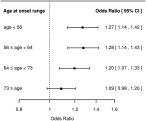
Genome-wide association studies (GWAS) have been successful at identifying associations with stroke and stroke subtypes, but have not yet identified any associations solely with small vessel stroke (SVS). SVS comprises one quarter of all ischemic stroke and is a major manifestation of cerebral small vessel disease, the primary cause of vascular cognitive impairment. Studies across neurological traits have shown that younger-onset cases have an increased genetic burden. We leveraged this increased genetic burden by performing an age-at-onset informed GWAS meta-analysis, including a large younger-onset SVS population, to identify novel associations with stroke.
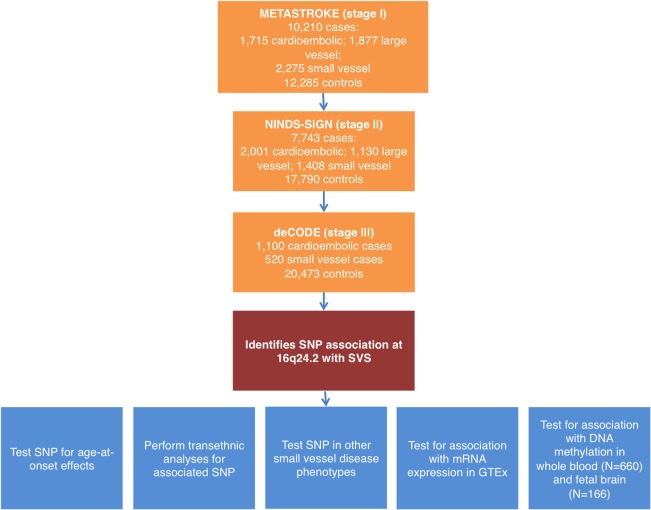
We used a three-stage age-at-onset informed GWAS to identify novel genetic variants associated with stroke. On identifying a novel locus associated with SVS, we assessed its influence on other small vessel disease phenotypes, as well as on messenger RNA (mRNA) expression of nearby genes, and on DNA methylation of nearby CpG sites in whole blood and in the fetal brain.
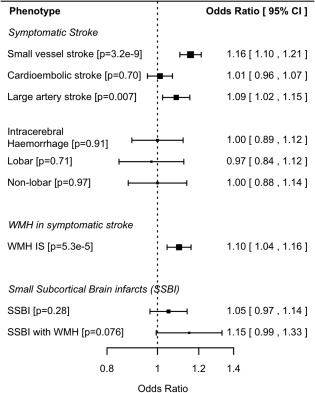
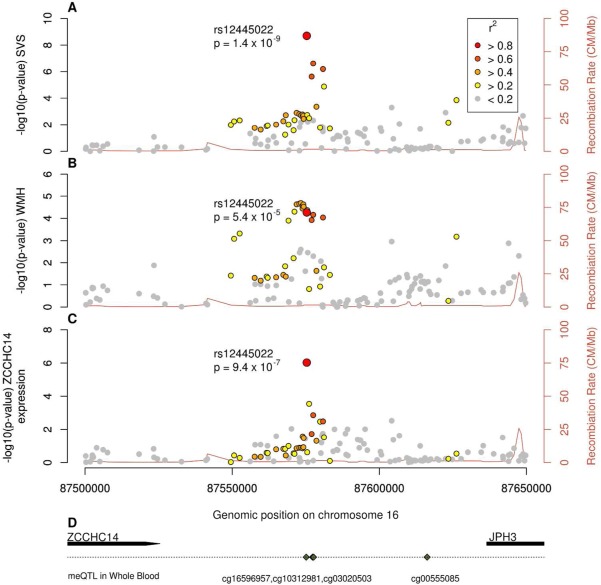
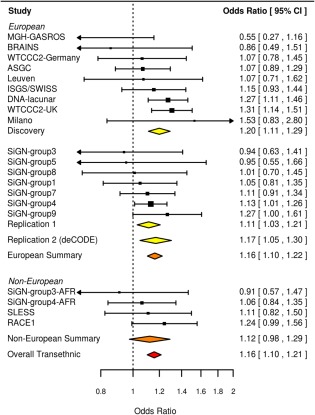
We identified an association with SVS in 4,203 cases and 50,728 controls on chromosome 16q24.2 (odds ratio [OR; 95% confidence interval {CI}] = 1.16 [1.10-1.22]; p = 3.2 × 10 ). The lead single-nucleotide polymorphism (rs12445022) was also associated with cerebral white matter hyperintensities (OR [95% CI] = 1.10 [1.05-1.16]; p = 5.3 × 10 ; N = 3,670), but not intracerebral hemorrhage (OR [95% CI] = 0.97 [0.84-1.12]; p = 0.71; 1,545 cases, 1,481 controls). rs12445022 is associated with mRNA expression of ZCCHC14 in arterial tissues (p = 9.4 × 10 ) and DNA methylation at probe cg16596957 in whole blood (p = 5.3 × 10 ).
16q24.2 is associated with SVS. Associations of the locus with expression of ZCCHC14 and DNA methylation suggest the locus acts through changes to regulatory elements. Ann Neurol 2017;81:383-394.
全基因组关联研究(GWAS)已成功识别出与中风及中风亚型的关联,但尚未发现仅与小血管性中风(SVS)相关的任何关联。SVS占所有缺血性中风的四分之一,是脑小血管病的主要表现,而脑小血管病是血管性认知障碍的主要原因。针对多种神经学特征的研究表明,发病年龄较小的病例遗传负担增加。我们通过进行一项基于发病年龄的GWAS荟萃分析,利用这种增加的遗传负担,纳入大量发病年龄较小的SVS人群,以识别与中风的新关联。
我们采用三阶段基于发病年龄的GWAS来识别与中风相关的新遗传变异。在确定一个与SVS相关的新位点后,我们评估其对其他小血管病表型的影响,以及对附近基因信使核糖核酸(mRNA)表达的影响,以及对全血和胎儿大脑中附近CpG位点DNA甲基化的影响。
我们在4203例病例和50728例对照中发现16号染色体q24.2区域与SVS存在关联(优势比[OR;95%置信区间{CI}] = 1.16 [1.10 - 1.22];p = 3.2×10 )。主要单核苷酸多态性(rs12445022)也与脑白质高信号有关(OR [95% CI] = 1.10 [1.05 - 1.16];p = 5.3×10 ;N = 3670),但与脑出血无关(OR [95% CI] = 0.97 [0.84 - 1.12];p = 0.71;1545例病例,1481例对照)。rs12445022与动脉组织中ZCCHC14的mRNA表达有关(p = 9.4×10 ),并与全血中探针cg16596957处的DNA甲基化有关(p = 5. ×10 )。
16q24.2与SVS相关。该位点与ZCCHC14表达及DNA甲基化的关联表明该位点通过调控元件的变化发挥作用。《神经病学纪事》2017年;81:383 - 394。