Cohen Osher, Oberhardt Matthew, Yizhak Keren, Ruppin Eytan
School of Computer Sciences and Sackler School of Medicine, Tel Aviv University, Tel Aviv, Israel.
Center for Bioinformatics and Computational Biology, University of Maryland, College Park, MD, United States of America.
PLoS One. 2016 Dec 20;11(12):e0168444. doi: 10.1371/journal.pone.0168444. eCollection 2016.
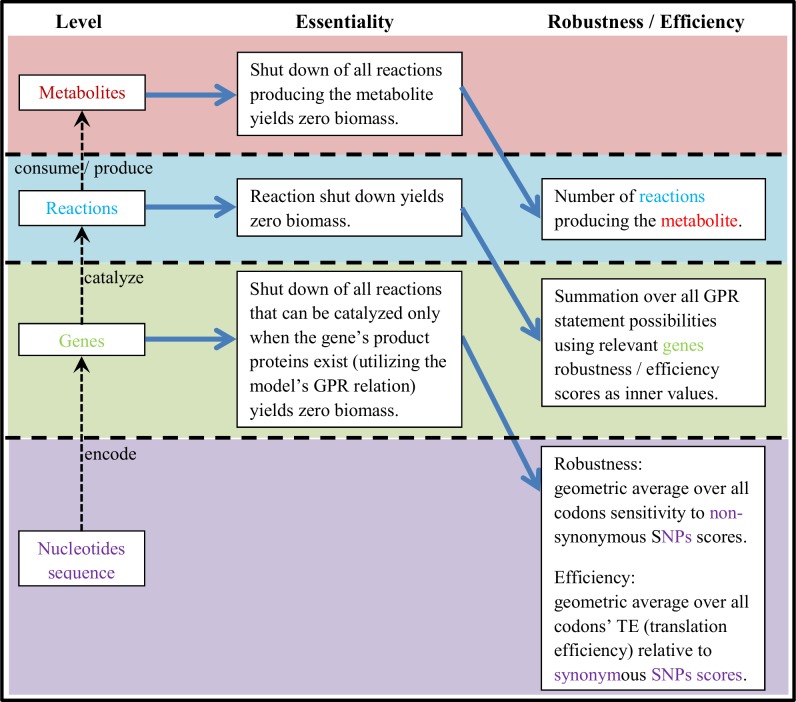
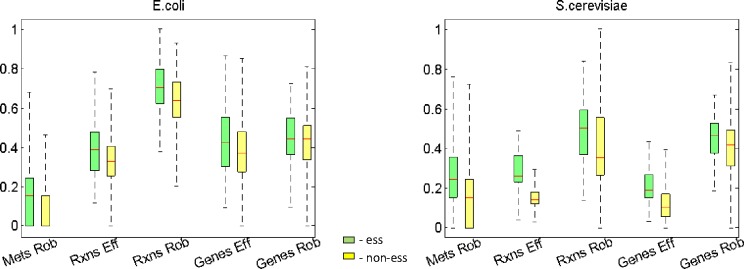
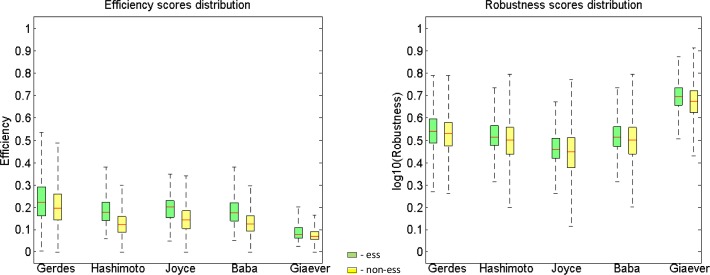
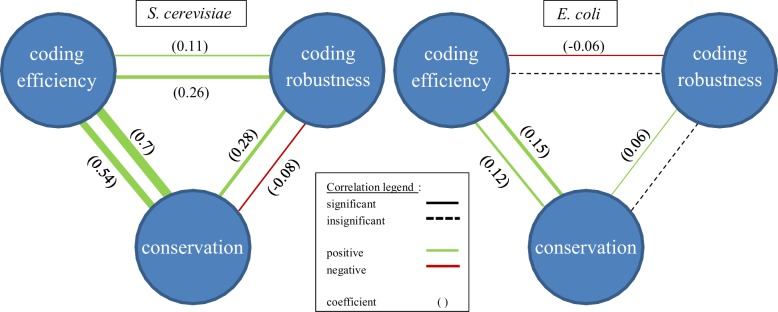
Genetic robustness is a hallmark of cells, occurring through many mechanisms and at many levels. Essential genes lack the common robustness mechanism of genetic redundancy (i.e., existing alongside other genes with the same function), and thus appear at first glance to leave cells highly vulnerable to genetic or environmental perturbations. Here we explore a hypothesis that cells might protect against essential gene loss through mechanisms that occur at various cellular levels aside from the level of the gene. Using Escherichia coli and Saccharomyces cerevisiae as models, we find that essential genes are enriched over non-essential genes for properties we call "coding efficiency" and "coding robustness", denoting respectively a gene's efficiency of translation and robustness to non-synonymous mutations. The coding efficiency levels of essential genes are highly positively correlated with their evolutionary conservation levels, suggesting that this feature plays a key role in protecting conserved, evolutionarily important genes. We then extend our hypothesis into the realm of metabolic networks, showing that essential metabolic reactions are encoded by more "robust" genes than non-essential reactions, and that essential metabolites are produced by more reactions than non-essential metabolites. Taken together, these results testify that robustness at the gene-loss level and at the mutation level (and more generally, at two cellular levels that are usually treated separately) are not decoupled, but rather, that cellular vulnerability exposed due to complete gene loss is compensated by increased mutational robustness. Why some genes are backed up primarily against loss and others against mutations still remains an open question.
基因稳健性是细胞的一个标志,它通过多种机制在多个层面发生。必需基因缺乏基因冗余这种常见的稳健性机制(即与具有相同功能的其他基因同时存在),因此乍一看,细胞似乎极易受到基因或环境扰动的影响。在这里,我们探讨一种假说,即细胞可能通过基因层面以外的各种细胞层面的机制来防止必需基因的丢失。以大肠杆菌和酿酒酵母为模型,我们发现,与非必需基因相比,必需基因在我们称为“编码效率”和“编码稳健性”的特性上更为富集,这分别表示一个基因的翻译效率和对非同义突变的稳健性。必需基因的编码效率水平与其进化保守水平高度正相关,这表明该特征在保护保守的、具有进化重要性的基因方面起着关键作用。然后,我们将我们的假说扩展到代谢网络领域,表明必需代谢反应由比非必需反应更“稳健”的基因编码,并且必需代谢物由比非必需代谢物更多的反应产生。综上所述,这些结果证明,基因丢失层面和突变层面(更普遍地说,在通常分开处理的两个细胞层面)的稳健性并非相互脱节,而是由于完全基因丢失而暴露的细胞脆弱性通过增加的突变稳健性得到了补偿。为什么有些基因主要是防止丢失,而有些基因是防止突变,这仍然是一个悬而未决的问题。