Yang Yuan, Solis-Escalante Teodoro, van de Ruit Mark, van der Helm Frans C T, Schouten Alfred C
Neuromuscular Control Laboratory, Department of Biomechanical Engineering, Delft University of Technology Delft, Netherlands.
Neuromuscular Control Laboratory, Department of Biomechanical Engineering, Delft University of TechnologyDelft, Netherlands; MIRA Institute for Biomedical Technology and Technical Medicine, University of TwenteEnschede, Netherlands.
Front Comput Neurosci. 2016 Dec 6;10:126. doi: 10.3389/fncom.2016.00126. eCollection 2016.
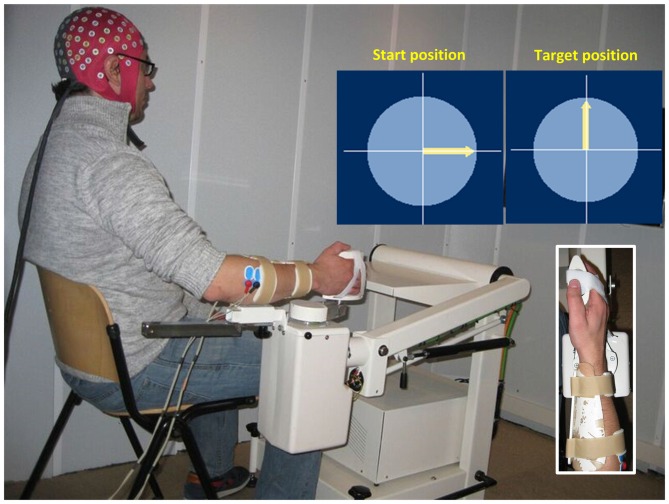
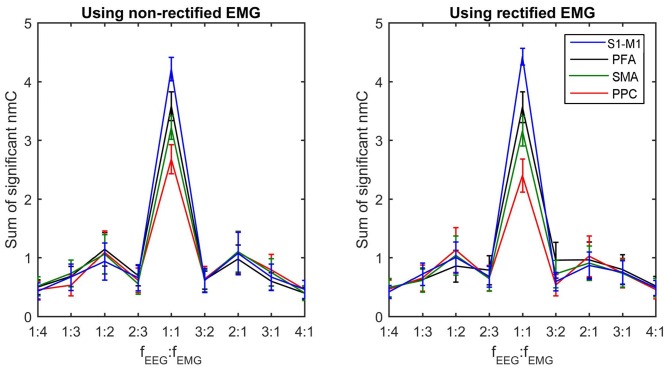
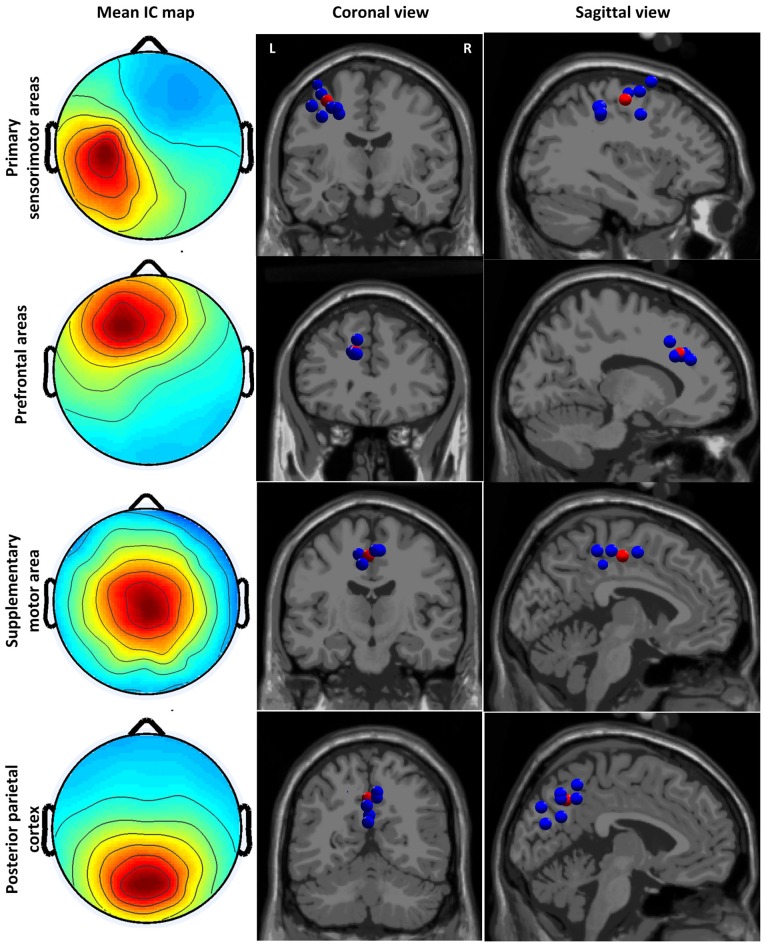
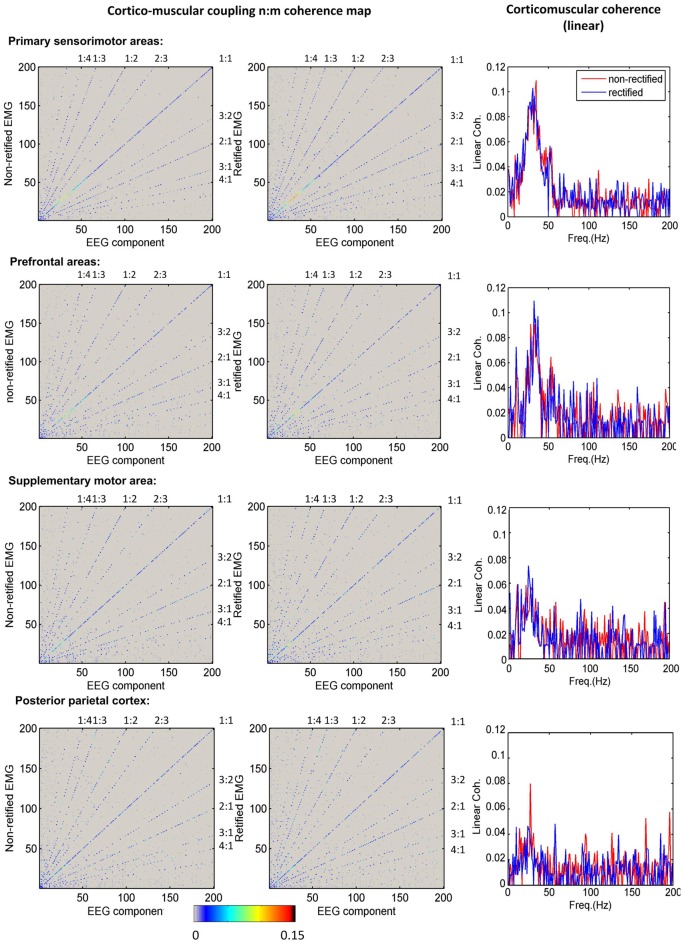
Coupling between cortical oscillations and muscle activity facilitates neuronal communication during motor control. The linear part of this coupling, known as corticomuscular coherence, has received substantial attention, even though neuronal communication underlying motor control has been demonstrated to be highly nonlinear. A full assessment of corticomuscular coupling, including the nonlinear part, is essential to understand the neuronal communication within the sensorimotor system. In this study, we applied the recently developed n:m coherence method to assess nonlinear corticomuscular coupling during isotonic wrist flexion. The n:m coherence is a generalized metric for quantifying nonlinear cross-frequency coupling as well as linear iso-frequency coupling. By using independent component analysis (ICA) and equivalent current dipole source localization, we identify four sensorimotor related brain areas based on the locations of the dipoles, i.e., the contralateral primary sensorimotor areas, supplementary motor area (SMA), prefrontal area (PFA) and posterior parietal cortex (PPC). For all these areas, linear coupling between electroencephalogram (EEG) and electromyogram (EMG) is present with peaks in the beta band (15-35 Hz), while nonlinear coupling is detected with both integer (1:2, 1:3, 1:4) and non-integer (2:3) harmonics. Significant differences between brain areas is shown in linear coupling with stronger coherence for the primary sensorimotor areas and motor association cortices (SMA, PFA) compared to the sensory association area (PPC); but not for the nonlinear coupling. Moreover, the detected nonlinear coupling is similar to previously reported nonlinear coupling of cortical activity to somatosensory stimuli. We suggest that the descending motor pathways mainly contribute to linear corticomuscular coupling, while nonlinear coupling likely originates from sensory feedback.
皮质振荡与肌肉活动之间的耦合在运动控制过程中促进神经元通信。这种耦合的线性部分,即皮质-肌肉相干性,受到了广泛关注,尽管已经证明运动控制背后的神经元通信是高度非线性的。对皮质-肌肉耦合进行全面评估,包括非线性部分,对于理解感觉运动系统内的神经元通信至关重要。在本研究中,我们应用最近开发的n:m相干性方法来评估等张腕部屈曲过程中的非线性皮质-肌肉耦合。n:m相干性是一种用于量化非线性交叉频率耦合以及线性同频率耦合的广义度量。通过使用独立成分分析(ICA)和等效电流偶极子源定位,我们根据偶极子的位置识别出四个与感觉运动相关的脑区,即对侧初级感觉运动区、辅助运动区(SMA)、前额叶区(PFA)和顶叶后皮质(PPC)。对于所有这些区域,脑电图(EEG)和肌电图(EMG)之间的线性耦合在β波段(15 - 35 Hz)出现峰值,同时检测到整数(1:2、1:3、1:4)和非整数(2:3)谐波的非线性耦合。脑区之间在与初级感觉运动区和运动联合皮质(SMA、PFA)相比感觉联合区(PPC)更强的相干性的线性耦合方面存在显著差异;但在非线性耦合方面不存在差异。此外,检测到的非线性耦合与先前报道的皮质活动与体感刺激的非线性耦合相似。我们认为下行运动通路主要促成线性皮质-肌肉耦合,而非线性耦合可能源于感觉反馈。