Bosche Bert, Molcanyi Marek, Rej Soham, Doeppner Thorsten R, Obermann Mark, Müller Daniel J, Das Anupam, Hescheler Jürgen, Macdonald R Loch, Noll Thomas, Härtel Frauke V
Division of Neurosurgery, St. Michael's Hospital, Keenan Research Centre for Biomedical Science and the Li Ka Shing Knowledge Institute of St. Michael's Hospital, Department of Surgery, University of TorontoToronto, ON, Canada; Department of Neurology, University Hospital of Essen, University of Duisburg-EssenEssen, Germany.
Institute of Neurophysiology, Medical Faculty, University of CologneCologne, Germany; Department of Neurosurgery, Research Unit for Experimental Neurotraumatology, Medical University GrazGraz, Austria.
Front Physiol. 2016 Dec 6;7:593. doi: 10.3389/fphys.2016.00593. eCollection 2016.
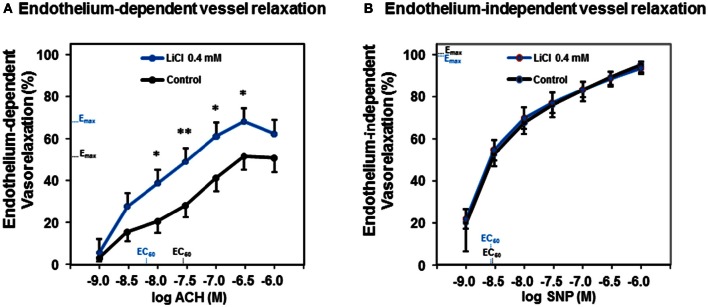
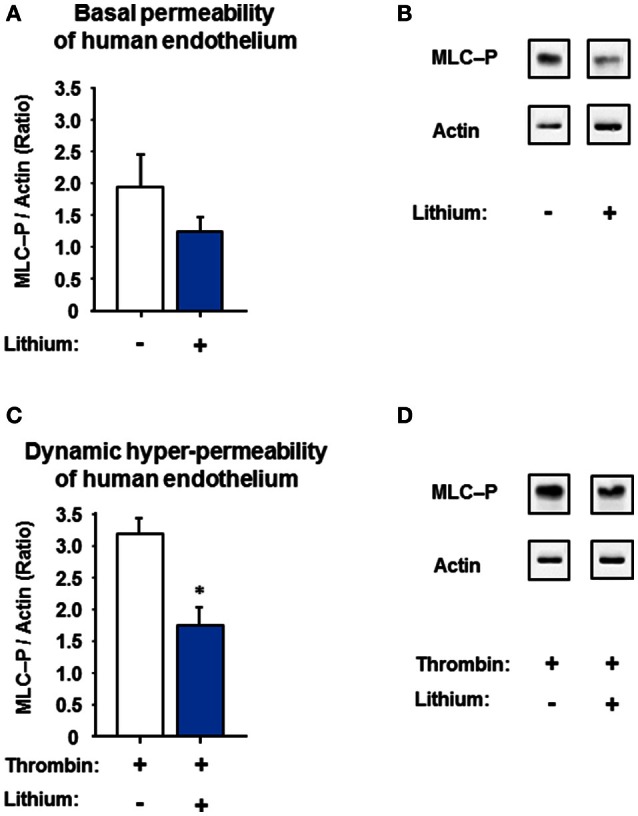
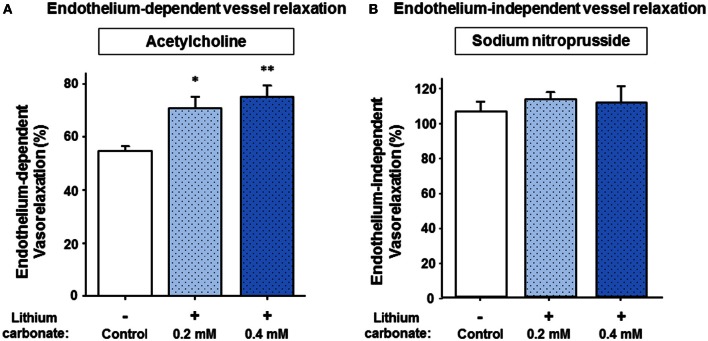
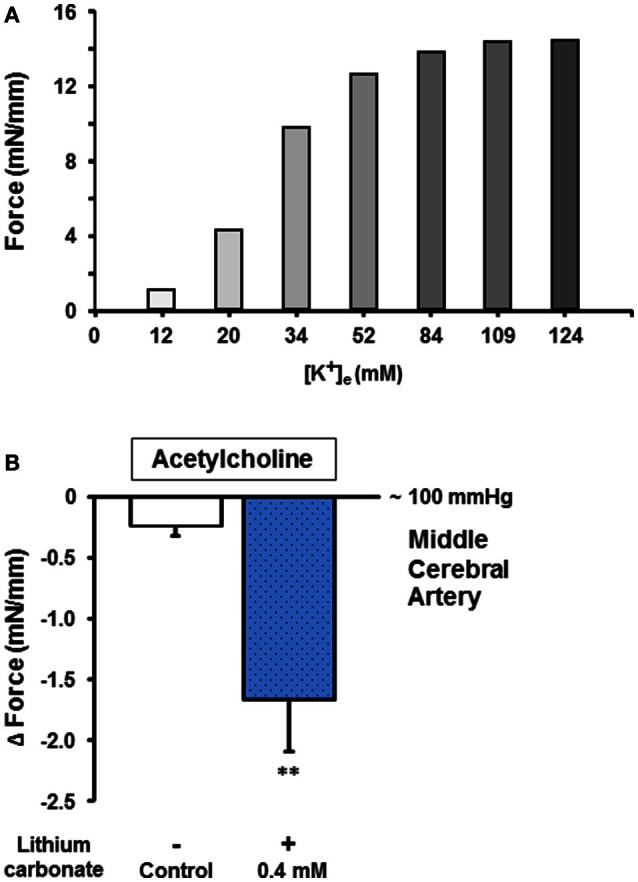
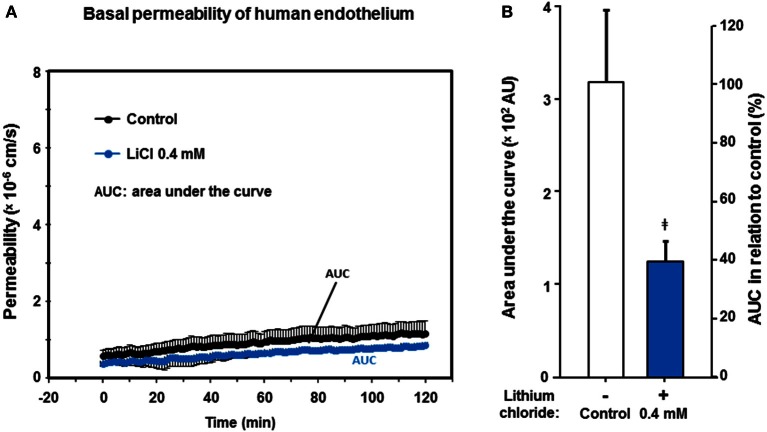
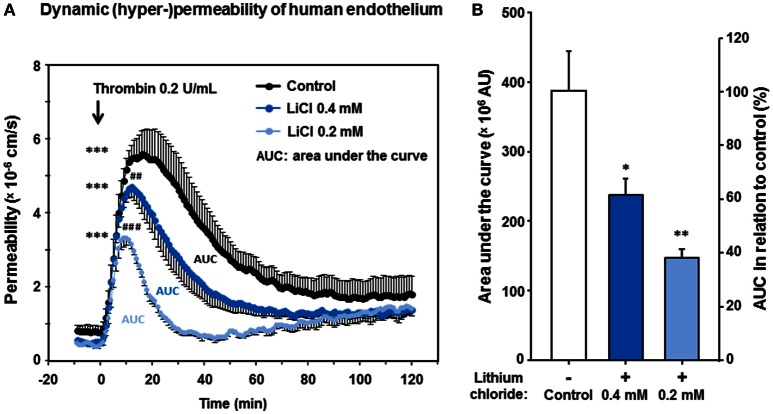
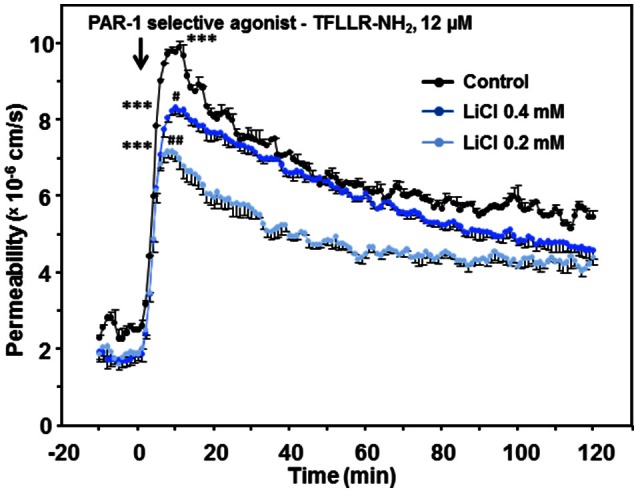
Lithium at serum concentrations up to 1 mmol/L has been used in patients suffering from bipolar disorder for decades and has recently been shown to reduce the risk for ischemic stroke in these patients. The risk for stroke and thromboembolism depend not only on cerebral but also on general endothelial function and health; the entire endothelium as an organ is therefore pathophysiologically relevant. Regardless, the knowledge about the direct impact of lithium on endothelial function remains poor. We conducted an experimental study using lithium as pharmacologic pretreatment for murine, porcine and human vascular endothelium. We predominantly investigated endothelial vasorelaxation capacities in addition to human basal and dynamic (thrombin-/PAR-1 receptor agonist-impaired) barrier functioning including myosin light chain (MLC) phosphorylation (MLC-P). Low-dose therapeutic lithium concentrations (0.4 mmol/L) significantly augment the cholinergic endothelium-dependent vasorelaxation capacities of cerebral and thoracic arteries, independently of central and autonomic nerve system influences. Similar concentrations of lithium (0.2-0.4 mmol/L) significantly stabilized the dynamic thrombin-induced and PAR-1 receptor agonist-induced permeability of human endothelium, while even the basal permeability appeared to be stabilized. The lithium-attenuated dynamic permeability was mediated by a reduced endothelial MLC-P known to be followed by a lessening of endothelial cell contraction and paracellular gap formation. The well-known lithium-associated inhibition of inositol monophosphatase/glycogen synthase kinase-3-β signaling-pathways involving intracellular calcium concentrations in neurons seems to similarly occur in endothelial cells, too, but with different down-stream effects such as MLC-P reduction. This is the first study discovering low-dose lithium as a drug directly stabilizing human endothelium and ubiquitously augmenting cholinergic endothelium-mediated vasorelaxation. Our findings have translational and potentially clinical impact on cardiovascular and cerebrovascular disease associated with inflammation explaining why lithium can reduce, e.g., the risk for stroke. However, further clinical studies are warranted.
血清浓度高达1 mmol/L的锂已用于双相情感障碍患者数十年,最近有研究表明,这能降低这些患者发生缺血性中风的风险。中风和血栓栓塞的风险不仅取决于大脑,还取决于整体内皮功能和健康状况;因此,作为一个器官的整个内皮在病理生理学上具有相关性。尽管如此,关于锂对内皮功能的直接影响的了解仍然很少。我们进行了一项实验研究,使用锂对小鼠、猪和人类血管内皮进行药物预处理。除了人类基础和动态(凝血酶/PAR-1受体激动剂损伤)屏障功能(包括肌球蛋白轻链(MLC)磷酸化(MLC-P))外,我们主要研究了内皮血管舒张能力。低剂量治疗性锂浓度(0.4 mmol/L)显著增强了脑动脉和胸主动脉的胆碱能内皮依赖性血管舒张能力,且不受中枢和自主神经系统影响。相似浓度的锂(0.2 - 0.4 mmol/L)显著稳定了凝血酶诱导和PAR-1受体激动剂诱导的人类内皮动态通透性,甚至基础通透性似乎也得到了稳定。锂减弱的动态通透性是由内皮MLC-P降低介导的,已知这会导致内皮细胞收缩和细胞旁间隙形成减少。众所周知,锂相关的对涉及神经元细胞内钙浓度的肌醇单磷酸酶/糖原合酶激酶-3-β信号通路的抑制似乎在内皮细胞中也同样发生,但具有不同的下游效应,如MLC-P降低。这是第一项发现低剂量锂作为一种直接稳定人类内皮并普遍增强胆碱能内皮介导的血管舒张的药物的研究。我们的研究结果对与炎症相关的心血管和脑血管疾病具有转化和潜在临床意义,解释了为什么锂可以降低例如中风风险。然而,仍需要进一步的临床研究。